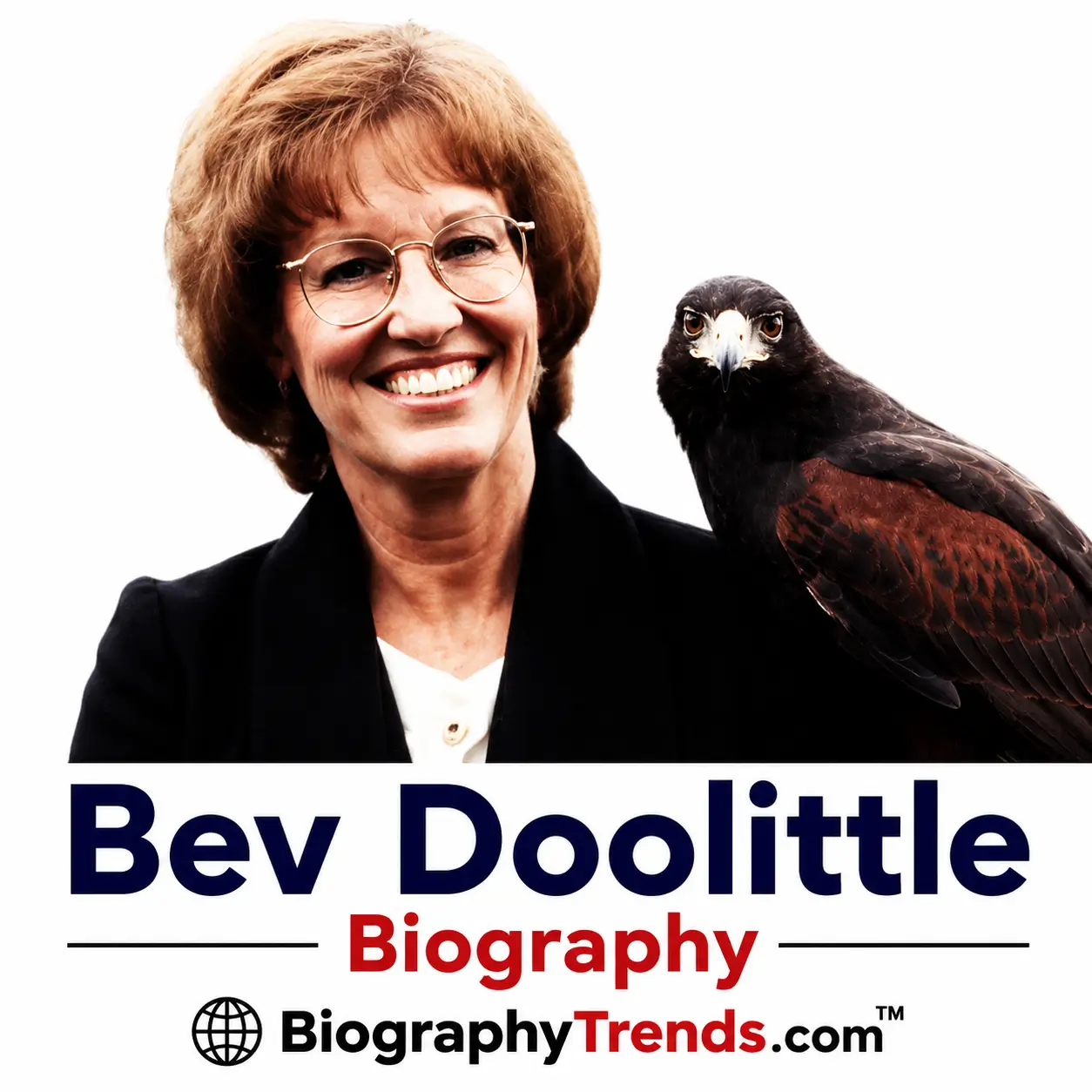
Bev Doolittle Biography stands as one of the most searched topics in contemporary American art, and for good reason. Bev Doolittle, the American watercolorist who revolutionized Western art with her signature camouflage technique, remains one of the most collected artists in the United States and is known internationally. Born on February 10, 1947, in California, Bev Doolittle would go on to fundamentally transform how viewers engage with paintings, creating a virtually new genre that blends detailed realism with hidden imagery. This comprehensive Bev Doolittle Biography explores every facet of her remarkable life from her California childhood and advertising career to her revolutionary camouflage art technique, record breaking print sales, and enduring legacy that continues to captivate art collectors in 2026 and beyond.
Bev Doolittle Biography: Early Life and Formative Years (1947–1968)
Birth and Family Background
Bev Doolittle was born on February 10, 1947, in California, where she was raised in a state known for its dramatic landscapes and artistic heritage. Growing up in postwar America, Bev developed an early appreciation for the natural world that would later define her entire artistic career. The diverse geography of California, from its coastal shores to its desert interiors and mountain ranges, provided a rich visual education for the young artist.
As a teenager, Bev demonstrated exceptional artistic talent that would set her apart from her peers. Her natural ability to observe and render the world around her was evident from an early age, and it became clear that she possessed a gift that demanded formal cultivation. This early promise would eventually lead her to one of the most prestigious art schools in the country.
The Teenage Scholarship
Bev Doolittle’s artistic potential was recognized when, as a teenager, she won a weekend scholarship to attend the prestigious Art Center College of Design in Los Angeles. This institution, renowned for its rigorous training in commercial and fine arts, would prove to be the crucible in which Bev’s professional identity was forged. The scholarship was not merely an honor; it was a preview of the formal education that would launch her into the professional art world.
The Art Center College of Design was known for its emphasis on technical precision, strong design principles, and the marriage of artistic vision with commercial application. These values would profoundly influence Bev’s approach to painting, even as she eventually moved away from commercial art toward fine art expression. The discipline and technical foundation she acquired during this period would serve her throughout her career, enabling the intricate detail and compositional complexity that define her camouflage paintings.
Art Center College of Design and Meeting Jay Doolittle (1968–1973)
Enrollment and Education
In 1968, Bev Doolittle officially enrolled at the Art Center College of Design in Los Angeles, one of the most respected art schools in the United States. The Art Center was known for producing graduates who went on to successful careers in advertising, illustration, and design. Its curriculum emphasized drawing, painting, design theory, and the practical skills needed to succeed in the commercial art world.
It was at the Art Center College of Design that Bev met Jay Doolittle, a fellow student who shared her passion for art and adventure. Their meeting was fortuitous, as Jay would become not only her husband but her lifelong creative partner, business manager, and most trusted critic. The bond they formed in art school would sustain them through decades of artistic exploration, commercial struggle, and eventual triumph.
The Honeymoon That Changed Everything
Bev and Jay Doolittle married and began their married life with a painting trip to Bryce Canyon and Zion National Parks in Utah. This honeymoon was not a conventional vacation; it was a declaration of their shared values and artistic priorities. The dramatic red rock formations, vast desert vistas, and pristine wilderness of the American Southwest made an indelible impression on both artists.
“We always loved the wilderness,” Bev would later recall. “Our dates were painting trips. Our honeymoon was out in nature.” This statement encapsulates the philosophy that would guide their entire lives: art and nature were inseparable, and the studio was wherever the wilderness beckoned.
The Advertising Years and the Call of Nature (1968–1973)
Career as Art Directors
For the next five years following their marriage, Bev and Jay Doolittle pursued careers as art directors for Erwin, Wasey & Co., a major advertising agency in Los Angeles. The work paid well and provided valuable professional experience. They worked on high profile accounts, including Friskies cat food, honing their skills in visual communication, layout, and design.
Yet despite the financial security and professional credentials, something was missing. “It paid well,” Bev explained, “but we didn’t like living in the city. We wanted to be close to nature, to paint outdoors and we wanted to travel.” The urban environment of Los Angeles, with its concrete sprawl and traffic, felt increasingly alien to two people whose hearts belonged to the wilderness.
The Decision to Leave
The Doolittles faced a crossroads that would define their future. They could continue in the comfortable but unfulfilling world of advertising, or they could risk everything to pursue their true passion. In a decision that would prove transformative, they chose the latter. They left their jobs, outfitted a camper, and embarked on an adventure as “traveling artists.”
They still have the hand painted sign that once hung from their camper. It reads, “Jay & Bev Doolittle Traveling Artists: Paintings and drawings from around the world.” This simple sign, preserved as a memento of their early days, represents the courage and conviction that would eventually lead to extraordinary success.
“We wanted to see if we were self disciplined enough to paint every day,” Bev said of their decision. This challenge to themselves, to maintain artistic discipline without the structure of employment, would test their commitment and ultimately prove their dedication.
The Traveling Artists and Birth of a Style (1973–1979)
Life on the Road
In 1973, Bev and Jay Doolittle began a year long journey throughout western North America in their camper. They traveled through the western United States, western Canada, and Baja California, painting the landscapes and wildlife they encountered. This period of intense immersion in the natural world was the crucible in which Bev’s distinctive style was formed.
The couple sold their work in malls and at outdoor shows in resort areas. They even sold art directly from their truck, embodying the romantic ideal of the wandering artist. However, the financial reality was harsh. They were, in Bev’s own words, “starving artists.” One weekend they sold 45 paintings but only made $700. That’s when Jay says they decided they might need to make adjustments to their prices.
Despite the financial struggles, this period was artistically fertile. Freed from the constraints of commercial advertising work, Bev was able to explore her own visual language. She began to focus on the American Western landscape and its wildlife, developing the themes that would define her career: Native American life, wild animals, horses, and the profound connection between humans and nature.
Developing the Camouflage Concept
Bev Doolittle’s distinctive talent began to fully blossom during this year long journey. She had the luxury of time to develop her unique style, to experiment with composition and subject matter, and to refine her watercolor technique. Watercolor, traditionally considered a medium for sketches and studies rather than finished works, became her primary medium. This was significant because realistic Western art had conventionally been dominated by oil painting, and Doolittle was instrumental in bringing watercolors into the genre.
The concept of camouflage in art was not entirely new, but Bev’s approach was unprecedented. She used camouflage not as a gimmick but as a narrative device, a way to slow down the viewing process and engage the viewer in an active discovery. “I use camouflage to slow down the storytelling in a painting,” she explained. “But my messages about our wilderness and native peoples are never hidden.”
Pintos and the Breakthrough (1979)
The Painting That Changed Everything
In 1979, Bev Doolittle completed a painting called “Pintos,” which changed her life forever. This painting, only her second use of the camouflage technique, would prove to be the dramatic departure point for her career. The story of its creation reveals the organic, intuitive nature of Bev’s creative process.
“Pintos” did not begin as a camouflage piece. Originally it was simply a few horses standing in front of a grove of trees. The trees just weren’t working for Bev, so she changed the background to snow covered rocks. Then the creative lightbulb turned on. Bev noticed that if she changed the horses to pintos, sometimes called “paint horses” because of their large patches of white and color, they would blend in with the rocks. Essentially they would become camouflaged against the natural background.
“You just realize the horses have found you before you find the horses,” Bev said of the effect. This simple insight, that animals could be hidden in plain sight through the clever manipulation of pattern and color, would become the foundation of her entire artistic identity.
The Greenwich Workshop Connection
In 1979, one of the art shows connected the Doolittles with The Greenwich Workshop, which describes itself as “North America’s leading publisher of fine art editions.” The publisher invited Bev to bring whatever she had to show them. “Whatever she had” was not a whole lot at the time. Bev really only had one piece she was comfortable showing: “Pintos.”
Thanks to “Pintos,” Bev signed with The Greenwich Workshop. The painting proved to be enormously successful. “It sold out in two weeks,” Bev recalled. “That kind of launched my career.” Jay added, “The magic there was the camouflage aspect.”
The problem was that it was the only painting she had. There was no catalogue to draw from. It was a problem that would persist throughout her career. Because of the detail in her work, Bev did not quickly mass produce paintings. This meant each painting had to be the next print to satisfy the demands of her publisher and clientele. This slow, meticulous process ensured that every work was a genuine artistic achievement rather than a commercial product.
The Greenwich Workshop Years and Rise to Fame (1979–1990s)
Building a Career in Fine Art Prints
Bev Doolittle built a successful career in the fine art print world with her signature camouflage paintings. The Greenwich Workshop became her exclusive publisher, producing limited edition prints of her watercolors that were snapped up by collectors across the United States and internationally. She became one of the most collected artists in the United States, a remarkable achievement for a watercolorist working in a genre traditionally dominated by oil painters.
Nearly all of her limited edition prints sold out, creating a sense of scarcity and exclusivity that drove demand even higher. “It got really crazy,” Bev said of the peak demand for her art. “People were buying them for investment and putting them under the bed.” This collector frenzy was unprecedented for a contemporary artist working in the Western art genre.
The Collector Phenomenon
Bev Doolittle’s prints became more than art; they became investments. Collectors purchased her limited editions not only for their aesthetic value but for their potential appreciation. The combination of artistic merit, limited availability, and broad popular appeal created a perfect storm of market demand. Her work transcended the traditional Western art audience, appealing to nature lovers, puzzle enthusiasts, and art investors alike.
The success of her print program allowed Bev and Jay to build a comfortable life while remaining true to their artistic values. Unlike many artists who compromise their vision for commercial success, Bev maintained strict control over her work, ensuring that each piece met her exacting standards before it was released as a print.
Iconic Masterpieces and the Camouflage Technique
The Forest Has Eyes
One of Bev Doolittle’s most famous works, “The Forest Has Eyes,” portrays a rider on horseback followed by a packhorse as they cross a forest stream. Yet hidden among the rocks and trees are 13 native faces. This painting exemplifies Bev’s camouflage technique at its most sophisticated. The hidden faces are not arbitrary additions; they are integral to the composition, emerging naturally from the landscape forms.
The painting rewards careful, prolonged viewing. At first glance, it appears to be a straightforward Western landscape. As the viewer continues to look, faces begin to emerge from the rocks and foliage, transforming the scene into something far more complex and meaningful. This active engagement, this demand that the viewer participate in the discovery, is the essence of Bev’s artistic philosophy.
Sacred Ground
“Sacred Ground” shows another rider on horseback followed by a packhorse as they ride through a grove of aspens. The detail in the trees, however, creates the illusion of three eagle heads facing the rider. This painting demonstrates Bev’s ability to weave multiple layers of meaning into a single composition. The aspens are simultaneously trees and eagle spirits, the landscape simultaneously physical and spiritual.
The painting speaks to the Native American belief in the interconnectedness of all living things, a theme that runs throughout Bev’s work. The eagle, a sacred symbol in many Native American cultures, appears not as a literal bird but as a spirit presence embedded in the natural world.
Prayer for the Wild Things
“Prayer for the Wild Things” is perhaps Bev’s most ambitious camouflage work. It contains 34 different animals from 26 different species hidden in the scenery. This painting was created in collaboration with saxophonist Paul Winter, due to their mutual admiration for each other’s art. Winter’s 1994 album of the same name featured actual “duets” with many of the animals pictured in Bev’s painting. He traveled to a number of national parks where he improvised duets with the sounds of the animals there. A portion of Bev’s painting appears on the cover of the album, which won the Grammy Award for Best New Age Album in 1995. Bev was even there at the Grammys that year when Winter’s album took home the award.
Hide and Seek
One of Bev’s most ingenious conceptual works is her twenty four set collection of paintings of dark brown horses set against light brown rocks and white snow. From a distance and arranged in order, the paintings spell out the words “Hide and Seek.” This piece demonstrates that Bev’s camouflage technique is not merely about hiding images within images; it is about creating a meta narrative that unfolds across multiple works.
The Camouflage Philosophy
Bev Doolittle is often called a “camouflage artist,” but she has always resisted this label. “If I have to be categorized at all, I like to think of myself as a ‘concept painter,'” she explained. “I am an artist who uses camouflage to get my story across, to slow down the viewing process so you can discover it for yourself. Everything I do is intended to enhance the idea of each piece. For me, camouflage is a means to an end, not an end in itself. My meaning and message are never hidden.”
This distinction is crucial. Bev’s camouflage is not trickery; it is storytelling. Each hidden element serves a narrative purpose, enriching the meaning of the painting rather than merely decorating it. She takes care that the technique doesn’t become “hokey.” Each camouflage piece must be meticulously planned so it doesn’t just appear as a gimmick.
Other Notable Works
“Woodland Encounter” is a deliberate study in camouflage by misdirection. The bright colored fox, dead center, distracts the eye from whatever is going on in the busy snowscape surrounding him. The richness of design, a wonderful, natural part of the trees themselves, rewards careful observation.
“Shoshone Crossing” features a snow filled meadow in which horseback riders are crossing. From farther away, the meadow appears to be the shape of a running horse. “Mesa Ruins” shows the Mesa Verde Canyon Anasazi dwellings up close, but from a distance gives an impression of the eye and nose of a Native American male.
“Eagle Heart” uses the Indian as a symbol for man living in harmony with nature. His belief in the eagle heart is so strong that he is surrounded by its spirit protectors and he becomes “one” with the spirit, rocks and snow.
“Sacred Circle” symbolically portrays the delicate thread that connects all natural things. Bev placed man in the center as he is the only animal who can both understand and alter the sacred circle.
“When the Wind Had Wings” depicts spots of a herd of galloping horses turning into birds at the far right of the print, inviting the viewer’s imagination to take flight.
Bev Doolittle Biography: Books, Children’s Literature, and Expanding the Brand
The Art of Bev Doolittle
Bev Doolittle has released five books of her art, including “The Art of Bev Doolittle,” which has sold more than half a million copies of its hardback edition, according to her publisher. This book, co authored with Elise Maclay, provides a comprehensive overview of her artistic development, techniques, and philosophy. It remains a valuable resource for collectors, scholars, and fans.
The success of this book demonstrated that Bev’s appeal extended beyond the fine art print market. She had become a cultural figure, an artist whose work resonated with a broad audience interested in nature, Native American culture, and visual puzzles.
Children’s Books
Bev has also introduced her work to younger art lovers through three children’s books. These books extend her message of environmental awareness and respect for nature to a new generation. By presenting her art in an accessible format for children, Bev ensures that her values and aesthetic sensibility will continue to influence future audiences.
The Earth Is My Mother
One of Bev’s most significant literary projects was “The Earth Is My Mother,” a book that tells the story of an 11 year old girl named Sarah who tries to raise people’s awareness of Magic Canyon, a place honored by Native Americans and special to many species. The book combines narrative storytelling with Bev’s paintings, which appear as “photographs” taken by the young protagonist.
The accompanying limited edition print of the same name features a portrait composed of 15 “photographs” that, when combined in a special way with one her mother took, reveal the portrait you see. This innovative blending of narrative and visual art demonstrates Bev’s willingness to push the boundaries of her medium.
Stone Lithographs and Artistic Evolution
A New Medium
In 2004, Bev Doolittle began creating hand pulled stone lithographs, a technique she learned from Utah based artist James Christensen. This marked a significant expansion of her artistic practice. Stone lithography, with its stark black and white imagery, offered a different aesthetic vocabulary from her colorful watercolors.
The prints from this series quickly became rare, with fewer than 20 pieces in some editions. Their scarcity made them highly sought after by collectors. The stark, graphic quality of the lithographs revealed another dimension of Bev’s artistic intelligence, her ability to create powerful images with minimal means.
Bev Doolittle Biography: Personal Life, Marriage, and Partnership with Jay Doolittle
A Creative Partnership
The marriage between Bev and Jay Doolittle is one of the great creative partnerships in American art history. Jay recognized his wife’s gift early in their relationship. While he also enjoyed painting, he knew she had something special. So he chose to support her artistic endeavors, even modeling for some of her paintings.
This support was not merely emotional; it was practical and professional. Jay managed the business side of Bev’s career, allowing her to focus entirely on her art. He provided constructive criticism, helping her refine her compositions and concepts. Their relationship was a true collaboration, with each partner contributing their strengths to a shared vision.
Mutual Support and Growth
As Bev’s art took off, Jay found his own creative outlets. After supporting Bev’s career for many years, he discovered an outlet for his own creativity in the writing of short stories. And just as he provided constructive criticism of his wife’s art through the years, she did the same for his writing. This mutual support and creative exchange kept their partnership vital and dynamic.
The Move to Southern Utah
The Doolittles spent most of their lives in California, having lived in the small town of Joshua Tree for many years before they decided to “retire” to Southern Utah, acknowledging that artists never really retire. Their otherworldly home in Joshua Tree sold to an executive from Facebook shortly after they moved.
When searching for a place to call home in the St. George area, they were initially looking around Snow Canyon State Park because of the natural beauty there. But they wanted somewhere with a little more space. “We just stumbled on Kayenta and fell in love with it,” Jay said. The move to the Ivins City development has inspired some new kinds of creativity for the couple.
Southern Utah has also rekindled some of the couple’s early artistic interests. The scenic surroundings speak to their nature loving souls and Bev says she is feeling inspired to do some plein air painting, something of a return to the days when she and Jay would travel around in their camper, painting the scenes they came across.
Environmental Advocacy and Native American Themes
A Voice for the Wilderness
Bev Doolittle has long been interested in the plight of Native Americans, wild animals, and ecological and environmental issues. Her books and paintings focus on these issues, using art as a means of raising awareness and inspiring action. “Earth is beautiful and exciting and I feel blessed that I have been allowed to explore so much of it,” she says.
A portion of the proceeds from sales of Doolittle prints is donated anonymously to environmental and other causes each year. This quiet philanthropy reflects her genuine commitment to the values her art espouses. She is not merely depicting nature; she is actively working to preserve it.
The Native American Connection
Bev’s work is deeply informed by Native American spirituality and the indigenous relationship to the land. She portrays Native Americans not as historical curiosities but as living presences, their spirits embedded in the landscape itself. In “Spirit of the Grizzly,” an Indian wearing a bearskin coat is reflected in the water as an actual grizzly. “Let My Spirit Soar” features an Indian reflection in the water as a flock of birds.
These paintings express a philosophical idea that we can be more connected to the earth in a visual way. As Jay explained, “That’s a way we weave that philosophical idea that we can be more connected to the earth in a visual way.”
The Therapeutic Dimension
Bev’s art has affected her collectors in profound ways. She mentions one phone call in particular. It came from a woman who had been driving through the mountains when she felt compelled to pull off the road and examine a stand of aspens. The woman was sure she saw the images of elk hidden in the contours of the trees, just as she might see in one of Bev Doolittle’s paintings.
“I’ve changed the way people look at things,” Bev said. This ability to transform perception, to make viewers more attentive and observant, is perhaps her greatest achievement. As a family therapist, one collector likened Bev’s art to the stories people tell that are reality in their minds but have an element of fiction to them. “It isn’t exactly what it appears,” she said of Bev’s camouflage art. “In a way, that’s almost like life. We think it’s like this but there’s something else that’s deeper. She portrays that in her paintings.”
Retirement to Southern Utah and Later Years
A New Chapter
In the final phase of her career, Bev Doolittle has embraced a quieter, more personal approach to art. “My whole career has been built on the limited edition print market,” she said. “I just want to get back to painting and see where it goes from there.” This return to pure painting, unencumbered by the demands of the print market, represents a full circle moment in her artistic journey.
Whatever she ends up painting, the important thing is that she will be painting for herself. If she ends up with a closet full of art, she may seek out a gallery to show her work, but for now the focus is simply on painting what she wants to paint.
Still, she remains grateful for the career that provided a living for her family and a chance to pursue her passion for painting. And she claims there was a little bit of luck involved, saying that she was at the right place at the right time. This humility, this recognition of fortune’s role in success, is characteristic of an artist who never lost sight of what matters most: the work itself.
The Art Market, Print Values, and Net Worth
The Rise in Value
Bev Doolittle’s work has appreciated significantly over the decades. During the peak of her print career, her limited editions sold out rapidly, creating a robust secondary market. Collectors who purchased her prints at issue price often saw their investments multiply as demand outstripped supply.
Original watercolors by Bev Doolittle command premium prices at auction and in galleries. Her original paintings, rare because of her meticulous working process and limited output, are particularly valuable. The combination of artistic merit, historical significance, and scarcity ensures that her work remains a sound investment.
Print Market Dynamics
Bev Doolittle’s prints were produced in various editions, with some limited to as few as 150 artist proofs. The rarity of certain editions has driven prices upward. Many of her prints, originally sold for hundreds of dollars, now command thousands on the secondary market.
The stone lithographs, produced in editions of fewer than 20 pieces, are among the most valuable works in her oeuvre. Their extreme scarcity and the technical mastery required to produce them make them highly desirable to serious collectors.
Net Worth Estimation
While Bev Doolittle’s exact net worth is not publicly disclosed, her status as one of America’s most collected artists suggests substantial wealth. Her print sales alone, numbering in the hundreds of thousands of units over her career, generated significant revenue. When combined with original painting sales, book royalties, licensing deals, and the appreciation of her personal art collection, her net worth is estimated to be in the range of several million dollars.
The Doolittles’ real estate holdings, including their former home in Joshua Tree (sold to a Facebook executive) and their current residence in the exclusive Kayenta development in Southern Utah, further contribute to their financial security. However, Bev and Jay have always maintained a relatively modest lifestyle, prioritizing artistic fulfillment over material display.
READ ALSO:
- Paul Cézanne Biography
- Atty. Michael Poa Biography
- Lynette Hooker Biography
- Shadrack Sibiya Biography
- Alan Hayward James Biography
Legacy and Influence on Contemporary Art
Changing Perceptions
Bev Doolittle’s legacy is multifaceted. She transformed watercolor from a medium associated with sketches and studies into a vehicle for major artistic statements in the Western art genre. She created a virtually new genre with her camouflage technique, influencing countless artists who have experimented with hidden imagery and visual puzzles.
Perhaps most importantly, she changed the way people look at art. Her paintings demand active engagement, transforming the viewer from passive observer into active participant. This democratization of the viewing experience, the idea that art should be accessible and interactive, has influenced contemporary art practices ranging from installation art to digital media.
Influence on Western Art
Bev Doolittle brought watercolor to prominence in a genre traditionally dominated by oils. Her success proved that watercolor could achieve the detail, depth, and emotional impact of any other medium. This opened doors for subsequent generations of watercolorists working in Western and wildlife art.
Her thematic focus on Native American spirituality, environmental conservation, and the sacredness of nature has influenced the direction of contemporary Western art. Artists working today continue to explore the themes and techniques she pioneered.
The Collector Legacy
Bev Doolittle’s impact extends beyond the art world into the lives of her collectors. Her prints hang in homes across America, introducing millions of people to the possibilities of visual art. The phone call from the woman who saw elk in the aspens is emblematic of her influence: she has changed the way ordinary people perceive the natural world.
Frequently Asked Questions About Bev Doolittle
How old is Bev Doolittle?
Bev Doolittle was born on February 10, 1947, which makes her 79 years old as of 2026. She was born and raised in California and has spent her life pursuing her passion for art and nature.
What is Bev Doolittle famous for?
Bev Doolittle is famous for her signature camouflage art technique, in which hidden images of animals, Native American faces, and other elements are concealed within the primary subject of her watercolor paintings. Her most famous works include “Pintos,” “The Forest Has Eyes,” “Sacred Ground,” and “Prayer for the Wild Things.” She is one of the most collected artists in the United States.
What is camouflage art?
Camouflage art is a technique in which certain details of a painting can be seen in more than one way. In Bev Doolittle’s work, animals or human faces are hidden within rocks, trees, clouds, or snow. The hidden images are not arbitrary; they are integral to the composition and serve narrative and philosophical purposes. Bev prefers to call herself a “concept painter” rather than a camouflage artist.
What is Bev Doolittle’s net worth?
While Bev Doolittle’s exact net worth is not publicly disclosed, she is estimated to be worth several million dollars based on her decades of successful print sales, original painting sales, book royalties, and real estate holdings. She is one of America’s most collected artists, and her limited edition prints have sold in the hundreds of thousands of units.
Who is Jay Doolittle?
Jay Doolittle is Bev Doolittle’s husband and lifelong creative partner. They met at the Art Center College of Design in Los Angeles and married in the late 1960s. Jay has managed the business side of Bev’s career while also pursuing his own creative interests, including writing short stories. He has been a constant supporter of Bev’s artistic endeavors and has modeled for some of her paintings.
What medium does Bev Doolittle use?
Bev Doolittle primarily works in watercolor, which was unconventional for Western art when she began her career. In 2004, she expanded her practice to include hand pulled stone lithographs, a black and white printmaking technique. She has also created porcelain boxes featuring her most popular paintings.
Where does Bev Doolittle live?
Bev Doolittle currently lives in Ivins City, near St. George in Southern Utah. She and Jay moved there from Joshua Tree, California, where they had lived for many years. They were drawn to Southern Utah by its natural beauty and proximity to wilderness areas.
What is Bev Doolittle’s most famous painting?
“Pintos” (1979) is widely considered Bev Doolittle’s most famous painting, as it launched her career and introduced her camouflage technique to the world. “The Forest Has Eyes” and “Prayer for the Wild Things” are also among her most celebrated and widely recognized works.
How many paintings has Bev Doolittle sold?
Bev Doolittle has sold hundreds of thousands of limited edition prints over her career, in addition to numerous original watercolors and stone lithographs. Her prints have sold out consistently, and she is considered one of the most commercially successful contemporary American artists.
What books has Bev Doolittle written?
Bev Doolittle has authored or co authored five books of her art, including “The Art of Bev Doolittle,” which has sold over half a million copies. She has also written three children’s books, including “The Earth Is My Mother.”
Conclusion: Why Bev Doolittle Matters in 2026
Bev Doolittle Biography research reveals a life of extraordinary dedication, artistic innovation, and quiet triumph. Bev Doolittle began her career as a “starving artist,” selling paintings from the back of a truck, and rose to become one of the most collected artists in American history. Today, in 2026, her influence continues to shape how we think about the relationship between art and nature, between viewer and painting, between representation and revelation.
What makes Bev Doolittle so enduringly relevant? Partly it is the sheer beauty of her paintings, the way she can transform a snowy landscape or a grove of aspens into a profound meditation on perception and connection. Partly it is her integrity as an artist, her refusal to let the camouflage technique become a gimmick, her insistence that every hidden element serves a deeper meaning. And partly it is the example she sets of artistic partnership, the way she and Jay built a life and career together based on shared values and mutual support.
In an age of digital art and artificial intelligence, Bev Doolittle’s handcrafted watercolors and stone lithographs remind us of the irreplaceable value of human observation and patience. Her paintings require time, both to create and to view. They reward the attentive eye and punish the glance. In a world of infinite scrolling and instant gratification, this demand for sustained attention is radical and necessary.
For anyone interested in American art, Bev Doolittle Biography is essential reading. Her life story, from the advertising studios of Los Angeles to the wilderness camps of the American West, from the “starving artist” years to the pinnacle of commercial success, offers a model of artistic dedication that continues to inspire. Her paintings, hanging in homes and galleries across the nation, remain as fresh and engaging as they were when first created, inviting us to look closer, to see deeper, and to reconnect with the natural world.
As we look toward the future of art in 2026 and beyond, Bev Doolittle’s example reminds us that true innovation need not reject tradition but can build upon it. She did not abandon realism for abstraction; she enriched realism with layers of meaning. She did not turn her back on narrative for conceptual art; she made narrative participatory. In her camouflage paintings, she created a new way of seeing that is simultaneously ancient and modern, intuitive and analytical, personal and universal.
Bev Doolittle Biography remains one of the most compelling narratives in contemporary American art. From her birth in California in 1947 to her current life in Southern Utah, Bev Doolittle has lived a life of artistic passion, environmental advocacy, and creative partnership that continues to resonate with collectors, scholars, and nature lovers around the world. Whether you are discovering her camouflage technique for the first time, revisiting a beloved print, or exploring the wilderness that inspires her work, Bev Doolittle offers an encounter with art that is as rewarding as it is revealing.