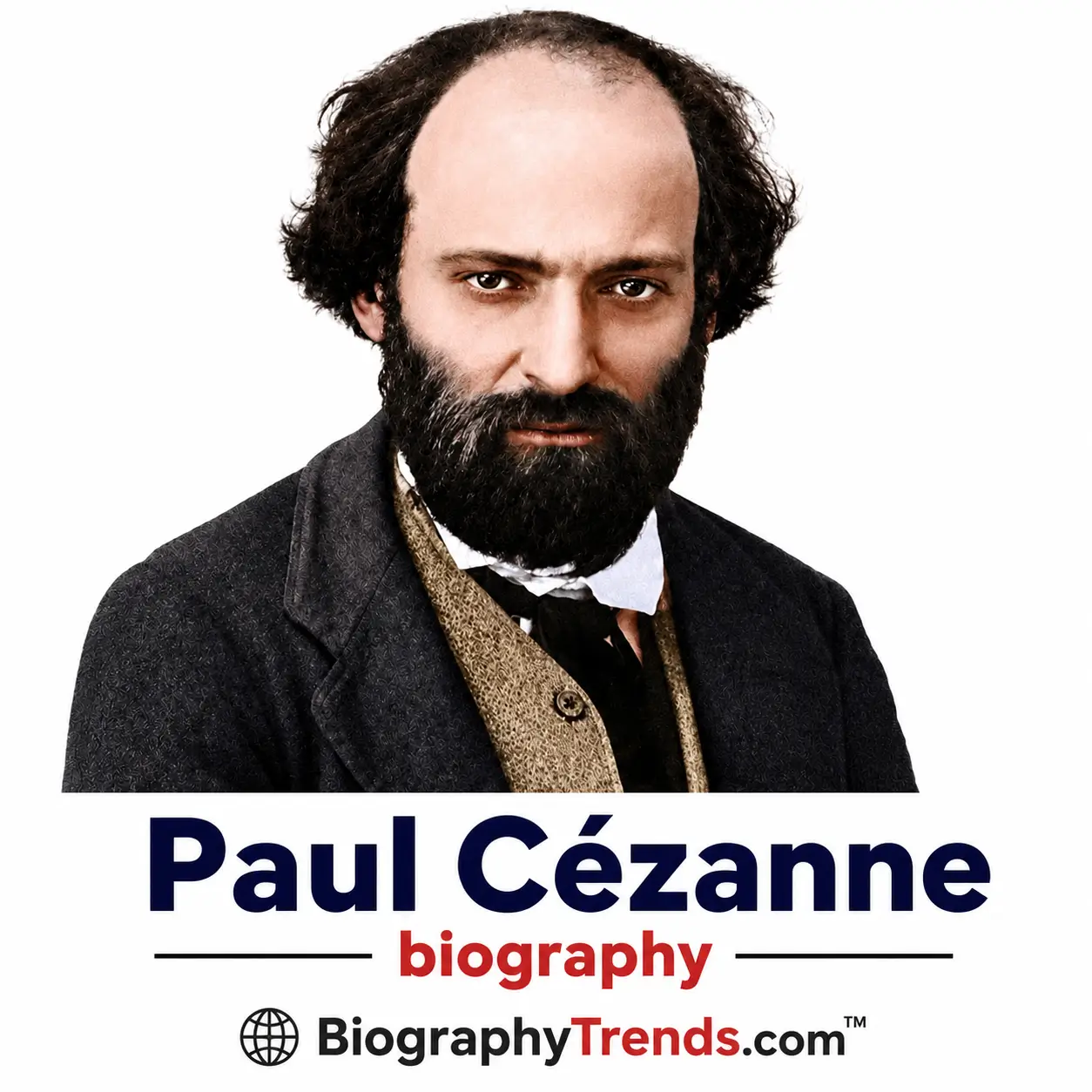
Paul Cézanne Biography stands as one of the most searched topics in art history, and for good reason. Paul Cézanne, the French Post-Impressionist master who bridged the gap between 19th century Impressionism and early 20th century Cubism, remains one of the most influential figures in the history of Western art. Born on January 19, 1839, in Aix en Provence, France, Paul Cézanne would go on to fundamentally transform how artists perceive and represent the visible world. This comprehensive Paul Cézanne Biography explores every facet of his remarkable life from his privileged childhood and tumultuous artistic journey to his revolutionary painting techniques and enduring legacy that continues to shape contemporary art in 2026 and beyond.
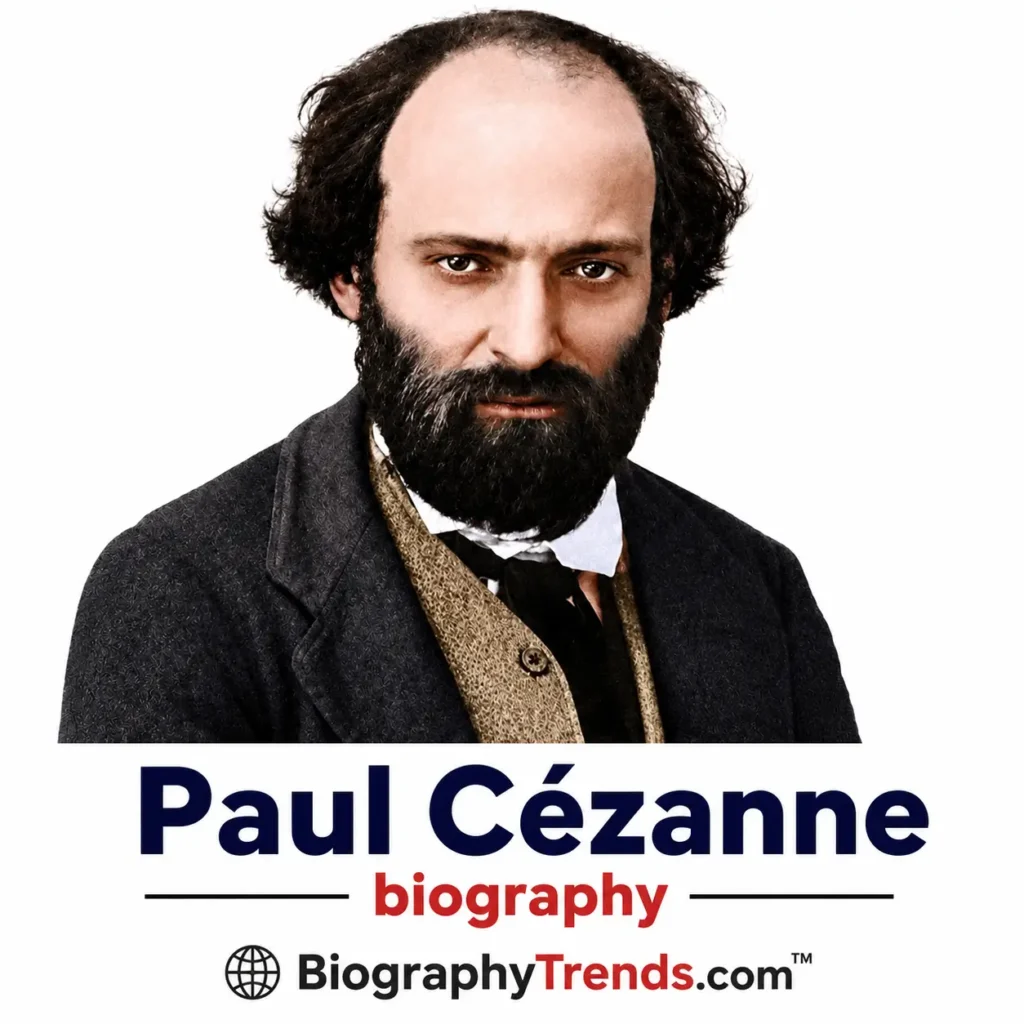
Paul Cézanne Biography: Early Life and Formative Years (1839–1861)
Birth and Family Background
Paul Cézanne was born on January 19, 1839, in Aix en Provence, a picturesque city in the Provence region of southern France. His father, Louis Auguste Cézanne, was a successful banker who had risen from humble origins to become one of the wealthiest citizens of Aix. His mother, Anne Élisabeth Honorine Aubert, came from a more modest background but provided the emotional warmth that would sustain Paul throughout his life.
The Cézanne family represented the emerging French bourgeoisie of the mid 19th century: prosperous, ambitious, and deeply invested in social status. Louis Auguste had founded his own bank and eventually became the co founder of the Cézanne & Cabassol bank, which provided the family with considerable financial security. This wealth would prove crucial to Paul’s artistic career, as it freed him from the economic pressures that plagued many of his contemporaries.
Childhood in Aix en Provence
Young Paul Cézanne grew up in an environment of comfort and privilege. The family home was located in the heart of Aix, and Paul attended the Collège Bourbon (now the Lycée Saint Louis), where he formed one of the most significant friendships of his life with Émile Zola. Zola, who was slightly older and more academically inclined, would later become one of France’s most celebrated novelists and a pivotal figure in Cézanne’s personal and artistic development.
The two boys shared a deep love of literature, poetry, and the natural world. They would often explore the countryside around Aix, particularly the area surrounding Mont Sainte Victoire, the mountain that would become Cézanne’s most enduring artistic obsession. These early experiences of the Provençal landscape, its ochre earth, vibrant light, and distinctive vegetation, would imprint themselves indelibly on Cézanne’s consciousness and later emerge as the defining subject of his mature work.
Early Artistic Inclinations
Despite his father’s hopes that he would enter the banking profession, Paul Cézanne showed early signs of artistic talent. He attended free drawing classes at the École de Dessin in Aix, where he received his first formal instruction in art. His earliest surviving works from this period include drawings and watercolors that demonstrate a precocious ability to observe and render the natural world.
In 1857, at the age of 18, Cézanne enrolled in law school at the University of Aix, bowing to his father’s wishes. However, his heart was never in legal studies. He continued to attend drawing classes and spent his free time painting and reading poetry. Zola, who had moved to Paris in 1858, wrote encouraging letters urging Paul to follow his artistic calling. By 1861, the tension between filial duty and personal passion had become unbearable.
The Decision to Become an Artist
In April 1861, Paul Cézanne made the fateful decision to leave law school and pursue art full time. His father, initially furious at this abandonment of a promising legal career, eventually relented, though not without conditions. Louis Auguste agreed to support Paul’s artistic ambitions on the condition that he enroll in a formal course of study in Paris. He also made it clear that Paul would not be his successor in the banking business.
This compromise marked the beginning of Paul Cézanne’s professional artistic career. With his father’s financial backing, he would later receive an inheritance of 400,000 francs, Cézanne was spared the grinding poverty that afflicted so many artists of his generation. This economic security, while sometimes resented by his more bohemian contemporaries, allowed him the freedom to experiment, fail, and eventually develop his revolutionary artistic vision without the pressure of immediate commercial success.
Studies in Paris and the Dark Period (1861–1870)
Arrival in Paris and the Académie Suisse
In 1861, Paul Cézanne arrived in Paris, the undisputed center of the European art world. He enrolled at the Académie Suisse, an informal and inexpensive art school that attracted many aspiring painters who could not afford or were rejected by the prestigious École des Beaux Arts. The Académie Suisse was notable for its lack of rigid academic structure; students could draw from live models without the strict supervision and classical curriculum imposed by the official academy.
During his time at the Académie Suisse, Cézanne encountered a circle of young, ambitious artists who would shape the future of French art. He met Camille Pissarro, who would become his closest artistic mentor and friend, as well as other future Impressionists. However, Cézanne’s time in Paris was not immediately productive. He struggled to find his artistic voice, and his early attempts at painting were marked by frustration and self doubt.
The Louvre and Old Masters
One of Cézanne’s most important activities during his Paris years was his frequent visits to the Louvre Museum. He studied the works of the Old Masters with intense concentration, particularly the paintings of Michelangelo, Titian, Rubens, and Delacroix. These visits were not mere sightseeing; they were rigorous analytical exercises in which Cézanne sought to understand the structural principles underlying the great works of the past.
The influence of Eugène Delacroix, the great French Romantic painter, was particularly strong during this period. Cézanne admired Delacroix’s bold use of color, dramatic compositions, and emotional intensity. He also drew inspiration from Gustave Courbet, the leading figure of French Realism, whose unidealized depictions of ordinary life and nature resonated with Cézanne’s own artistic sensibilities.
The Dark Period: Style and Themes
Cézanne’s early work, often referred to as his “Dark Period” (approximately 1861–1870), is characterized by a somber palette, heavy impasto, and emotionally charged subject matter. His paintings from this time feature thick, dramatic brushstrokes applied with a palette knife, creating heavily textured surfaces that seem almost sculptural. The colors are predominantly dark: deep browns, blacks, and greens, with occasional flashes of red or orange.
The subject matter of the Dark Period reflects Cézanne’s inner turmoil and the influence of Romanticism. He painted scenes of violence and sensuality, including “The Abduction” (1867), “The Orgy” (1868), and “The Murder” (1867–1870). These works reveal a young artist struggling with powerful emotions and searching for a means of expression that could contain them. The brushwork is aggressive, the compositions unstable, and the overall mood one of existential anxiety.
The Jas de Bouffan Murals
In 1859, Louis Auguste Cézanne purchased the Jas de Bouffan, a large country estate on the outskirts of Aix. This baroque mansion, formerly the residence of the provincial governor, would become Paul Cézanne’s home and workplace for much of his life. In 1860, Cézanne obtained permission to paint the walls of the drawing room, creating a series of large format murals depicting the four seasons.
These murals, “Spring,” “Summer,” “Autumn,” and “Winter,” are remarkable for their ambition and technical accomplishment. Cézanne signed them ironically as “Ingres,” a reference to the neoclassical master Jean Auguste Dominique Ingres, whose work Cézanne actually disliked. The winter picture is additionally dated 1811, alluding to Ingres’ painting “Jupiter and Thetis,” which was created around that time and displayed in the Musée Granet in Aix. These murals, now in the collection of the Petit Palais in Paris, demonstrate Cézanne’s early engagement with classical themes and his willingness to challenge artistic conventions even in his youth.
Rejection by the Salon
Throughout the 1860s, Paul Cézanne submitted his work repeatedly to the Paris Salon, the official exhibition of the Académie des Beaux Arts. Each time, his paintings were rejected. The Salon’s conservative jury, composed of established academic painters, found Cézanne’s work too radical, too dark, and too emotionally raw. These rejections were deeply painful to the sensitive artist, confirming his worst fears about his own inadequacy and fueling his growing resentment of the art establishment.
The rejection by the Salon also had practical consequences. Without Salon acceptance, Cézanne could not sell his work to the wealthy collectors who frequented the official exhibition. He was dependent on his father’s allowance and the occasional purchase by sympathetic friends. This financial dependence would continue to shape his relationship with his father and his own sense of artistic identity for many years.
The Impressionist Years and Marriage (1870–1878)
The Franco Prussian War and L’Estaque
The outbreak of the Franco Prussian War in 1870 disrupted the Parisian art world and forced many artists to flee the capital. On May 31, 1870, Paul Cézanne served as best man at Émile Zola’s wedding in Paris, but shortly thereafter, he and his companion Marie Hortense Fiquet left for the south of France to avoid the conflict. They settled in L’Estaque, a small fishing village near Marseille, where Cézanne would find a new source of artistic inspiration.
L’Estaque’s Mediterranean atmosphere, its bright light, vivid colors, and dramatic coastal scenery, had a profound effect on Cézanne’s palette. For the first time, he began to paint with lighter, more brilliant tones, moving away from the darkness of his early period. The landscapes he produced in L’Estaque, such as “The Sea at L’Estaque” (1878–1880), show a new confidence in color and a growing interest in the structural possibilities of the painted surface.
Cézanne avoided conscription during the war, and although he was denounced as a deserter in January 1871, he managed to evade capture. The details of this period remain somewhat mysterious, as documents from this time are missing. After the Paris Commune was crushed, Cézanne and Hortense returned to Paris in May 1871.
Marriage and Family Life
On January 4, 1872, Marie Hortense Fiquet gave birth to a son, Paul fils. The couple’s relationship was complicated from the beginning. Cézanne had kept his liaison with Hortense secret from his father for years, fearing that Louis Auguste would cut off his financial allowance if he discovered that Paul had a mistress and child. This deception created a web of secrecy and anxiety that would haunt Cézanne throughout his life.
Cézanne’s mother was aware of the situation and participated in family events, but his father remained in the dark for years. The artist received a monthly allowance of 100 francs from his father, barely enough to support a family in Paris, and lived in constant fear of losing even this modest income. The strain of this deception, combined with Cézanne’s naturally anxious and irritable temperament, made domestic life difficult.
In 1872, the crippled painter Achille Emperaire sought refuge with the Cézanne family in Paris due to financial hardship. He soon felt obliged to leave, later writing: “It was necessary, otherwise I would not have escaped the fate of the others. I found [Cézanne] here abandoned by everyone. Zola, Solari and all the others are no longer mentioned. He’s the strangest guy imaginable.” This glimpse into Cézanne’s social isolation reveals a man who, despite his artistic ambitions, struggled to maintain close human connections.
Camille Pissarro and Impressionist Techniques
The most transformative event of Cézanne’s Impressionist period was his friendship with Camille Pissarro. In 1872, Pissarro invited Cézanne to work with him in Pontoise, in the Oise Valley northwest of Paris. Pissarro, a gentle and patient mentor, became the only artist willing to guide the difficult and sensitive Cézanne through the principles of Impressionism.
Under Pissarro’s tutelage, Cézanne learned to paint outdoors (en plein air), capturing the fleeting effects of light and atmosphere with small, broken brushstrokes of pure color. Pissarro advised him to “always only paint with the three primary colours (red, yellow, blue) and their immediate deviations,” and to refrain from linear contouring, defining shapes instead through the gradation of color tonal values.
This instruction was revolutionary for Cézanne. He began to see that color itself could create form, depth, and structure, that a patch of blue next to a patch of yellow could suggest volume and space without the need for drawn outlines. Pissarro later recalled of their time together: “We were always together, but still each of us kept what counts alone: our own feelings.”
The Influence of Vincent van Gogh and Paul Gachet
During his time in Auvers sur Oise (1872–1874), Cézanne met Dr. Paul Gachet, a physician and passionate art lover who would later become famous as Vincent van Gogh’s doctor. Gachet was also an amateur painter and made his studio available to Cézanne, providing a space where the artist could work and experiment.
The influence of Vincent van Gogh, who was active during this same period, also touched Cézanne’s work. While the two artists never met, they were part of the same artistic circles, and Cézanne would have been aware of van Gogh’s bold, expressive use of color and brushwork. Both artists shared a desire to move beyond the optical concerns of Impressionism toward a more emotionally and structurally engaged form of painting.
The First Impressionist Exhibitions
Cézanne participated in the first Impressionist group exhibitions in 1874 and 1877, showing alongside Claude Monet, Edgar Degas, Pierre Auguste Renoir, and Camille Pissarro. These exhibitions, organized in defiance of the official Salon, were intended to showcase the new artistic directions being explored by the younger generation of painters.
However, the critical reception was brutal. Art critics savaged Cézanne’s contributions, finding them crude, unfinished, and technically incompetent. One critic described his work as “the work of a madman,” while another mocked his “clumsy” brushwork and “distorted” forms. These attacks were devastating to Cézanne’s fragile self esteem and contributed to his growing withdrawal from the Parisian art world.
Despite the criticism, Cézanne’s participation in the Impressionist exhibitions was historically significant. It placed him at the center of the most important artistic movement of his generation and established connections with fellow artists who would later champion his work. Monet, Degas, and Renoir all spoke enthusiastically about Cézanne’s paintings, recognizing in them a unique vision that transcended the limitations of conventional criticism.
The Mature Period and Artistic Breakthrough (1878–1890)
Retreat to Provence
Following the harsh criticism of his Impressionist exhibitions, Paul Cézanne increasingly withdrew from Parisian artistic life. From the late 1870s to the early 1890s, he spent most of his time in Provence, particularly in Aix en Provence and the surrounding countryside. This period of relative isolation proved to be the most productive and transformative of his career.
In Provence, Cézanne developed the distinctive style that would define his mature work and establish his place in art history. He moved away from the fleeting impressions of light and atmosphere that characterized Impressionism, focusing instead on the underlying geometric structure of the visible world. His paintings from this period are simultaneously deep and flat, naturalistic and abstract, traditional and revolutionary.
The Development of Geometric Simplification
The central insight of Cézanne’s mature period was his belief that everything in nature could be understood in terms of three basic geometric forms: the sphere, the cylinder, and the cone. This principle, which he articulated in his later years, guided his approach to every subject he painted, from apples and mountains to human figures and architectural elements.
In practice, this meant that Cézanne began to break down complex natural forms into their essential geometric components. A tree trunk became a cylinder; a head became a sphere; a mountain became a cone. But this was not a cold, analytical process; it was an attempt to capture the fundamental structure of reality, the underlying order that Cézanne believed existed beneath the surface appearances of the world.
This geometric simplification had profound implications for the history of art. By emphasizing the two dimensional surface of the canvas while simultaneously creating an illusion of depth, Cézanne challenged the traditional Renaissance system of linear perspective. His paintings invite the viewer to see multiple viewpoints simultaneously, to experience space as something constructed by the artist rather than merely reproduced from nature.
The Mont Sainte Victoire Series
No discussion of Paul Cézanne’s mature period can be complete without addressing his obsessive engagement with Mont Sainte Victoire, the limestone mountain that dominates the landscape east of Aix en Provence. Cézanne painted this mountain over 80 times throughout his career, in oils, watercolors, and drawings, making it one of the most extensively explored subjects in the history of art.
The Mont Sainte Victoire series reveals Cézanne’s evolving artistic vision over several decades. Early versions, such as “Mont Sainte Victoire and the Viaduct of the Arc River Valley” (1882–1885), show the mountain as a solid, clearly defined mass set within a conventional landscape composition. Later versions, painted in the final years of his life, dissolve the mountain into shimmering patches of color, the geological form becoming almost indistinguishable from the surrounding atmosphere.
What drew Cézanne to this particular mountain? Partly it was personal history, Mont Sainte Victoire had been a constant presence in his childhood, visible from the streets of Aix and the grounds of the Jas de Bouffan. Partly it was the mountain’s distinctive form, with its rugged limestone cliffs and distinctive profile. But mostly, it was the challenge it presented: to capture the essence of a natural form that was simultaneously permanent and ever changing, solid and ephemeral.
Cézanne’s approach to Mont Sainte Victoire was methodical and almost scientific. He would set up his easel at the same spots: the Bibémus quarry, the Lauves studio, the Montbriand road, and paint the mountain under different conditions of light, weather, and season. Each painting was an experiment in color and form, an attempt to realize his sensation of the mountain in paint.
Still Life as Structural Exercise
While the Mont Sainte Victoire series explored the structure of landscape, Cézanne’s still life paintings investigated the geometry of objects in an interior space. His still lifes, featuring apples, pears, peaches, bottles, bowls, and tablecloths, are among the most celebrated works in the history of art, and they reveal the full depth of his artistic intelligence.
Cézanne’s approach to still life was revolutionary. Rather than arranging his objects for decorative effect or symbolic meaning, he used them as opportunities to explore the fundamental problems of painting: how to represent three dimensional form on a two dimensional surface, how to create depth through color rather than line, how to balance the demands of representation with the autonomous logic of the painted surface.
His famous declaration that he wanted to “treat nature by the cylinder, the sphere, the cone” is most evident in his still lifes. The apples become spheres, the bottles cylinders, the table a flat plane that tilts impossibly toward the viewer. The compositions are carefully constructed, with objects arranged in a shallow space that seems to push forward toward the picture plane. The brushstrokes are visible, deliberate, and rhythmic, creating a tapestry of color that is both descriptive and abstract.
Paintings like “Still Life with Apples and a Pot of Primrose” (1890) and “The Basket of Apples” (1893–1894) demonstrate Cézanne’s mastery of this genre. The objects are rendered with extraordinary solidity and weight, yet they also participate in a larger formal structure that transcends mere representation. The table tilts, the bottles lean, the apples roll, and yet everything holds together in a harmonious composition that is entirely the artist’s creation.
Portraits and Self Portraits
Cézanne’s portraits and self portraits offer a more intimate glimpse into his artistic psychology. Unlike his landscapes and still lifes, which are concerned with the external world, his portraits explore the human presence, both his own and that of his sitters.
His self portraits, painted throughout his career, trace the aging of the artist from a young, dark haired man to a white bearded elder. They are remarkable for their unflinching honesty and psychological depth. Cézanne does not idealize himself; he presents himself as he was: intense, anxious, and utterly absorbed in his work. The brushwork in the self portraits is often more fluid and expressive than in his other paintings, suggesting a more direct emotional engagement with the subject.
His portraits of others, including his wife Hortense, his son Paul fils, and local workers, share this quality of intense observation. Cézanne was not a flattering portraitist; he painted what he saw, with all the imperfections and idiosyncrasies that make each face unique. His “Portrait of the Gardiner Vallier” (1906), painted in the final months of his life, is a masterpiece of late style: economical, powerful, and deeply human.
The Final Period and Masterworks (1890–1906)
The Card Players Series
In 1890, Paul Cézanne began work on what would become one of his most celebrated series: “The Card Players.” This series of five paintings depicts Provençal peasants engaged in the simple, timeless activity of playing cards. The paintings vary in size and composition, from large canvases featuring multiple figures to smaller, more intimate works focusing on just two players.
“The Card Players” series represents the culmination of Cézanne’s lifelong interest in the dignity of rural labor. The sitters were local workers from the Cézanne family estate, including a gardener and a farmhand. Cézanne painted them with the same seriousness and attention that earlier artists had reserved for aristocrats and mythological heroes. There is no condescension in these paintings, only a profound respect for the human presence.
The most famous version of “The Card Players” (1894–1895), now in the Musée d’Orsay in Paris, features two men seated at a small table, their attention entirely absorbed by the game. The composition is spare and monumental, the colors muted and earthy. The painting demonstrates Cézanne’s system of color gradations to build form and create a three dimensional quality in the figures. The men’s faces are modeled with subtle shifts of warm and cool tones, their bodies solid and weighty within the shallow space.
This version of “The Card Players” would later become the most expensive painting ever sold (at the time), purchased by the Royal Family of Qatar in 2011 for a price estimated between $250 million and $300 million. It remains one of the most valuable works of art in existence.
The Bathers Series
Cézanne’s “Bathers” series, which occupied him from the 1870s until his death, represents his most ambitious engagement with the classical tradition of the nude in landscape. These paintings depict groups of nude figures, male and female, bathing in or beside a river, set within a lush, Arcadian landscape.
The largest and most famous of these works, “The Large Bathers” (1898–1905), was still unfinished at the time of Cézanne’s death in 1906. It debuted at the Salon d’Automne that same year and is now in the collection of the Philadelphia Museum of Art. The painting measures approximately 210.5 × 250.8 cm (82.9 × 98.7 in), making it one of the largest canvases Cézanne ever attempted.
“The Large Bathers” is a triumph of composition and color. The figures are arranged in a triangular formation that echoes the classical compositions of Poussin, while the landscape is built from patches of green, blue, and ochre that dissolve into pure abstraction at the edges. The bodies are modeled with Cézanne’s characteristic geometric simplification, yet they retain a sensuous, almost sculptural presence. The painting is simultaneously a return to the classical tradition and a radical departure from it, a fitting summation of Cézanne’s artistic project.
The Final Years: Château Noir and Mortality
In the last decade of his life, Cézanne’s work took on a darker, more meditative quality. He became increasingly preoccupied with thoughts of mortality, a preoccupation reflected in his vanitas still lifes featuring skulls. “Pyramid of Skulls” (1901) depicts four human skulls stacked on top of one another, painted in dark, moody hues. These works are memento mori in the tradition of Dutch Golden Age painting, yet they are rendered with Cézanne’s distinctive geometric simplification and coloristic intensity.
In 1897, Cézanne’s mother died, a loss that deeply affected him. In November 1899, at the insistence of his sister, he sold the now practically deserted Jas de Bouffan estate and moved into a small city apartment at 23, Rue Boulegon in Aix en Provence. He hired a housekeeper, Mme Bremond, to look after him until his death.
Despite failing health, Cézanne continued to paint with undiminished intensity. “Château Noir” (1903–1904), a moody painting of a castle obscured by trees, showcases the realization of his artistic vision in his final years. The building seems to emerge from the surrounding vegetation through sheer force of color, its forms dissolved into the rhythmic brushstrokes that define Cézanne’s late style.
The Last Days and Death
On October 15, 1906, while painting outdoors near Mont Sainte Victoire, Paul Cézanne was caught in a sudden rainstorm. He continued to work for some time before collapsing from exposure. A passing driver found him and took him back to his apartment in Aix. He died of pneumonia on October 22, 1906, at the age of 67.
His last letter, written to his son Paul on September 5, 1906, reveals the artist’s enduring struggle and ambition: “Finally, I want to tell you that as a painter I am becoming more clairvoyant to nature, but that it is always very difficult for me to realize my feelings. I cannot reach the intensity that unfolds before my senses, I do not possess that wonderful richness of colour that animates nature.”
These words capture the essence of Paul Cézanne’s artistic life: a relentless pursuit of an impossible ideal, a constant striving to capture in paint the fullness of visual experience. He died believing himself a failure, never having achieved the recognition he deserved. Yet within a decade of his death, he would be hailed as the father of modern art.
Revolutionary Artistic Techniques and Style
The Modulation of Color
The cornerstone of Paul Cézanne’s artistic method was his revolutionary approach to color. Unlike the Impressionists, who sought to capture the fleeting effects of light through broken color, Cézanne used color to construct form and space. He believed that changes in color were equivalent to changes in plane, that a shift from warm to cool, or from light to dark, could indicate a shift in the orientation of a surface in space.
This principle, which Cézanne learned from Pissarro and developed into a personal system, allowed him to create the illusion of three dimensional form without relying on traditional shading or linear perspective. In his mature works, every patch of color is simultaneously descriptive (it tells us something about the object being painted) and constructive (it helps build the overall structure of the painting).
Cézanne’s color palette was relatively limited, he favored earth tones, greens, blues, and ochres, but his ability to modulate these colors was extraordinary. A single apple might contain dozens of distinct color variations, each one contributing to the overall form while also participating in the larger color harmony of the composition.
The Constructive Brushstroke
Cézanne’s brushwork is instantly recognizable: short, parallel strokes of paint, applied with a loaded brush, that build up the surface of the canvas like masonry. These strokes are not blended or smoothed; they remain distinct, creating a vibrating, tactile surface that seems to shimmer with energy.
This “constructive stroke” served multiple purposes. It created texture and visual interest, breaking the flatness of the painted surface. It allowed Cézanne to build form gradually, adjusting and correcting as he worked. And it asserted the autonomy of the painting as a physical object, reminding the viewer that they were looking at paint on canvas, not a window onto reality.
The direction of Cézanne’s brushstrokes was carefully considered. In his landscapes, vertical strokes might indicate trees, while horizontal strokes suggested the ground or water. In his still lifes, the strokes followed the contours of objects, emphasizing their roundness and volume. This directional brushwork created a kind of visual rhythm that unifies the composition and guides the viewer’s eye across the canvas.
The Treatment of Space
Perhaps the most radical aspect of Cézanne’s art was his treatment of space. Traditional Western painting, since the Renaissance, had relied on linear perspective to create the illusion of depth. Objects were made smaller as they receded into the distance, and parallel lines converged at a vanishing point on the horizon.
Cézanne rejected this system. In his paintings, the foreground and background often seem to exist on the same plane. The table in a still life tilts upward toward the viewer, flattening the space. The mountain in a landscape seems to press forward, its bulk occupying the same pictorial space as the trees in the foreground. This “flattening” of space was not a mistake or a limitation; it was a deliberate strategy that emphasized the two dimensional nature of the canvas while still suggesting three dimensional form.
This approach to space had enormous consequences for the development of modern art. Picasso and Braque, the founders of Cubism, explicitly credited Cézanne as their primary inspiration. They took his flattening of space to its logical extreme, breaking objects into multiple viewpoints and reassembling them as geometric facets on the picture plane.
The Sensation and Realization
Cézanne famously described his working method as a process of “sensation and realization.” He would stand before his motif, whether a mountain, a bowl of fruit, or a group of bathers, and attempt to capture his visual sensation in paint. But this was not a simple transcription of what he saw; it was a complex process of translation, in which the raw data of perception was transformed into the structured language of painting.
This process was slow and laborious. Cézanne would often work on a single canvas for months or even years, returning to it again and again, each time adjusting the colors and forms in response to his changing perception. He was notorious for abandoning paintings that did not meet his exacting standards, leaving them “unfinished” by conventional standards but complete in terms of his own artistic vision.
The concept of aller sur le motif, going out to the motif, painting directly from nature, was central to Cézanne’s practice. Unlike studio painters who worked from drawings or memory, Cézanne insisted on the direct encounter with nature. He believed that only through prolonged, intense observation could he achieve the “realization” of his sensations in paint.
Iconic Masterpieces and Series
The Mont Sainte Victoire Series
As previously discussed, the Mont Sainte Victoire series represents the fullest expression of Cézanne’s landscape art. Spanning his entire career, these paintings trace the evolution of his style from relatively conventional landscape painting to radical abstraction. The later versions, painted in the final years of his life, are almost pure color compositions, the mountain dissolving into patches of blue, green, and violet.
“Mont Sainte Victoire” (1904–1906), one of the last paintings in the series, is a masterpiece of late style. The mountain is barely recognizable as a geological form; it has become a shimmering presence, a mountain of color rather than a mountain of rock. The brushstrokes are broader and more fluid than in earlier works, the colors more intense and arbitrary. This painting anticipates the color field abstractions of mid 20th century artists like Mark Rothko and Barnett Newman.
The Card Players
“The Card Players” series (1890–1895) represents Cézanne’s most significant engagement with the human figure. The paintings depict Provençal peasants in moments of quiet concentration, their bodies solid and monumental within the shallow space. The smallest and most famous version, now in the Musée d’Orsay, is a masterpiece of economy and restraint: two men, a table, a few bottles, and nothing else.
The significance of “The Card Players” extends beyond its aesthetic qualities. The series demonstrates Cézanne’s ability to find grandeur in humble subjects, to elevate the everyday to the level of high art. It also shows his mastery of composition, the way he could arrange a few simple elements into a harmonious and visually satisfying whole.
The Bathers
“The Large Bathers” (1898–1905) is the culmination of Cézanne’s lifelong engagement with the classical nude. The painting combines references to Renaissance and Baroque art, particularly the compositions of Poussin and Rubens, with a radically modern treatment of form and space. The figures are modeled with geometric simplicity, the landscape built from patches of pure color.
This painting influenced a generation of 20th century artists. Picasso studied it intently, and its influence can be seen in the figures of “Les Demoiselles d’Avignon” (1907). Matisse also admired it, and its color harmonies echo in his own great compositions of the Fauvist period.
Still Life with Apples and a Pot of Primrose
“Still Life with Apples and a Pot of Primrose” (1890) exemplifies Cézanne’s mature approach to the still life genre. The composition is carefully balanced, with the round forms of the apples contrasting with the vertical accent of the primrose pot. The colors are warm and harmonious, the brushstrokes visible and rhythmic. This painting demonstrates how Cézanne could transform the most ordinary objects into a profound meditation on form, color, and space.
The Boy in the Red Vest
“Portrait of a Boy in a Red Vest” (1888–1890) is one of Cézanne’s most celebrated portraits. The sitter, a local boy, is depicted with extraordinary presence and psychological depth. The red vest provides a striking color accent against the muted background, while the boy’s face is modeled with subtle gradations of warm and cool tones. This painting was stolen from a Swiss museum in 2008 and recovered in a Serbian police raid in 2012, a dramatic episode that underscored the enduring value and desirability of Cézanne’s work.
Personal Life, Relationships, and Character
The Relationship with Marie Hortense Fiquet
Paul Cézanne’s relationship with Marie Hortense Fiquet, whom he married in 1886, was one of the most complicated aspects of his personal life. Hortense was a frequent model for Cézanne’s paintings and drawings, appearing in numerous portraits throughout their relationship. Yet the marriage was far from a conventional love match.
Cézanne had kept Hortense secret from his father for 16 years, a deception that speaks to his deep seated fear of paternal disapproval. Even after their marriage and the birth of their son, Hortense was rarely welcome at the Jas de Bouffan, and Cézanne’s relationship with his wife was marked by emotional distance and practical separation. They often lived apart, with Hortense in Paris and Cézanne in Aix.
Despite these difficulties, Hortense remained a constant presence in Cézanne’s art. Her face, with its distinctive features and melancholy expression, appears in dozens of paintings and drawings. Cézanne painted her not as an idealized beauty but as a real woman, with all the imperfections and vulnerabilities of human existence. These portraits are among the most honest and moving in his oeuvre.
The Father Son Dynamic
The relationship between Paul Cézanne and his father, Louis Auguste, was the defining psychological drama of the artist’s life. Louis Auguste was a domineering figure who had built his fortune through hard work and determination. He expected his son to follow in his footsteps, to become a respectable professional rather than a bohemian artist.
Their conflict was not merely about career choice; it was about fundamentally different worldviews. Louis Auguste represented the values of the French bourgeoisie: stability, respectability, and material success. Paul represented the emerging values of modern art: individual expression, creative freedom, and the pursuit of beauty for its own sake. These values were incompatible, and their clash shaped Cézanne’s personality and art in profound ways.
Despite their conflicts, Louis Auguste eventually supported Paul’s artistic career, and his financial generosity allowed the artist to work without the pressure of commercial success. Cézanne inherited 400,000 francs from his father, a sum that secured his financial independence for life. Yet the psychological wound of paternal disapproval never fully healed, and it manifested in Cézanne’s diffidence, his social awkwardness, and his relentless self criticism.
Social Isolation and Artistic Solitude
Paul Cézanne was not a sociable man. He was shy, irritable, and prone to outbursts of temper. He found it difficult to maintain close friendships, and his relationships with fellow artists were often strained. Even his oldest friend, Émile Zola, would eventually become estranged from him.
This social isolation was both a burden and a blessing. It freed Cézanne from the distractions and compromises of artistic society, allowing him to focus entirely on his work. It also protected him from the influence of fashionable trends and commercial pressures. In his solitude, Cézanne was able to develop his unique artistic vision without interference or distraction.
Yet the loneliness took its toll. Cézanne’s letters reveal a man of deep sensitivity and emotional need, someone who craved recognition and understanding but was unable to reach out for them. His art became his primary mode of communication, the means by which he expressed what he could not say in words.
Character and Temperament
Those who knew Paul Cézanne described him as a man of contradictions. He was simultaneously arrogant and insecure, passionate and withdrawn, stubborn and indecisive. He could be warm and generous with those he trusted, but cold and dismissive with strangers. He was deeply religious in a conventional Catholic sense, yet his art challenged every convention of religious painting.
This complex temperament is reflected in his art. The tension between order and chaos, between control and spontaneity, between tradition and innovation, animates every canvas. Cézanne was not a comfortable artist; his work demands effort from the viewer, just as it demanded effort from its creator. But for those willing to engage with it, the rewards are immeasurable.
The Break with Émile Zola
A Friendship of Youth
The friendship between Paul Cézanne and Émile Zola was one of the most significant relationships in either man’s life. They had met as schoolboys in Aix, drawn together by their shared love of literature and their outsider status in the conservative bourgeois society of provincial France. Zola, the illegitimate son of an Italian engineer, and Cézanne, the banker’s son who wanted to be an artist, were natural allies against the conventional world.
Their friendship deepened during Cézanne’s early years in Paris, when Zola was already establishing himself as a writer. Zola encouraged Cézanne to pursue his artistic ambitions, providing emotional support and practical advice. Their correspondence from this period reveals a warm, affectionate relationship, full of shared jokes and literary references.
Zola’s Novel: L’Œuvre
The breaking point came in 1886 with the publication of Zola’s novel L’Œuvre (The Masterpiece). The novel tells the story of Claude Lantier, a talented but ultimately failed painter who destroys himself in pursuit of an impossible artistic ideal. Lantier is a composite character, drawing on aspects of several artists Zola knew, including Édouard Manet and Paul Cézanne.
Cézanne recognized himself in Lantier, and he was devastated. The novel portrayed the artist as a tragic failure, a man whose genius was undermined by his own temperament and the incomprehension of the world around him. Whether Zola intended this as a portrait of Cézanne is still debated by scholars, but Cézanne certainly took it as such.
The publication of L’Œuvre ended the friendship between the two men. Cézanne never spoke to Zola again, and when Zola died in 1902, Cézanne refused to attend the funeral. The wound was too deep, the betrayal too personal.
The Meaning of the Break
The break with Zola was more than a personal quarrel; it was a symbolic moment in the history of modern art. It represented the final separation of the artist from the literary culture that had nurtured him, the assertion of painting’s autonomy from the narratives and interpretations of outsiders.
Cézanne’s reaction also reveals his profound insecurity about his own artistic worth. He was terrified that Zola’s portrait might be accurate, that he might indeed be a failure. This fear drove him to work even harder, to push his art to ever greater heights of ambition and complexity. In a strange way, Zola’s betrayal may have been the catalyst for Cézanne’s greatest achievements.
Legacy and Influence on Modern Art
“The Father of Us All”
Paul Cézanne’s influence on 20th century art is so vast and pervasive that it is difficult to overstate. Pablo Picasso famously declared, “Cézanne was the father of all of us,” and Henri Matisse called him “a kind of dear god of painting.” These were not empty compliments; they were acknowledgments of a fundamental debt.
Cézanne’s legacy rests on several key innovations. His geometric simplification of natural forms provided the foundation for Cubism. His bold, arbitrary use of color influenced the Fauves. His flattening of pictorial space anticipated abstract art. His emphasis on the structural properties of painting inspired generations of artists to think about the medium in new ways.
The 1907 Retrospectives
The full extent of Cézanne’s influence became apparent only after his death. In 1907, two major retrospectives paid tribute to the artist: an exhibition of 79 watercolors at the Galerie Bernheim Jeune in Paris (June), and a comprehensive retrospective at the Salon d’Automne (October–November), featuring 49 paintings and seven watercolors in two rooms of the Grand Palais.
These exhibitions were transformative events in the history of art. They introduced Cézanne’s work to a new generation of artists who had never seen his paintings in person. Visitors included Georges Braque, André Derain, Wassily Kandinsky, Henri Matisse, and Pablo Picasso, all of whom would go on to revolutionize art in their own ways, inspired by what they saw.
The art historian Julius Meier Graefe, who would write the first Cézanne biography in 1910, attended the Salon d’Automne retrospective. So did the poet Rainer Maria Rilke and the diplomat and art patron Harry Graf Kessler. The exhibitions established Cézanne’s reputation as the pivotal figure in the transition from 19th century art to modernism.
Influence on Cubism
Cézanne’s influence on Cubism was direct and explicit. Picasso and Braque studied his paintings intensively, particularly the late works with their fractured planes and multiple viewpoints. Cézanne’s famous advice to “treat nature by the cylinder, the sphere, the cone” became a guiding principle for the Cubists, who took geometric simplification to its logical extreme.
Braque described the influence of Cézanne on his art as an “initiation” and said in 1961: “Cézanne was the first to turn away from the learned mechanized perspective.” Picasso admitted that “he was the only master for me… he was a father figure to us: it was he who offered us protection.”
The Cubists took Cézanne’s flattening of space and made it systematic, breaking objects into facets that showed multiple viewpoints simultaneously. They took his geometric simplification and made it rigorous, reducing the visible world to a vocabulary of cubes, cones, and cylinders. In doing so, they fulfilled the promise implicit in Cézanne’s work, pushing his innovations to their ultimate conclusion.
Influence on Fauvism and Expressionism
While the Cubists were inspired by Cézanne’s structure, the Fauves were drawn to his color. Matisse, Derain, and Vlaminck admired Cézanne’s bold, arbitrary use of color, his willingness to paint a tree blue or a mountain violet if the composition demanded it. They took this license and exaggerated it, creating paintings of explosive, non naturalistic color.
Matisse, in particular, acknowledged his debt to Cézanne. Even at the age of 80, in 1949, he said that he owed the most to the art of Cézanne. The color harmonies of Matisse’s greatest works, the Dance, the Music, the Red Studio, can be traced back to Cézanne’s example.
Expressionist artists, including those of the German Die Brücke and Der Blaue Reiter groups, also found inspiration in Cézanne. His emotional intensity, his willingness to distort form for expressive effect, and his rejection of academic conventions all resonated with the Expressionist sensibility.
Influence on Abstract Art
Cézanne’s influence extended beyond representational art into pure abstraction. His emphasis on the flatness of the picture plane, his reduction of natural forms to geometric essences, and his treatment of color as an independent structural element all anticipated the developments of abstract art in the mid 20th century.
Artists like Piet Mondrian, Kasimir Malevich, and Wassily Kandinsky drew on Cézanne’s example in their own moves toward abstraction. Mondrian’s grid paintings, with their emphasis on pure form and color, can be seen as the ultimate extension of Cézanne’s geometric simplification. Kandinsky’s abstract compositions, with their vibrant color harmonies, owe a debt to Cézanne’s coloristic experiments.
Literary and Philosophical Influence
Cézanne’s influence was not limited to the visual arts. Writers and philosophers also found inspiration in his work. Ernest Hemingway compared his writing to Cézanne’s landscapes, and in his memoir A Moveable Feast, he wrote: “I was learning something from the painting of Cézanne that made writing simple true sentences far from enough to make the stories have the dimensions that I was trying to put in them.”
The philosopher Maurice Merleau Ponty wrote extensively about Cézanne, using his art as a case study for his phenomenological investigations into perception and embodiment. Merleau Ponty’s essay “Cézanne’s Doubt” (1945) remains one of the most profound philosophical engagements with any artist’s work.
The Art Market and Record Breaking Sales
The Rise in Value
The increase in value of Paul Cézanne’s work over the past century is a remarkable story in itself. During his lifetime, Cézanne struggled to sell his paintings, and his prices were far below those of more established artists like Manet, Monet, or Renoir. The 1899 auction of the Chocquet collection, which included 32 first rank Cézannes, achieved prices of 4,000 to 5,000 francs per painting, substantial sums, but still “far below those for paintings by Manet, Monet or Renoir.”
The first buyer of a Cézanne painting was Claude Monet, followed by fellow artists like Degas, Renoir, and Pissarro. These purchases were acts of solidarity and recognition as much as investments. It was only after Cézanne’s death, and particularly after the 1907 retrospectives, that his market value began to rise dramatically.
Record Breaking Auctions
The modern art market has seen several record breaking sales of Cézanne’s work. On May 10, 1999, his painting “Rideau, Cruchon et Compotier” sold for $61.5 million at Sotheby’s in New York, the fourth highest price paid for a painting up to that time, and the most expensive still life painting ever sold.
On May 8, 2007, Cézanne’s watercolor “Still Life with Green Melon” set a record for a work on paper when it sold for $25.5 million, far above its estimate of $18 million. A preparatory watercolor for “The Card Players” series, previously thought lost for sixty years, sold for $19.1 million on May 1, 2012.
The Card Players: The World’s Most Expensive Painting
The most spectacular sale of a Cézanne painting occurred in 2011, when one of the five versions of “The Card Players” was sold to the Royal Family of Qatar. The price was variously estimated at between $250 million and possibly as high as $300 million, either price signifying a new mark for the highest price ever paid for a painting at that time. The record was eventually surpassed in November 2017 by Leonardo da Vinci’s “Salvator Mundi,” but “The Card Players” remains the third most expensive painting of all time.
The Paul Allen Collection Sale
On November 8, 2022, Cézanne’s “La Montagne Sainte Victoire” sold for $138 million as part of the Paul Allen collection sale at Christie’s in New York City. This set a new record for the highest price paid for a Cézanne work at auction and confirmed the artist’s status as one of the most valuable in the history of art.
Nazi Looted Art
The high value of Cézanne’s work has also led to controversies over Nazi looted art. Several Cézanne paintings were confiscated by the Nazis during World War II or sold under duress by Jewish owners. In recent decades, museums and collectors have faced legal challenges and restitution claims over these works. The resolution of these cases continues to be a complex and emotionally charged issue in the art world.
Cézanne in Popular Culture and Philosophy
Films About Cézanne
Paul Cézanne’s life and art have inspired several films. The most notable is “Cézanne and I” (Cézanne et moi, 2016), directed by Danièle Thompson, which explores the complex friendship between Cézanne and Émile Zola. The film stars Guillaume Canet as Zola and Guillaume Gallienne as Cézanne, and it dramatizes their relationship from their schooldays in Aix to their final estrangement.
Other films about Cézanne include documentaries that explore his artistic techniques and the landscapes that inspired him. These films have helped to introduce Cézanne’s work to new audiences and to deepen public understanding of his artistic achievements.
Cézanne in Fiction
Cézanne has appeared as a character in numerous works of fiction, often as a symbol of artistic integrity and the struggle against convention. His life story, the bourgeois background, the paternal conflict, the artistic isolation, the posthumous recognition, provides rich material for novelists and playwrights.
The writer Émile Zola, of course, used aspects of Cézanne’s personality in his novel L’Œuvre, though the extent to which Claude Lantier is based on Cézanne remains a matter of scholarly debate. Other writers have drawn on Cézanne’s example to explore themes of creativity, ambition, and the price of artistic integrity.
Philosophical Interpretations
Cézanne’s work has been the subject of extensive philosophical analysis, particularly in the phenomenological tradition. Maurice Merleau Ponty’s essay “Cézanne’s Doubt” is the most famous example, but philosophers from Martin Heidegger to Gilles Deleuze have engaged with Cézanne’s art as a way of thinking about perception, embodiment, and the nature of reality.
For Merleau Ponty, Cézanne’s paintings revealed the pre reflective, embodied nature of perception, the way we see the world before conscious thought intervenes. Cézanne’s slow, methodical process of painting was, for Merleau Ponty, a way of capturing this primordial experience of the world, prior to the conceptual categories that normally structure our vision.
Contemporary Relevance
In 2026, Paul Cézanne remains as relevant as ever. His work continues to be exhibited in major museums worldwide, and his influence can be seen in contemporary art practices ranging from abstract painting to digital art. The questions he raised about the relationship between perception and representation, between nature and artifice, between tradition and innovation, are still central to artistic discourse.
The 2026 art world, with its emphasis on digital media, artificial intelligence, and virtual reality, might seem far removed from Cézanne’s oil paintings of Provençal landscapes. Yet the fundamental problem he addressed, how to translate visual experience into artistic form, remains as pressing as ever. In an age of image saturation and digital manipulation, Cézanne’s insistence on the material reality of paint and the integrity of the artist’s vision offers a valuable counterpoint.
READ ALSO:
- Lynette Hooker Biography: Age, Career, Bahamas Case & New Evidence
- Shadrack Sibiya Biography: Age, Education, SAPS Role & Scandal 2026
- Alan Hayward James Biography: $37M Air Force Fraud Case Explained 2026
- James Tolkan Biography: Age, Movie Career, Top Gun & BTTF Star Dies at 94
Visiting Cézanne’s World Today
Aix en Provence: The Cézanne Trail
For those who wish to experience Paul Cézanne’s world firsthand, Aix en Provence offers a rich itinerary of sites associated with the artist’s life and work. The city has embraced its most famous son, and visitors can follow the “Cézanne Trail” to key locations.
The Musée Granet, located in the Place Saint Jean de Malte, houses an important collection of Cézanne’s work, including paintings, drawings, and watercolors. The museum is closed on Mondays, so plan your visit accordingly. The collection includes some of Cézanne’s earliest works, including the murals from the Jas de Bouffan that were removed from the walls and transferred to canvas.
The Bastide du Jas de Bouffan
The Bastide du Jas de Bouffan, located at 4 route de Valcros, is the country estate that Cézanne’s father purchased in 1859 and that served as the artist’s home and workplace for much of his life. The building and the old trees in the park were among Cézanne’s favorite subjects, and he painted them repeatedly throughout his career.
Visitors to the Jas de Bouffan can see the rooms where Cézanne lived and worked, including the drawing room where he painted his early murals. The estate provides a vivid sense of the environment that shaped Cézanne’s art: the light, the vegetation, the architecture of Provence.
Mont Sainte Victoire
No visit to Cézanne’s world is complete without seeing Mont Sainte Victoire. The mountain can be viewed from numerous vantage points around Aix, and visitors can rent an e bike or take a short drive through the iron enriched russet earth of the countryside to experience the landscape that Cézanne painted so obsessively.
The best views are from the Bibémus quarry and the road to Montbriand, where Cézanne set up his easel countless times. Watching the subtle tones and shapes of the rockface evolve during the afternoon hours, one can imagine Cézanne beside you, painting the mountain he loved with his short, parallel, distinctive brushstrokes.
The Atelier des Lauves
Cézanne’s final studio, the Atelier des Lauves, is another essential stop. Located on the outskirts of Aix, this studio was built to Cézanne’s specifications in 1902 and served as his workplace until his death. It has been preserved as a museum and contains many of the objects that appear in his still life paintings: the plaster cupid, the skulls, the bowls and bottles.
The studio offers a unique glimpse into Cézanne’s working methods. The light is extraordinary, flooding in from large north facing windows, and the space is arranged with the same care for composition that Cézanne brought to his paintings.
Frequently Asked Questions About Paul Cézanne
How old was Paul Cézanne when he died?
Paul Cézanne was 67 years old when he died on October 22, 1906. He was born on January 19, 1839, in Aix en Provence, France. Despite his relatively short life by modern standards, he produced an extraordinary body of work that continues to influence artists more than a century after his death.
What is Paul Cézanne famous for?
Paul Cézanne is famous for being the “father of modern art.” He is best known for his revolutionary approach to painting, which emphasized geometric structure, color modulation, and the flattening of pictorial space. His most famous works include the “Mont Sainte Victoire” series, “The Card Players” series, “The Large Bathers,” and his numerous still life paintings featuring apples and other fruit.
Why is Paul Cézanne called the father of modern art?
Paul Cézanne is called the father of modern art because his innovative techniques and artistic philosophy laid the groundwork for Cubism, Fauvism, and abstract art. Pablo Picasso famously said, “Cézanne was the father of all of us,” acknowledging the debt that 20th century artists owed to his example. Cézanne’s geometric simplification of natural forms, his treatment of color as a structural element, and his flattening of pictorial space all anticipated the major developments of modern art.
What was Paul Cézanne’s painting style?
Paul Cézanne’s painting style evolved significantly over his career. His early work was dark and moody, influenced by Romanticism and Realism. During his Impressionist period, he adopted lighter colors and broken brushstrokes. His mature style is characterized by geometric simplification, constructive brushstrokes, color modulation, and the flattening of pictorial space. He believed that everything in nature could be understood in terms of the sphere, cylinder, and cone.
How many times did Cézanne paint Mont Sainte Victoire?
Paul Cézanne painted Mont Sainte Victoire over 80 times throughout his career, in oils, watercolors, and drawings. This makes it one of the most extensively explored subjects in the history of art. The series spans his entire career and traces the evolution of his style from relatively conventional landscape painting to radical abstraction.
What is the most expensive Cézanne painting ever sold?
One version of “The Card Players” was sold in 2011 to the Royal Family of Qatar for a price estimated between $250 million and $300 million, making it one of the most expensive paintings ever sold at that time. More recently, “La Montagne Sainte Victoire” sold for $138 million in 2022 as part of the Paul Allen collection sale at Christie’s.
Did Paul Cézanne have children?
Yes, Paul Cézanne had one child, a son named Paul fils, born on January 4, 1872, to his partner (and later wife) Marie Hortense Fiquet. Paul fils was the only child of the marriage, and he outlived his father by many years, eventually inheriting the artist’s estate.
Why did Cézanne and Zola stop being friends?
Paul Cézanne and Émile Zola ended their friendship after the publication of Zola’s novel L’Œuvre (The Masterpiece) in 1886. Cézanne believed that the novel’s protagonist, Claude Lantier, a failed painter who destroys himself in pursuit of an impossible artistic ideal, was based on him. The portrayal was deeply hurtful to Cézanne, and he never spoke to Zola again.
Where can I see Cézanne’s paintings?
Paul Cézanne’s paintings can be seen in major museums worldwide. The most important collections are in the Musée d’Orsay and the Musée de l’Orangerie in Paris, the Metropolitan Museum of Art in New York, the Philadelphia Museum of Art, the National Gallery in London, and the Musée Granet in Aix en Provence. Many of his works are also in private collections and appear occasionally at auction.
What techniques did Cézanne use?
Cézanne used several distinctive techniques that became hallmarks of his style. These included the “constructive stroke,” short, parallel brushstrokes that build up the surface of the canvas; color modulation, the use of subtle shifts in color to create form and depth; geometric simplification, the reduction of natural forms to basic geometric shapes; and the flattening of pictorial space, the rejection of traditional linear perspective in favor of a more ambiguous, multi layered space.
Conclusion: Why Paul Cézanne Matters in 2026
Paul Cézanne Biography research reveals a life of extraordinary dedication, struggle, and ultimate triumph. Paul Cézanne died in 1906 believing himself a failure, yet within a decade, he was recognized as the most important artist of his generation. Today, in 2026, his influence continues to shape how we think about art, perception, and the relationship between the artist and the natural world.
What makes Paul Cézanne so enduringly relevant? Partly it is the sheer beauty of his paintings, the way he could transform a simple bowl of apples or a view of a mountain into a profound meditation on form, color, and space. Partly it is his integrity as an artist, his refusal to compromise his vision for commercial success or critical approval. And partly it is the example he set of artistic ambition, the way he pushed painting to its limits in pursuit of an impossible ideal.
In an age of digital reproduction and virtual reality, Cézanne’s insistence on the material reality of paint and the embodied nature of perception seems more valuable than ever. His paintings remind us that art is not merely a matter of images but of substances, pigment, canvas, brushstroke, that engage our senses in ways that screens cannot replicate.
For anyone interested in the history of art, Paul Cézanne Biography is essential reading. His life story, from the bourgeois comfort of Aix to the artistic isolation of his final years, from the darkness of his early work to the luminous achievements of his maturity, offers a model of artistic dedication that continues to inspire. His paintings, scattered in museums and private collections around the world, remain as fresh and challenging as they were when he painted them, inviting us to see the world with new eyes.
As we look toward the future of art in 2026 and beyond, Paul Cézanne’s example reminds us that true innovation comes not from rejecting the past but from engaging with it deeply, not from chasing trends but from following one’s own vision with relentless determination. He was, in the deepest sense, a modern artist, not because he anticipated the future, but because he was true to himself. And in that self truth, he created a legacy that will endure as long as people continue to paint, to look, and to wonder at the world around them.
Paul Cézanne Biography remains one of the most compelling narratives in the history of art. From his birth in Aix en Provence in 1839 to his death in 1906, Paul Cézanne lived a life of artistic passion, personal struggle, and creative innovation that continues to resonate with artists, scholars, and art lovers around the world. Whether you are studying his revolutionary techniques, visiting the landscapes he painted, or simply standing before one of his masterpieces in a museum, Paul Cézanne offers an encounter with art at its most profound and transformative.