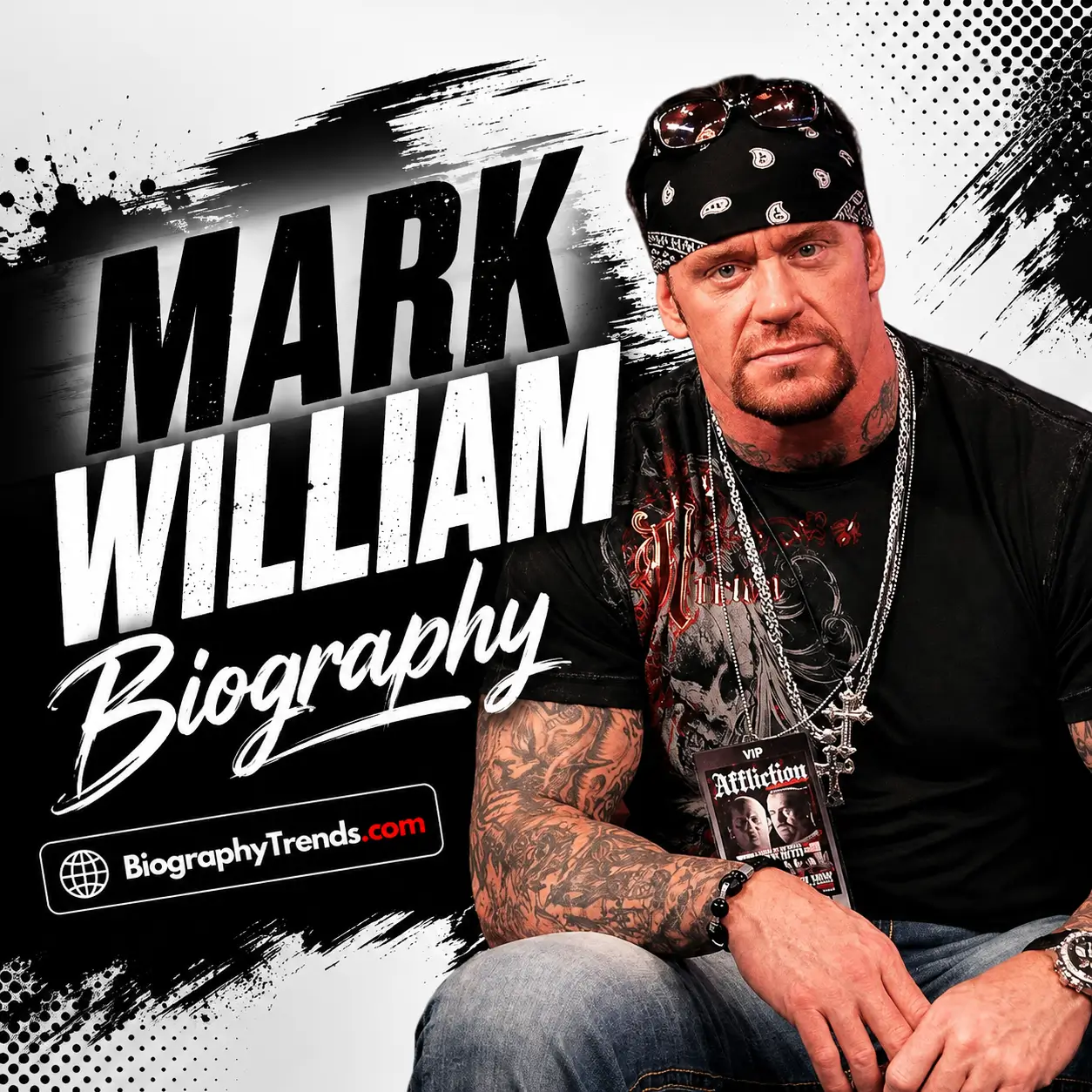
From Houston Texas to the WWE Hall of Fame
Calaway Mark William biography, born on March 24, 1965, in Houston, Texas, stands as one of the most iconic figures in the history of professional wrestling. For over three decades, he captivated millions of fans worldwide under the ring name The Undertaker, a supernatural, macabre character that became the defining image of World Wrestling Entertainment. From his debut at Survivor Series in 1990 to his emotional retirement in 2020 and subsequent induction into the WWE Hall of Fame in 2022, Calaway built a legacy that transcends the squared circle. His 21 match undefeated streak at WrestleMania, his legendary Hell in a Cell battles, and his evolution from the Deadman to the American Badass made him a household name and a symbol of longevity in an industry known for burnout and broken bodies.
But behind the black trench coat, the wide brimmed hat, and the gong that signaled his arrival lay a complex personal life marked by three marriages, five children, persistent rumors of infidelity, and a retirement that has proven more challenging than any opponent he ever faced in the ring. At 61 years old in 2026, Calaway has transitioned from active competition to a new phase of life as a podcaster, WWE brand ambassador, and family man. Yet the shadows of his past, including the dissolution of his second marriage amid whispers of an affair with a fellow WWE performer, continue to follow him.
This comprehensive biography explores Mark Calaway’s age, his extraordinary wrestling career, his three marriages, the cheating allegations that swirled around his divorce from second wife Sara Frank, his current life with Michelle McCool, his net worth of $17 million, and the ongoing rumors that have kept his personal life in the headlines long after his final match. From the basketball courts of Texas to the main event of WrestleMania, from the tattoo of his wife’s name on his throat to the podcast microphone in his Austin mansion, this is the story of the man behind the Phenom.
Mark William Biography: Early Life and Athletic Beginnings
Birth and Childhood in Houston Texas
Mark William Calaway entered the world on March 24, 1965, in Houston, Texas, the youngest of five sons born to Frank and Betty Calaway. Growing up in the sprawling Texas metropolis, Mark was immersed in a culture that valued physicality, competition, and the kind of larger than life personality that would later serve him so well in professional wrestling. The Calaway household was a bustling environment with five boys, and Mark learned early how to hold his own among his older brothers.
Frank Calaway worked to provide for his large family, while Betty managed the household and instilled in her sons the values of hard work, discipline, and perseverance. The family’s financial situation was modest, and Mark understood from an early age that success would require dedication and sacrifice. The Calaway boys were encouraged to pursue athletics, and Mark showed early promise in multiple sports. His natural size, coordination, and competitive drive set him apart from his peers, even as a child.
Growing up in Houston during the 1970s and 1980s, Mark was exposed to the booming energy of a city that was rapidly becoming one of America’s largest and most diverse metropolitan areas. The Houston sports scene, with its passionate fan bases for the Oilers, Astros, and Rockets, provided a backdrop for Mark’s developing love of athletic competition. He attended Waltrip High School, where he would begin to forge the physical and mental attributes that would carry him to international fame.
High School Sports and the Path to College Athletics
At Waltrip High School, Mark Calaway emerged as a standout athlete, participating in both the football and basketball teams. His height, which would eventually reach 6 feet 10 inches, made him a natural fit for basketball, where he played as a center. On the football field, his size and athleticism made him a formidable presence. These formative years were crucial for Mark’s development, teaching him the fundamentals of teamwork, discipline, and the physical toll that competitive sports exact on the body.
Mark’s performances on the basketball court attracted the attention of college recruiters, and he eventually received a basketball scholarship to Angelina College in Lufkin, Texas, located approximately 115 miles northeast of Houston. The scholarship represented a significant opportunity for the Calaway family, offering Mark a path to higher education through his athletic abilities. At Angelina College, Mark continued to develop his basketball skills while adjusting to the demands of college life.
After his time at Angelina College, Mark transferred to Texas Wesleyan University in Fort Worth, Texas, where he played center for the Rams basketball team during the 1985 to 1986 season. He also majored in sports management, a field that reflected his passion for athletics and his practical understanding of the business side of sports. However, Mark’s college career would not reach its expected conclusion. In 1986, he made the pivotal decision to drop out of school to pursue a career in professional sports.
The decision to leave college was not made lightly. Mark briefly considered playing professional basketball in Europe, where American players often found opportunities that were not available in the United States. However, he ultimately chose a different path, one that would lead him away from the basketball court and into the world of professional wrestling. This transition from legitimate athlete to sports entertainer would prove to be one of the most consequential decisions of his life, setting in motion a career that would make him one of the most recognizable figures in global entertainment.
Mark William Biography: Training and Early Wrestling Career
The Texas Red Persona and World Class Championship Wrestling
Mark Calaway’s professional wrestling journey began in 1984 when he started training under the legendary Buzz Sawyer, a hard nosed wrestler known for his intense in ring style and his equally intense training methods. Sawyer’s wrestling school was not for the faint of heart, and Mark’s physical conditioning from basketball served him well as he learned the fundamentals of the wrestling business. He also received training from Rick Davidson and John Davidson, who helped refine his in ring technique and character work.
Calaway made his professional debut on June 26, 1987, working under a mask as Texas Red for World Class Championship Wrestling (WCCW), the Dallas based promotion that had launched the careers of numerous wrestling stars. The Texas Red gimmick was a masked character that allowed the young Calaway to gain experience while hiding his inexperience behind a disguise. During this period, he also worked under other names including The Commando, Boris Dragu, and The Master of Pain, each gimmick providing valuable lessons in character development and audience interaction.
Working for WCCW and its affiliate promotions, including the Continental Wrestling Association and Georgia Championship Wrestling, Calaway earned a reputation as a big man with star potential. His size, athleticism, and willingness to learn made him a valuable commodity in the territorial wrestling system that still existed in the late 1980s. These early years were characterized by long drives between towns, modest payoffs, and the constant hustle of a young wrestler trying to make a name for himself.
On April 1, 1989, Calaway won his first professional wrestling championship as The Master of Pain in the United States Wrestling Association (USWA), defeating Jerry Lawler for the title. He later captured the USWA Texas Heavyweight Championship on October 5, 1989. These early title reigns, while not on the level of the championships he would later hold, were significant milestones that validated his decision to pursue wrestling and demonstrated his potential to promoters and fans alike.
World Championship Wrestling and the Mean Mark Callous Persona
In late 1989, Mark Calaway signed with World Championship Wrestling (WCW), the Atlanta based promotion that was emerging as the primary competitor to Vince McMahon’s World Wrestling Federation. In WCW, Calaway adopted the ring name Mean Mark Callous, a dark, brooding character managed by Paul E. Dangerously (later known as Paul Heyman). The Mean Mark gimmick was a significant step forward in Calaway’s character development, incorporating elements of the supernatural and the macabre that would eventually define The Undertaker.
As Mean Mark Callous, Calaway was presented as a mysterious figure with telekinetic powers, a precursor to the supernatural abilities that would become central to The Undertaker’s persona. He briefly held the WCW Tag Team Championship and competed against some of the company’s top stars. However, WCW management, including booker Ole Anderson, reportedly did not see significant star potential in Calaway, viewing him as just another big man in a company full of physically imposing performers.
This lack of vision from WCW management would prove to be one of the most consequential misjudgments in wrestling history. In 1990, after a brief stint in New Japan Pro Wrestling where he competed as Punisher Dice Morgan, Calaway’s WCW contract expired. He made the decision to leave the company and pursue opportunities elsewhere, a move that would lead him directly to the doorstep of the World Wrestling Federation and the character that would make him a global icon.
Mark William Biography: The Birth of The Undertaker and WWE Dominance
Debut at Survivor Series 1990
Mark Calaway signed with the World Wrestling Federation in 1990 and was given the ring name Kane the Undertaker, which was quickly shortened to simply The Undertaker. The character was conceived as a supernatural mortician from Death Valley, managed by the equally macabre Paul Bearer, played by William Moody. The Undertaker’s debut came at Survivor Series 1990, where he appeared as the mystery partner of Ted DiBiase’s Million Dollar Team, facing Dusty Rhodes’ Dream Team.
From the moment he stepped into the ring, The Undertaker was unlike anything WWE fans had seen before. His towering presence, ghostly pallor, and eerie mannerisms created an immediate impression. The character’s supernatural elements, including his ability to no sell opponent’s attacks, sit up after taking devastating moves, and control the arena lights with his mere presence, tapped into primal fears and fascinations that resonated with audiences of all ages.
The partnership with Paul Bearer, who carried an urn that supposedly contained the source of The Undertaker’s power, became one of the most iconic manager wrestler pairings in WWE history. Bearer’s high pitched voice, maniacal laughter, and devotion to his charge added layers of storytelling that elevated The Undertaker beyond a simple monster heel. Together, they created a mythology that would sustain the character for over three decades.
First WWE Championship and Early Feuds
The Undertaker’s impact was immediate and profound. On November 27, 1991, exactly one year after his debut, he defeated Hulk Hogan to win his first WWE Championship at Survivor Series 1991 in a match dubbed Hulk Hogan’s Gravest Challenge. The victory was a stunning statement of The Undertaker’s importance to the company, as Hogan was the biggest star in professional wrestling at the time. Although Hogan won the title back just six days later, the brief reign established The Undertaker as a main event caliber performer.
The early years of The Undertaker’s career were marked by feuds with some of the biggest names in WWE history. He battled Jake The Snake Roberts, Macho Man Randy Savage, The Ultimate Warrior, Yokozuna, and the Million Dollar Corporation. Each feud added new dimensions to the character and demonstrated Calaway’s versatility as a performer. Whether playing the role of unstoppable villain or avenging hero, The Undertaker consistently delivered matches and moments that captivated audiences.
The Casket Match, a specialty bout where the objective was to lock one’s opponent inside a coffin, became synonymous with The Undertaker. These matches, while controversial and macabre, were box office draws that showcased the character’s unique appeal. The Undertaker’s ability to blend athleticism with theatrical presentation set him apart from other big men in wrestling and established a template for the modern WWE superstar.
The Streak and WrestleMania Immortality
The Phenom’s Undefeated Legacy
Perhaps no aspect of The Undertaker’s career is more celebrated than The Streak, his unprecedented 21 consecutive victories at WrestleMania, WWE’s flagship annual event. The Streak began at WrestleMania VII in 1991 with a victory over Jimmy Snuka and grew into one of the most compelling narratives in professional wrestling history. Each year, fans anticipated not just whether The Undertaker would win, but how he would win, what new spectacle he would present, and which opponent would fall before the Deadman’s unstoppable momentum.
The Streak transformed WrestleMania into The Undertaker’s personal showcase. His matches against legendary opponents including Kane, Big Boss Man, Triple H, Ric Flair, Randy Orton, Batista, Edge, Shawn Michaels, and CM Punk became the most anticipated bouts on the card, often overshadowing even the main event championship matches. The quality of these matches, particularly the back to back classics against Shawn Michaels at WrestleMania 25 and 26, demonstrated that The Undertaker was not merely a character performer but one of the greatest in ring technicians of his generation.
The Streak became a cultural phenomenon that extended beyond the wrestling world. Mainstream media outlets covered it, casual fans who did not follow WWE regularly were aware of it, and it became a betting line at sportsbooks. The mystique of The Streak was such that many believed it would never end, that The Undertaker would retire with his WrestleMania perfection intact. This belief made the events of WrestleMania 30 all the more shocking.
The End of The Streak at WrestleMania 30
On April 6, 2014, at WrestleMania 30 in New Orleans, Louisiana, The Undertaker faced Brock Lesnar in a match that would become one of the most talked about moments in wrestling history. When Lesnar hit his third F5 and pinned The Undertaker, the referee’s three count did not just end a match; it ended a legacy. The crowd at the Mercedes Benz Superdome fell into stunned silence, unable to process what they had just witnessed. The Streak, 21 years in the making, was over at 21 and 1.
The decision to end The Streak was reportedly made by Vince McMahon, WWE’s chairman, who believed that Lesnar, as a legitimate mixed martial arts champion and mainstream attraction, was the only performer worthy of breaking the record. The Undertaker himself was said to have supported the decision, believing that the time had come to pass the torch. However, the reaction from fans was overwhelmingly negative, with many feeling that the ending was anticlimactic and that The Streak should have remained intact until The Undertaker’s retirement.
The physical toll of the match was evident on The Undertaker, who suffered a severe concussion early in the bout and reportedly had little memory of the finish. Images of him being helped to the backstage area by medical staff became iconic, symbolizing both his dedication and the physical price he had paid for three decades of competition. The end of The Streak marked the beginning of the final chapter of The Undertaker’s in ring career, a chapter that would last six more years and include both triumphant returns and painful farewells.
Character Evolution: From Deadman to American Badass and Back
The Ministry of Darkness and the Attitude Era
The Undertaker’s character underwent numerous evolutions throughout his career, each reflecting the changing landscape of WWE and Calaway’s own creative instincts. In 1999, during the height of the Attitude Era, The Undertaker transformed into the leader of the Ministry of Darkness, a Satanic themed faction that included wrestlers such as Bradshaw, Faarooq, Mideon, Viscera, Edge, Christian, and Gangrel. This version of The Undertaker was darker and more sinister than ever before, engaging in storylines that pushed the boundaries of acceptable television content.
The most controversial moment of this era came when The Undertaker attempted to marry Stephanie McMahon, the daughter of WWE chairman Vince McMahon, in a bizarre segment that saw Stephanie tied to a crucifix like symbol. The Undertaker later admitted that this storyline was probably the most out there thing he ever did in his career. The Ministry of Darkness eventually merged with Vince McMahon’s Corporation to form the Corporate Ministry, a storyline that demonstrated the character’s versatility and Calaway’s willingness to adapt to whatever creative direction WWE required.
The American Badass and Big Evil
In May 2000, The Undertaker underwent his most dramatic transformation yet, abandoning the supernatural Deadman persona in favor of a biker character known as The American Badass. This version of The Undertaker rode a motorcycle to the ring, wore bandanas and sunglasses instead of a trench coat and hat, and spoke in a more natural, less theatrical manner. The American Badass was essentially Mark Calaway playing a version of himself, a tough, no nonsense biker who did not need supernatural powers to intimidate his opponents.
The American Badass persona resonated with fans who appreciated the authenticity and attitude that Calaway brought to the character. He engaged in feuds with top stars including Stone Cold Steve Austin, The Rock, Kurt Angle, and Brock Lesnar, delivering some of the most physically intense matches of his career. The character evolved into Big Evil, a darker, more aggressive version of the biker persona that retained the attitude while adding a menacing edge.
In 2004, The Undertaker returned to his Deadman persona at WrestleMania XX, facing his storyline brother Kane. However, elements of the American Badass remained, creating a hybrid character that combined the supernatural mystique of the original with the toughness and attitude of the biker. This hybrid version of The Undertaker would carry him through the remainder of his career, allowing him to access both the theatrical spectacle of the Deadman and the gritty realism of the American Badass as the situation demanded.
The Final Years and Retirement
The Last Ride and WrestleMania 36
The final years of The Undertaker’s in ring career were marked by a series of farewells, returns, and physical struggles that made his retirement one of the most prolonged and emotionally complex in wrestling history. In 2017, after losing to Roman Reigns at WrestleMania 33, The Undertaker left his iconic trench coat, hat, and gloves in the center of the ring, a gesture that was widely interpreted as his retirement. The image of the empty ring filled with the symbols of his character became one of the most poignant visuals in WWE history.
However, The Undertaker was not finished. He returned at WrestleMania 34 to defeat John Cena in a squash match that lasted less than three minutes. He then competed in a series of matches that, while financially lucrative, were physically demanding and increasingly difficult for a man in his mid fifties. The match against Goldberg at Super ShowDown 2019 was particularly criticized for its sloppiness and botches, leading to widespread concern about The Undertaker’s physical condition.
The true final match came at WrestleMania 36 in 2020, where The Undertaker faced AJ Styles in a cinematic Boneyard Match. Filmed at a remote location rather than in a traditional arena, the match allowed for creative editing and special effects that masked Calaway’s physical limitations. The Undertaker defeated Styles by burying him alive, a fittingly macabre conclusion to a career defined by supernatural spectacle. The match received widespread praise and is widely considered the perfect ending to The Undertaker’s career.
Official Retirement and Hall of Fame Induction
On June 21, 2020, in the final episode of the documentary series Undertaker: The Last Ride, Mark Calaway officially announced his retirement from professional wrestling. He stated that if there was ever a perfect ending to a career, the Boneyard Match was it. While he left the door slightly ajar for a potential emergency return if WWE Chairman Vince McMahon were in a pinch, he made clear that he had no desire to get back in the ring.
The official farewell came on November 22, 2020, at the Survivor Series event, which marked exactly 30 years since his WWE debut. The event was dedicated to The Undertaker, and he appeared in his trademark trench coat and stetson hat to deliver an emotional farewell speech. Standing in the ring where he had created so many memories, Calaway spoke directly to the fans who had supported him for three decades. His final words, delivered in character, were both a thank you and a goodbye: My time has come to let The Undertaker Rest in Peace. A ten bell salute and a holographic appearance by his late manager Paul Bearer provided a fittingly theatrical conclusion to the career of the most theatrical performer in WWE history.
On April 1, 2022, Mark Calaway was formally inducted into the WWE Hall of Fame at the American Airlines Center in Dallas, Texas. The induction ceremony was a celebration of his contributions to the wrestling industry, featuring a 137 minute speech that opened with a 10 minute emotional standing ovation from the live audience. Calaway’s acceptance speech, hailed by media outlets as matchless and beyond compare, was motivational and filled with self reflections and life philosophies for success. He stood before mannequins displaying the various iterations of his Deadman character, a visual reminder of the evolution that had defined his career.
Marriage to Jodi Lynn: The First Chapter
Meeting and Marriage in 1989
Mark Calaway’s first marriage was to a woman named Jodi Lynn, a relatively obscure chapter in the life of a man who would become one of the most famous entertainers in the world. The couple exchanged vows in 1989, when Calaway was still in the early stages of his wrestling career and had not yet adopted The Undertaker persona. This marriage lasted a full decade, a significant achievement in the wrestling business, where relationships are often strained by constant travel, physical toll, and the temptations of life on the road.
During their marriage, Jodi Lynn and Mark welcomed their first child, a son named Gunner Vincent Calaway, born in 1993. The arrival of Gunner added a new dimension to Calaway’s life, transforming him from a young wrestler trying to make his mark into a father with responsibilities beyond the ring. The birth of his son coincided with the early years of The Undertaker’s WWE career, a period of intense professional growth that must have created significant challenges for the new family.
Jodi Lynn’s decision to marry Calaway before he became famous demonstrated a commitment that predated his success. She supported him through the early struggles of his career, the long drives between wrestling territories, and the uncertainty of a profession where financial stability was never guaranteed. Her presence during this formative period provided the foundation upon which Calaway built his future success.
Divorce in 1999 and the End of the First Marriage
In 1999, after a decade of marriage, Mark Calaway and Jodi Lynn parted ways. The reasons for their divorce have remained private, consistent with Calaway’s general approach to keeping his personal life out of the public eye. The end of this marriage coincided with a period of significant change in Calaway’s professional life, as the Attitude Era was transforming WWE into a more adult oriented, controversial product. The demands of this new era, combined with the physical toll of a decade in the ring, may have contributed to the strain on the marriage.
The divorce from Jodi Lynn marked the end of Calaway’s first matrimonial chapter and set the stage for the relationships that would follow. It also left him as a single father to Gunner, a responsibility that he took seriously despite the demands of his career. The experience of divorce and single fatherhood likely shaped Calaway’s approach to his subsequent relationships and his understanding of the challenges that come with balancing family life and a career in professional wrestling.
Marriage to Sara Frank: The Tattoo and the Troubles
Wedding in 2000 and WWE Storyline Integration
In the year 2000, Mark Calaway took a significant step in his personal life by marrying Sara Frank, a woman who would become far more visible to wrestling fans than his first wife. Unlike the private nature of his marriage to Jodi Lynn, Calaway’s relationship with Sara was incorporated into WWE storylines in ways that blurred the line between his personal and professional lives. This integration of his real marriage into his fictional wrestling persona was a departure from his previous approach and signaled a new era of openness, however controlled, about his personal life.
One of the most memorable and permanent expressions of Calaway’s love for Sara was the tattoo of her name that he had inked on his throat. This visible declaration of devotion became a symbol of their commitment and was incorporated into The Undertaker’s on screen presentation. The tattoo was impossible to hide and served as a constant reminder to fans that behind the supernatural character was a man deeply in love with his wife.
Sara’s involvement in WWE storylines reached its peak during a controversial angle in which Diamond Dallas Page was portrayed as stalking her. This storyline led to a fierce feud between Page and The Undertaker, with Sara appearing on television to play her role in the narrative. While the storyline was criticized by some for its exploitative nature, it demonstrated the extent to which Calaway was willing to incorporate his real life into his wrestling persona.
Children and Family Life
During their marriage, Mark and Sara Calaway welcomed two daughters into their family: Chasey Calaway, born on November 21, 2000, and Gracie Calaway, born on May 15, 2005. The birth of their daughters transformed Calaway from a father of one into a father of three, adding new responsibilities and joys to his life. The family lived in Austin, Texas, where Calaway had established a home base away from the spotlight of WWE’s primary operations in Connecticut.
The Calaway household during this period was presumably a blend of the ordinary and the extraordinary. On one hand, Mark was a husband and father trying to balance the demands of a career that required him to be on the road for most of the year. On the other hand, he was The Undertaker, a global icon whose face was recognized by millions and whose character was the subject of countless nightmares and fantasies. This duality must have created unique challenges for the family, particularly as the children grew old enough to understand their father’s unusual profession.
Sara’s role as the wife of The Undertaker was not an easy one. She had to navigate the pressures of being married to a public figure while also dealing with the physical and emotional toll that his career exacted. Wrestling marriages are notoriously difficult, with the constant travel, physical injuries, and temptations of the road creating stress that many relationships cannot survive. Sara’s willingness to appear in WWE storylines suggested a level of comfort with the wrestling business that not all wrestling wives possess.
The Cheating Allegations and Affair Rumors with Michelle McCool
The most controversial aspect of Mark Calaway’s marriage to Sara Frank was the persistent rumor that he was involved in an affair with fellow WWE performer Michelle McCool during the final years of his second marriage. These allegations, while never definitively proven, swirled throughout the wrestling industry and among fans, creating a cloud of speculation that has followed Calaway into his third marriage.
The timeline of events suggests a possible overlap between Calaway’s separation from Sara and the beginning of his relationship with Michelle McCool. Calaway and Sara divorced in 2007, and he married McCool in 2010, a three year gap that could indicate a period of courtship or could simply reflect the time needed to finalize a divorce and move on. However, McCool had been working for WWE since 2004, and the two would have had ample opportunity to interact during the final years of Calaway’s marriage to Sara.
The nature of WWE’s workplace, where performers spend long hours together, travel extensively, and share intimate physical contact in the ring, creates an environment where romantic relationships frequently develop. The close proximity of Calaway and McCool, combined with the reported strain in his marriage to Sara, provided fertile ground for rumors to take root. Whether these rumors were based on fact or mere speculation has never been conclusively established, but their persistence has shaped public perception of Calaway’s personal life.
Some wrestling observers have noted that Calaway’s divorce from Sara and his subsequent marriage to McCool improved his career both in terms of match quality and storyline engagement. Whether this was due to personal happiness translating into professional performance or simply coincidence is a matter of interpretation. What is clear is that the transition from Sara to Michelle McCool coincided with a period of renewed creative energy for The Undertaker, including some of his most acclaimed matches and character evolutions.
The Divorce from Sara Frank in 2007
Mark Calaway and Sara Frank’s marriage came to an end in 2007, marking the conclusion of a seven year union that had produced two daughters and countless memories. The reasons for their divorce remained private, with both parties choosing not to discuss the details publicly. This privacy was consistent with Calaway’s general approach to his personal life, though the rumors of infidelity made complete silence impossible.
The divorce left Calaway as a single father to three children, including Gunner from his first marriage and Chasey and Gracie from his marriage to Sara. The challenges of co parenting while maintaining a demanding WWE schedule must have been significant, though Calaway has generally kept these struggles out of the public eye. The end of his second marriage set the stage for the relationship that would define the next phase of his life, a relationship that would also be conducted within the unique pressures of the wrestling world.
The tattoo of Sara’s name on Calaway’s throat became a complicated symbol after their divorce. While some wrestlers have had tattoos of former partners removed or covered, Calaway’s throat tattoo remained visible throughout his subsequent relationship and marriage. This permanent reminder of his second marriage served as a testament to the genuine love he once felt, even as the relationship had ended, and as a visible marker of the personal history that he carried into his future.
Marriage to Michelle McCool: The Third and Current Union
From Diva Search Competitor to Life Partner
Michelle Leigh McCool was born on January 25, 1980, in Palatka, Florida, and her path to WWE stardom was as unconventional as her future husband’s. A former middle school science teacher, McCool entered WWE through the 2004 Diva Search competition, a reality television style contest designed to find new female talent for the company. She did not win the competition, but her athleticism, charisma, and determination earned her a developmental contract and eventually a spot on the main roster.
McCool’s WWE career was marked by significant accomplishments. She became the inaugural WWE Divas Champion in 2008 and later unified that title with the WWE Women’s Championship in 2009, making her the first woman to hold both titles simultaneously. Her partnership with Layla El, known as LayCool, dominated the women’s division for years and established McCool as one of the top female performers of her era. She won two Slammy Awards and was ranked number one in the Pro Wrestling Illustrated Female 50 in 2010, the same year she was named Woman of the Year.
Before her relationship with Calaway, McCool was married to Jeremy Louis Alexander, whom she had dated since high school. The couple divorced in 2006, leaving McCool single when she and Calaway began their relationship. The timing of their respective divorces, Calaway’s in 2007 and McCool’s in 2006, fueled speculation about when their relationship actually began and whether there was any overlap with their previous marriages.
Wedding in 2010 and Family Expansion
Mark Calaway and Michelle McCool were married on June 26, 2010, in Houston, Texas, in a ceremony that brought together two of WWE’s most recognizable performers. The wedding took place at a time when both were active in WWE, though McCool would retire from in ring competition in 2011 due to injuries and a desire to start a family. The couple’s decision to marry was a public declaration of their commitment, one that has endured for over 15 years as of 2026.
In August 2012, Mark and Michelle welcomed their first child together, a daughter named Kaia Faith Calaway. The birth of Kaia added a fourth child to Calaway’s growing family and marked a new chapter in his life as a father. The couple later adopted a son named Kolt, further expanding their family and demonstrating their commitment to providing a loving home for children in need.
The Calaway household in Austin, Texas, became a blended family that included Gunner from Mark’s first marriage, Chasey and Gracie from his second marriage, and Kaia and Kolt from his marriage to Michelle. Managing such a complex family dynamic while maintaining a career in WWE required significant effort and compromise. Michelle’s decision to retire from wrestling allowed her to focus on family life, while Mark continued to perform part time until his full retirement in 2020.
Michelle McCool’s WWE Hall of Fame Induction in 2025
In 2025, Michelle McCool received one of the highest honors in professional wrestling when she was inducted into the WWE Hall of Fame as part of the Class of 2025. The induction was announced by WWE Chief Content Officer Paul Triple H Levesque on ESPN’s Get Up program, with Mark Calaway and Michelle present for the surprise announcement. The honor recognized McCool’s contributions to WWE’s women’s division, including her status as the inaugural Divas Champion and her role in elevating women’s wrestling during a pivotal era.
The induction ceremony took place on April 18, 2025, at the Fontainebleau Las Vegas in Winchester, Nevada, the night before WrestleMania 41. Mark Calaway had the honor of inducting his wife into the Hall of Fame, a moment that brought their personal and professional lives full circle. The ceremony was a celebration of McCool’s journey from middle school science teacher to WWE legend, and it cemented the Calaway family’s status as a wrestling dynasty with two Hall of Fame members.
McCool’s induction also made her and Mark one of the few married couples to both be inducted into the WWE Hall of Fame, joining an elite group that includes other wrestling power couples. The honor was particularly meaningful given the controversy that had surrounded the beginning of their relationship, serving as a public validation of their marriage and a testament to its longevity.
Life in Retirement: Austin Texas and Beyond
The Austin Mansion and Private Lifestyle
Following his retirement from active competition, Mark Calaway settled into a life of relative privacy in Austin, Texas, where he had maintained a residence for many years. His home in Cedar Creek, located on the edge of Austin, is a sprawling mansion that reflects his love of privacy, the outdoors, and the finer things in life. The property features multiple bedrooms, state of the art amenities, a large swimming pool, and extensive outdoor space that ensures the family can enjoy their time away from the public eye.
Austin, with its vibrant music scene, outdoor recreation opportunities, and laid back culture, has provided the perfect backdrop for Calaway’s retirement. The city is known for its live music venues, barbecue restaurants, and motorcycle friendly roads, all of which align with Calaway’s personal interests. His decision to remain in Texas rather than relocating to WWE’s headquarters in Connecticut or to a more traditional celebrity enclave like Los Angeles reflects his deep roots in the state and his desire for a life that is grounded in the values of his upbringing.
Calaway’s retirement lifestyle has been characterized by a balance of public appearances and private family time. He has made sporadic appearances on WWE programming, including a notable moment during the RAW Netflix premiere episode where he shared a moment with Rhea Ripley after her Women’s World Championship victory. He also plays a key role in WWE’s A&E series WWE LFG: Legends and Future Greats, coaching rising stars alongside other wrestling legends. These appearances allow him to stay connected to the business that made him famous while maintaining the freedom to prioritize his family.
The Six Feet Under Podcast and YouTube Channel
In 2024, Mark Calaway launched the Six Feet Under podcast, a project that allowed him to share stories from his legendary career, interview fellow wrestlers and celebrities, and connect with fans in a new medium. The podcast was initially launched independently before being brought in house by WWE in early 2025. It was relaunched as a WWE and Fanatics production on WWE’s official YouTube channel in June 2025, with new episodes dropping every other Wednesday.
The podcast is co hosted by Calaway’s wife, Michelle McCool, creating a dynamic that blends professional insight with personal chemistry. The show features interviews with wrestling legends, current stars, and celebrities from outside the wrestling world, including former United States President Donald Trump. The podcast has been praised for Calaway’s natural storytelling ability and his willingness to discuss topics that he might have avoided during his active career.
In November 2025, WWE launched a specialized YouTube channel devoted to The Undertaker, which serves as the new home for the Six Feet Under podcast. The channel represents WWE’s recognition of Calaway’s enduring value as a brand ambassador and content creator. As WWE’s head of digital, Steve Braband, noted, It comes very naturally to him, just sitting and talking about wrestling especially, and telling stories. There’s nobody better than Taker. The podcast and YouTube channel have given Calaway a platform to shape his legacy on his own terms, sharing the stories and perspectives that he believes are most important.
The Fake Divorce Rumors of 2026
The Social Media Hoax
In 2026, Mark Calaway and Michelle McCool found themselves at the center of a social media hoax that claimed The Undertaker had filed for divorce from his wife after she had cheated on him. The rumor spread rapidly across platforms like X (formerly Twitter), Facebook, and Instagram, with many fans expressing shock and disbelief at the apparent end of one of wrestling’s most enduring marriages. The claim was particularly believable given the history of cheating allegations that had surrounded Calaway’s divorce from Sara Frank, creating a narrative that seemed to repeat itself.
However, fact checking organizations and wrestling news outlets quickly debunked the rumor, confirming that there was no evidence of a divorce filing and that the Calaways remained happily married. The hoax was traced to unreliable sources and clickbait websites that manufactured the story to generate traffic and engagement. The speed with which the rumor spread demonstrated both the enduring interest in Calaway’s personal life and the vulnerability of public figures to misinformation in the social media age.
The fake divorce rumor was particularly ironic given that 2026 was a year in which the Calaways were publicly celebrating their 15th wedding anniversary and Michelle’s recent Hall of Fame induction. The couple’s social media presence, while limited, showed no signs of marital strife, and their joint appearances on the Six Feet Under podcast continued without interruption. The hoax served as a reminder of the challenges that celebrity couples face in maintaining privacy and controlling their narrative in an era of instant information and viral misinformation.
The Legacy of the Cheating Allegations
The persistence of cheating allegations in Mark Calaway’s personal narrative reflects the broader culture of speculation and rumor that surrounds professional wrestling. The close quarters in which wrestlers work, the blurred lines between storyline and reality, and the passionate fan base that consumes every detail of performers’ lives create an environment where rumors thrive. Whether the allegations of an affair with Michelle McCool during his marriage to Sara were based on fact or fiction, they have become a permanent part of Calaway’s public biography.
The impact of these allegations on Calaway’s legacy is complex. On one hand, they have cast a shadow over his personal life that contrasts with the heroic image of The Undertaker character. On the other hand, they have humanized him, reminding fans that behind the supernatural persona was a man capable of making mistakes and facing the same relationship challenges as anyone else. The fact that his marriage to Michelle McCool has endured for over 15 years suggests that whatever difficulties marked its beginning, the relationship has proven to be genuine and lasting.
READ ALSO:
- Nolan Wells Biography: Age, Death, Real Autopsy Result & fight for justice
- Atty. Michael Poa Biography: Age, Career, Education, Wife & Net Worth 2026
- Stephen Colbert Biography: Trump Slams America & Leading Late-Night Host
- Pastor John MacArthur Biography: Age 92, Family, America & Grace Church 2026
Net Worth, Financial Success, and Business Ventures
Building a $17 Million Fortune
As of 2026, Mark Calaway has an estimated net worth of $17 million, a fortune built through over three decades of professional wrestling, merchandise sales, endorsements, and business ventures. His peak WWE salary was approximately $2.5 million per year, making him one of the highest paid performers in the company’s history. Even in retirement, Calaway continues to earn a significant income through his WWE Legends contract, which pays him an estimated $2.5 million annually for sporadic appearances, promotional work, and his role as a brand ambassador.
The foundation of Calaway’s wealth was his in ring career, during which he main evented countless pay per view events, sold millions of dollars in merchandise, and became one of the most marketable characters in WWE history. The Undertaker action figures, t shirts, and memorabilia have generated substantial revenue for both Calaway and WWE, with his likeness remaining popular long after his retirement. His deal with WWE 2K video games and other licensing agreements have provided additional income streams that continue to contribute to his net worth.
Calaway’s business ventures extend beyond wrestling. He has invested in real estate, including his Austin mansion and other properties in Texas. He has also pursued business opportunities with colleague Scott Everhart, though the specifics of these ventures remain private. His sponsorship deals with companies such as G Fuel, DraftKings, and Conor’s Cure have added to his income while aligning him with brands that fit his image and values.
Car and Motorcycle Collections
Mark Calaway’s personal interests are reflected in his impressive collection of vehicles, which includes both classic cars and customized motorcycles. His car collection features several models that reflect his rugged, powerful image, including a 1978 Mercedes Benz W123 valued at approximately $13,710, a Jeep Wrangler Rubicon worth around $42,000, a Chevrolet Tahoe at $52,000, a Mercedes Benz G Class at $140,950, and a Bentley Continental GT valued at $202,500. These vehicles represent a range of styles from utilitarian to luxurious, reflecting Calaway’s diverse tastes.
However, it is his love of Harley Davidson motorcycles that has become most closely associated with his public persona. The American Badass character rode a motorcycle to the ring, and Calaway’s real life passion for bikes made this aspect of the character authentic. He owns several Harley Davidson motorcycles, each customized to suit his imposing persona. These bikes have been featured in his wrestling entrances, his promotional materials, and his personal social media, making them an integral part of The Undertaker brand.
Mark William Biography: The Undertaker’s Legacy and Cultural Impact
The Greatest Character in WWE History
Mark Calaway’s portrayal of The Undertaker is widely regarded as the greatest character in WWE history and one of the most iconic creations in the history of professional wrestling. The character’s longevity, consistency, and evolution over three decades set a standard that no other performer has matched. From the Western mortician of 1990 to the Satanic leader of the Ministry of Darkness to the motorcycle riding American Badass and back to the hybrid Deadman, The Undertaker demonstrated a versatility that belied the seemingly limited nature of the original gimmick.
The Undertaker’s impact on the wrestling industry extends beyond his own performances. He proved that a supernatural character could be taken seriously by audiences, that theatrical presentation could coexist with athletic competition, and that a performer could maintain a single character for decades without it becoming stale. Young wrestlers who grew up watching The Undertaker have cited him as a primary influence, and his entrance, with its gong, lightning, and slow, deliberate walk to the ring, has been imitated countless times.
Calaway’s influence is also evident in the special match types that he popularized. The Hell in a Cell match, first contested by The Undertaker and Shawn Michaels in 1997, became one of WWE’s most brutal and celebrated bout types. His 1998 King of the Ring match against Mankind, in which he threw Mick Foley off the top of the 16 foot steel cage and through the announcer’s table, is widely considered one of the most iconic moments in wrestling history. The image of Foley lying broken on the concrete floor while The Undertaker looked on from above has been replayed millions of times and remains a defining image of the Attitude Era.
The Man Behind the Character
Perhaps the most remarkable aspect of Mark Calaway’s career is the dichotomy between the terrifying character he portrayed and the respected professional he was behind the scenes. Fellow wrestlers consistently describe Calaway as one of the most respected figures in the locker room, a leader who set the standard for professionalism, work ethic, and dedication to the craft. His willingness to help younger performers, his protection of the business during the kayfabe era, and his loyalty to WWE through multiple competitive threats earned him the admiration of colleagues and executives alike.
Calaway’s commitment to his character was legendary. During the height of his career, he rarely broke kayfabe, maintaining the illusion that The Undertaker was a real supernatural entity even in his personal interactions. This dedication to the performance created an aura of mystery that enhanced the character’s appeal and set him apart from performers who were more willing to blend their on screen and off screen personas. Even after the kayfabe era ended, Calaway maintained a level of privacy and separation from his character that preserved The Undertaker’s mystique.
The transition from active performer to retired legend has not been easy for Calaway. He has spoken openly on his podcast about the struggles of adjusting to life without the structure and adrenaline of professional wrestling. The void left by the end of his in ring career was significant, and it took him time to find new purposes and passions. His podcast, his coaching role in WWE LFG, and his family life have provided the fulfillment that wrestling once offered, but the adjustment process has been a journey of self discovery.
The Family Man Behind the Phenom
Fatherhood and Five Children
Mark Calaway’s role as a father to five children is perhaps the aspect of his life that most contradicts the dark, supernatural image of The Undertaker. His eldest child, Gunner Vincent Calaway, was born during his first marriage to Jodi Lynn and has pursued a career outside of wrestling. Gunner’s decision to forge his own path reflects the independence that Calaway has encouraged in his children, even as he has remained a presence in their lives.
Chasey and Gracie Calaway, born during his marriage to Sara Frank, have grown up largely out of the public eye. Calaway has been protective of his children’s privacy, shielding them from the spotlight that his fame inevitably attracted. This protection has been consistent across all his children, reflecting his belief that they should have the freedom to choose their own paths without the burden of their father’s celebrity.
Kaia Faith Calaway, born in 2012, and adopted son Kolt represent the newest generation of the Calaway family. Kaia’s birth came at a time when Calaway was winding down his in ring career, allowing him to be more present for her early years than he had been for his older children. The adoption of Kolt demonstrated Calaway and Michelle’s commitment to expanding their family and providing a loving home for children in need.
Balancing Fame and Family
The challenge of balancing a global wrestling career with family responsibilities is one that Mark Calaway has navigated for over three decades. The demands of WWE, with its constant travel, physical toll, and public scrutiny, make maintaining stable family relationships extraordinarily difficult. Calaway’s three marriages reflect both the challenges of this lifestyle and his persistent desire for a lasting partnership.
His current marriage to Michelle McCool has benefited from the timing of their relationship, which began as Calaway was transitioning from full time performer to part time legend. McCool’s own retirement from wrestling in 2011 allowed her to focus on family life while Calaway continued to work a reduced schedule. This balance has proven more sustainable than the arrangements of his previous marriages, which existed during the most demanding years of his career.
Conclusion: Mark William Biography
Mark William biography is the story of a man who transformed himself into a legend, who maintained a character for three decades without letting it consume his humanity, and who navigated the complexities of fame, family, and personal growth with a dignity that matched his on screen persona. At 61 years old, with a net worth of $17 million, a place in the WWE Hall of Fame, and a marriage to Michelle McCool that has endured for over 15 years, Calaway has achieved a level of success and stability that few performers in any field ever attain.
The cheating allegations that shadowed his divorce from Sara Frank and the fake divorce rumors of 2026 are footnotes in a life that has been defined far more by professional excellence and personal resilience than by scandal. Whether or not Calaway was unfaithful during his second marriage remains a matter of speculation, but what is undeniable is the longevity and authenticity of his relationship with Michelle McCool. Their partnership, forged in the unique crucible of professional wrestling, has produced a family, a podcast, and a shared Hall of Fame legacy that speaks to its genuine foundation.
From the basketball courts of Texas Wesleyan University to the main event of WrestleMania, from the tattoo of Sara’s name on his throat to the podcast microphone in his Austin mansion, Mark Calaway has lived a life of remarkable range and depth. The Undertaker may have Rest in Peace, but Mark Calaway continues to evolve, to tell stories, to raise his family, and to remind the world that behind every great character is a human being with all the complexity, contradiction, and capacity for growth that humanity entails. His legacy is not just the 21 match WrestleMania streak or the gong that signaled his arrival; it is the example of a man who gave everything to his craft, made mistakes, learned from them, and found peace in the life he built after the lights went down and the crowd went home.