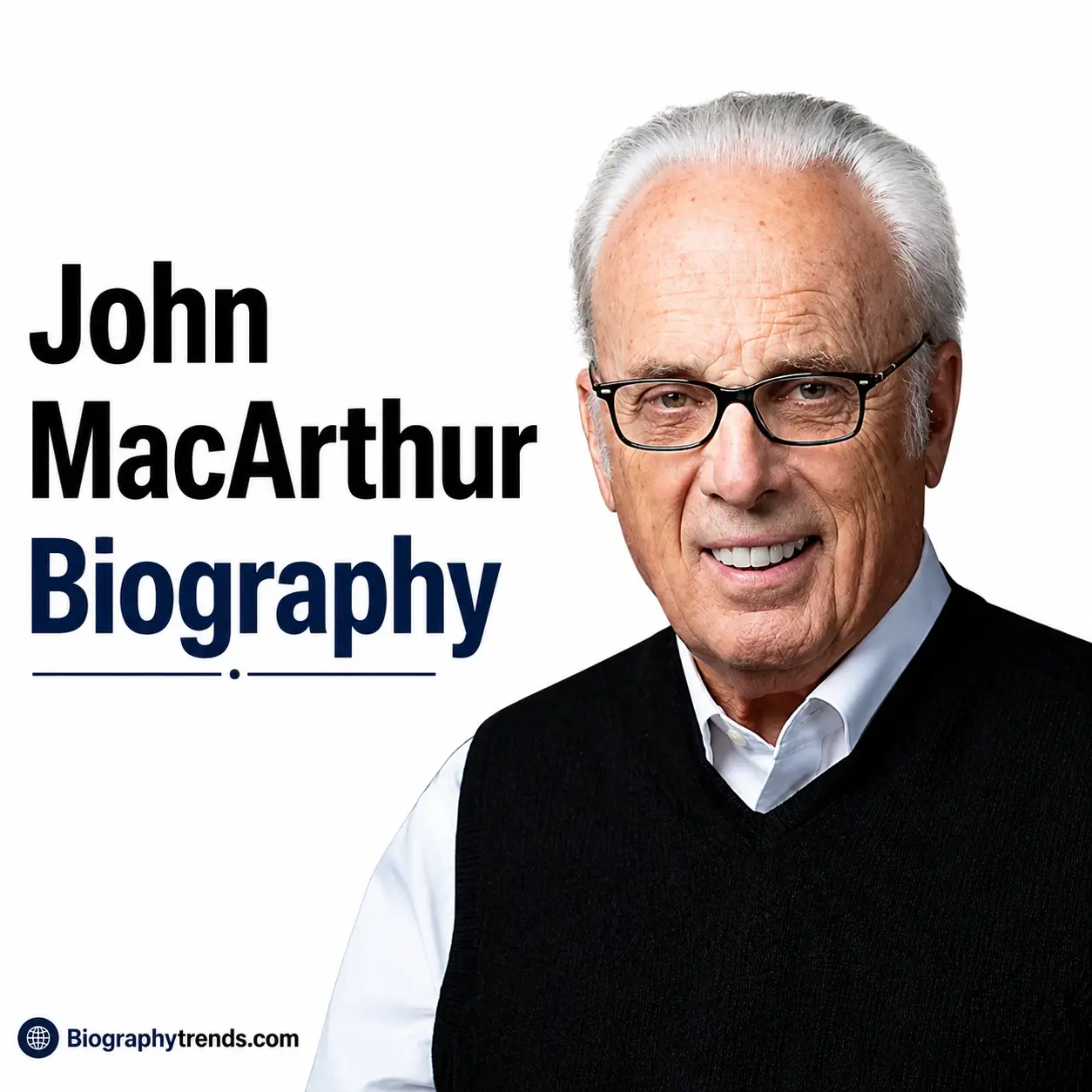
Pastor John MacArthur Fullerton Jr. (June 19, 1939 – July 14, 2025) stands as one of the most influential evangelical pastors, theologians, and Bible teachers in American church history. For over five decades, he served as the pastor-teacher of Grace Community Church in Sun Valley, California, building a ministry that would touch millions of lives across the globe through radio, television, books, and digital media. Known for his unwavering commitment to expository preaching, MacArthur became a towering figure in Reformed Baptist theology, shaping the spiritual landscape of modern evangelicalism through his verse-by-verse teaching of Scripture.
MacArthur’s ministry was characterized by an uncompromising dedication to the authority and sufficiency of God’s Word. His famous motto, “Unleashing God’s truth, one verse at a time,” became the hallmark of Grace to You, the media ministry that broadcast his teachings to every corner of the earth. From a small church of 450 members to a global ministry reaching millions, MacArthur’s life story is a testament to the power of faithful biblical exposition and the transformative impact of a life surrendered to God’s calling.

John MacArthur biography: Early Life and Family Background
Birth and Childhood in Los Angeles
John MacArthur was born on June 19, 1939, in Los Angeles, California, at St. Vincent’s Hospital, which continues to operate today. He entered a family deeply rooted in Christian ministry, with a legacy of faith that would profoundly shape his future calling. His father, Jack MacArthur, was a prominent Baptist radio preacher whose voice reached thousands through the airwaves, while his mother, Irene Dockendorf, provided the nurturing foundation of a Christian home.
The MacArthur family heritage included spiritual leadership spanning generations. John was the grandson of Canadian Anglican minister Harry MacArthur, who passed away in 1950, continuing a lineage of gospel ministry that would find its fullest expression in John’s own life and work. In a 1979 interview, MacArthur revealed that he was “distantly related to General Douglas MacArthur… a fifth cousin,” connecting him to one of America’s most celebrated military families, though his own battlefield would be the pulpit rather than the theater of war.
Growing up in the shadow of his father’s radio ministry, young John was immersed in biblical teaching from his earliest years. The MacArthur household was one where Scripture was honored, prayer was practiced, and Christian service was modeled daily. This environment planted seeds of faith that would germinate throughout his adolescence and eventually blossom into a lifetime of ministry. However, like many preacher’s kids, John would need to navigate the tension between inherited faith and personal conviction, ultimately making the Christian faith his own through a genuine conversion experience.
Athletic Dreams and a Life-Changing Accident
During his teenage years, John MacArthur developed a passion for athletics that would rival his spiritual interests. He was a talented and competitive young man who dreamed of pursuing a career in professional sports. His athletic abilities were significant enough that he attracted attention from scouts and seriously considered a future in professional athletics. This dream seemed within reach for the young Californian, whose competitive drive and physical gifts set him apart from his peers.
However, divine providence would intervene through a devastating car accident when MacArthur was just 18 years old. While attending school far from home, he was involved in a severe collision that left him skidding on the asphalt at high speed, causing significant injuries to his lower body. The accident was a turning point that would forever alter the trajectory of his life. Lying in recovery, far from the familiar comforts of home, MacArthur found himself at a crossroads between two potential futures: the glory of athletic achievement or the calling of pastoral ministry.
The accident forced a period of serious reflection about life’s purpose and God’s plan. During his convalescence, MacArthur surrendered fully to the Lord’s will, abandoning his athletic ambitions in favor of gospel ministry. He would later describe this moment as the point where he “never seriously considered anything but pastoring from that moment forward.” The painful experience became a divine appointment, stripping away worldly ambitions and clarifying his eternal purpose. This surrender was not made begrudgingly but with a sense of divine calling that would sustain him through more than five decades of ministry.
Education and Theological Formation
College Years and Academic Preparation
John MacArthur’s educational journey reflected both his family’s conservative evangelical roots and his own developing theological convictions. He began his higher education at Bob Jones University in Greenville, South Carolina, from 1957 to 1959. Bob Jones, known for its fundamentalist Baptist identity and strict moral code, provided MacArthur with a rigorous foundation in biblical studies and Christian doctrine. The university’s emphasis on biblical inerrancy and separatist fundamentalism would influence MacArthur’s early thinking, though he would later develop a more nuanced approach to theological engagement with culture.
After a gap year, MacArthur enrolled at Los Angeles Pacific College (affiliated with the Free Methodist Church) in 1960. This transition marked a broadening of his educational experience, exposing him to different denominational traditions while maintaining his commitment to evangelical orthodoxy. His time at Los Angeles Pacific College helped prepare him for the next phase of his theological education, equipping him with the academic skills and biblical knowledge necessary for graduate-level seminary training.
Talbot Theological Seminary and Expository Preaching
The most formative period of MacArthur’s education came at Talbot Theological Seminary, the graduate school of the Bible Institute of Los Angeles (BIOLA) located in La Mirada, California. Under the mentorship of Dr. Charles L. Feinberg, a renowned Old Testament scholar and Jewish Christian theologian, MacArthur immersed himself in the intensive study of Scripture. Feinberg’s influence was profound, modeling the kind of scholarly rigor and spiritual devotion that MacArthur would later embody in his own ministry.
At Talbot, MacArthur earned his Master of Divinity degree in 1963 (some sources indicate 1964), graduating with honors. More importantly, he developed his distinctive approach to expository preaching the verse-by-verse, systematic explanation of biblical texts that would become the signature of his pulpit ministry. Under Feinberg’s guidance, MacArthur learned to handle the original languages of Scripture, understand historical and grammatical contexts, and apply biblical truth with precision and power. This method stood in stark contrast to the topical preaching and anecdotal style that characterized much of American evangelicalism in the mid-20th century.
During his seminary years, MacArthur also began to develop his theological framework, embracing the doctrines of grace (Calvinism) that would define his ministry. He studied the great expositors of church history, from John Calvin to Charles Spurgeon, and committed himself to the recovery of expository preaching in the local church. This educational foundation, combined with his natural gifts for communication and leadership, positioned him for a ministry that would influence generations of pastors and Bible teachers.
John MacArthur biography: Marriage and Family Life
Meeting Patricia and Building a Christian Home
In 1963, while completing his theological education, John MacArthur met Patricia Sue Smith, the woman who would become his lifelong partner in ministry and marriage. Their courtship was marked by shared commitment to Christ and a mutual desire to serve God together. They married in the same year, beginning a partnership that would span more than six decades and produce a large, godly family.
Patricia MacArthur proved to be more than a supportive spouse; she was a true partner in ministry who shared John’s passion for God’s Word and His people. While John devoted himself to study and preaching, Patricia created a home environment that reflected their shared values. She managed the demands of being a pastor’s wife with grace and humility, avoiding the spotlight while faithfully serving behind the scenes. Their marriage became a model of Christian partnership, demonstrating the biblical pattern of mutual submission and shared mission.
The MacArthurs established their home in Southern California, where they would raise their family and build their ministry together. Despite the increasing demands of a growing church and expanding media presence, John and Patricia prioritized their relationship and family life. Those who knew them well observed a genuine affection and partnership that withstood the pressures of public ministry. Patricia’s steady presence provided the emotional and spiritual foundation that enabled John to maintain his demanding schedule of preaching, writing, and traveling.
Children, Grandchildren, and Great-Grandchildren
The MacArthur family grew to include four children: Matt, Marcy, Mark, and Melinda. Each child was raised in the nurture and admonition of the Lord, immersed in the biblical teaching that flowed from their father’s study. John took seriously his responsibility as a spiritual leader in his home, applying the same biblical principles he taught from the pulpit to his own family life. Despite his public prominence, those close to the family noted that MacArthur was a present and engaged father who delighted in his children.
As the children grew to adulthood and married, the MacArthur family expanded to include numerous in-laws who shared their Christian commitment. The family home became a gathering place for grandchildren, with a sign reportedly displayed that read, “Grandma and grandpa’s grandchildren spoiled while you wait.” This playful acknowledgment of their delight in grandchildren revealed a softer side of the often-serious theologian. By the time of his death, MacArthur was survived by his wife Patricia, four married children, fifteen grandchildren, and nine great-grandchildren a testament to God’s blessing on their family line.
MacArthur’s commitment to family extended beyond his immediate household to the broader family of God at Grace Community Church. He often taught on the importance of strong families as the foundation of healthy churches, and he modeled this priority in his own life. Despite the global reach of his ministry, he remained deeply connected to his local church family, knowing many members by name and taking personal interest in their spiritual welfare. This integration of family and ministry life demonstrated his belief that the pastor’s home should be a microcosm of the church he leads.
John MacArthur biography: Early Ministry and Call to Grace Community Church
Associate Pastor and Conference Speaker
Following his graduation from Talbot Theological Seminary, John MacArthur served as an associate pastor at the church his father led in Burbank, California, from 1964 to 1966. This apprenticeship under his father’s leadership provided invaluable practical experience in pastoral ministry. He learned the rhythms of church life, the challenges of shepherding God’s people, and the demands of weekly preaching. Working alongside his father also deepened their bond and allowed Jack MacArthur to mentor his son in the realities of ministry that seminary could not fully teach.
During this period, MacArthur also served as a traveling representative for Talbot Theological Seminary, visiting churches and conferences to promote the school and recruit students. This role honed his communication skills and expanded his network within evangelical circles. He preached extensively each month at various churches and conferences, developing his distinctive expository style before diverse audiences. These early preaching opportunities revealed both his gift for clear biblical exposition and his growing frustration with the shallow, entertainment-driven preaching that dominated much of American evangelicalism.
MacArthur later reflected on this period with characteristic candor: “Everywhere I went I saw insipid preaching devoid of biblical content. I saw people who could not live as God intended them to live because they just didn’t know who they were.” This observation fueled his developing passion for expository preaching that would transform lives through the clear communication of biblical truth. He began to formulate a ministry philosophy centered on teaching Christians their identity in Christ, believing that proper self-understanding would produce proper Christian living.
The Call to Grace Community Church
In February 1969, John MacArthur received the call that would define his life’s work: an invitation to become the pastor of Grace Community Church in Sun Valley, California. The church was small, with a membership of approximately 450 people, and carried the financial burden of supporting two widows from previous pastors. When MacArthur arrived to candidate for the position, he brought his developing commitment to expository preaching, delivering a message that lasted one hour and twenty-five minutes far longer than the thirty-minute sermons to which the congregation was accustomed.
His wife Patricia, observing the congregation’s reaction to this unusually long sermon, confidently predicted that he would never be invited back. However, the church leaders recognized something distinctive in MacArthur’s approach. They asked him to stay on one condition: that he would teach them like that every week. This agreement launched a pastoral relationship that would last fifty-six years, transforming a modest congregation into a thriving church of several thousand members with global influence.
The early years at Grace Community Church were marked by remarkable growth. Under MacArthur’s expository teaching, the church doubled in size approximately every two years. This growth necessitated several moves: from the original chapel to the newly built Family Center (gymnasium) in 1971, and finally to the current Worship Center in 1977. Additional buildings for teaching and fellowship were constructed over the years, creating a bustling campus that served as a hub for ministry activity in the San Fernando Valley.
More significant than the numerical growth was the spiritual foundation MacArthur established. He invested heavily in teaching men systematic and biblical theology, meeting with groups weekly to build a core of biblically literate leaders. His philosophy was simple but profound: “If I take care of the depth of my ministry, God will take care of the breadth.” This focus on depth over breadth, substance over style, would characterize his entire ministry and produce lasting fruit that transcended mere attendance figures.
The Grace to You Media Ministry
Origins and Expansion
The media ministry that would make John MacArthur a household name among evangelicals began almost accidentally. From his earliest days at Grace Community Church, MacArthur’s sermons were recorded for the benefit of homebound church members who could not attend services. These recordings captured the clear, authoritative exposition that characterized his preaching, and soon church members began sharing them with friends and family beyond the Sun Valley congregation.
Eventually, these recordings made their way onto Christian radio stations, and the Grace to You ministry was born. The radio program launched in 1977, featuring a daily half-hour broadcast of MacArthur’s verse-by-verse Bible teaching. What began as a local outreach quickly expanded into a nationally syndicated program, eventually airing on hundreds of stations across the United States and around the world. The program’s success was driven by MacArthur’s unique ability to make complex theological concepts accessible to ordinary believers while maintaining biblical accuracy and depth.
Grace to You grew from a small tape ministry into a sophisticated media organization responsible for distributing MacArthur’s books, audio recordings, and daily and weekend radio broadcasts. By the height of its reach, the program aired nearly 1,500 times daily in the English-speaking world and over 500 times in Spanish-speaking countries. The ministry expanded to include television broadcasts, podcast distribution, and a comprehensive website offering free access to MacArthur’s entire sermon archive. Today, as the ministry’s tagline proclaims, “the sun never sets on John MacArthur’s preaching.”
Digital Presence and Global Reach
With the advent of the internet, Grace to You adapted to new technologies while maintaining its commitment to substantive biblical teaching. The ministry’s website became a vast repository of MacArthur’s sermons, available for free download in audio and text formats. This digital archive contains thousands of expository messages covering virtually every book of the Bible, making MacArthur’s teaching accessible to anyone with an internet connection, regardless of geographic location or economic means.
The Grace to You YouTube channel, podcast feeds, and social media presence extended the ministry’s reach to younger generations who might never listen to traditional radio. Despite his traditional approach to preaching, MacArthur embraced these new media as tools for disseminating God’s Word more widely. The ministry’s adaptability ensured that his voice continued to influence believers long after many of his contemporaries had faded from public memory.
In 2017, responding to growing requests from supporters, the John MacArthur Charitable Trust was established to provide support for the ongoing and expanding work of the MacArthur family of ministries. This organizational development ensured the sustainability of Grace to You and related ministries, creating a structure for continued gospel impact beyond MacArthur’s lifetime. The trust represented a strategic approach to stewardship, recognizing that the resources God had provided through decades of ministry should be carefully managed for maximum eternal impact.
The Master’s University and Seminary
Transforming a Struggling Bible College
In 1985, John MacArthur’s commitment to Christian education led him to accept the presidency of a struggling Bible college in Santa Clarita, California. The institution was in decline, facing the kinds of challenges that had shuttered many similar schools during the latter half of the 20th century. MacArthur saw an opportunity to create an educational institution that would embody the same biblical convictions that characterized his preaching ministry.
He renamed the school The Master’s College (now The Master’s University) and immediately began implementing changes that would transform its academic culture and spiritual atmosphere. The curriculum was overhauled to emphasize biblical integration in every discipline, faculty were hired who shared MacArthur’s commitment to inerrancy and expository teaching, and the student body was cultivated to produce graduates who would serve Christ faithfully in every vocation. Under his leadership, The Master’s University became known for its rigorous academics and unwavering biblical worldview.
The following year, 1986, MacArthur founded The Master’s Seminary (TMS) as a graduate institution specifically designed to train men for pastoral ministry. The seminary’s distinctives reflected MacArthur’s own ministry philosophy: expository preaching, biblical counseling, elder-led church government, and theologically rich pastoral training. TMS quickly gained a reputation as one of the premier institutions for training expositors, attracting students from around the world who desired to preach God’s Word with the same clarity and conviction they heard in MacArthur’s pulpit.
Chancellor Emeritus and Educational Legacy
MacArthur served as president of The Master’s College and president of The Master’s Seminary until transitioning to the role of chancellor emeritus in later years. Even as his health declined, he remained deeply committed to these institutions, viewing them as essential extensions of his pastoral ministry. The seminary, in particular, represented his investment in the next generation of church leaders, ensuring that the principles of expository preaching and biblical church leadership would continue long after his death.
The impact of MacArthur’s educational vision extends far beyond the graduates of The Master’s University and Seminary. His books on pastoral ministry, including “Rediscovering Pastoral Ministry” and “The Book on Leadership,” have shaped the thinking of countless pastors who never attended his institutions. The annual Shepherd’s Conference, hosted by Grace Community Church, became a gathering point for thousands of pastors who received encouragement, instruction, and fellowship centered on the priority of biblical preaching. Through these educational and conference ministries, MacArthur multiplied his influence exponentially, creating a movement of expository preachers that continues to shape evangelical Christianity.
Literary Ministry and Published Works
The MacArthur Study Bible
Perhaps no single publication better represents John MacArthur’s ministry than The MacArthur Study Bible. First published in 1997, this massive volume contains nearly 25,000 study notes designed to help readers understand what Scripture says and means. The notes reflect MacArthur’s grammatical-historical hermeneutic, his high view of Scripture, and his commitment to making complex theological concepts accessible to ordinary believers. The study Bible has sold over one million copies and received a Gold Medallion Book Award, becoming a staple resource for serious Bible students around the world.
The MacArthur Study Bible was later made available in several English translations, including the New King James Version, the New American Standard Bible, and the English Standard Version. International editions in Spanish, Russian, German, French, Portuguese, Italian, Arabic, and Chinese extended its reach to believers across linguistic and cultural boundaries. In 2021, MacArthur collaborated with a team from The Master’s Seminary and the Lockman Foundation to produce the Legacy Standard Bible (LSB), an update of the 1995 edition of the New American Standard Bible, further cementing his commitment to biblical accuracy and accessibility.
The New Testament Commentary Series
MacArthur’s most ambitious scholarly project was The MacArthur New Testament Commentary series, a 34-volume set covering every verse of the New Testament. The first volume, on Hebrews, was released in 1983, and the final volume was completed in 2015, representing over three decades of intensive study and writing. These commentaries translated MacArthur’s expository sermons into written form, preserving his verse-by-verse teaching for future generations of pastors and Bible students.
The commentary series has sold over 2.8 million copies, an astonishing figure for a technical biblical commentary set. Each volume reflects MacArthur’s careful attention to grammatical detail, historical context, and theological precision, combined with practical application for Christian living. The commentaries are cross-referenced to his sermon series, allowing readers to access both the written and spoken forms of his exposition. For many pastors, these commentaries became the first resource they consulted when preparing messages, serving as a model of how to move from biblical text to theological truth to practical application.
Landmark Books and Theological Controversies
Throughout his career, MacArthur authored or edited more than 150 books covering theology, biblical interpretation, Christian living, and cultural commentary. Several of these works sparked significant controversy within evangelicalism, demonstrating MacArthur’s willingness to address divisive issues when he believed biblical truth was at stake.
“The Gospel According to Jesus” (1988) became MacArthur’s first blockbuster bestseller and launched him into worldwide acclaim. The book made a bold case for “Lordship Salvation,” arguing that genuine saving faith necessarily produces submission to Christ’s lordship. This position challenged the “easy believism” that MacArthur saw permeating evangelicalism, where a prayer of confession without life transformation was treated as sufficient for salvation. The book reached the top ten list of the Bookstore Journal, a rare achievement for a doctrinal study, and sparked debates that continue in evangelical theology today.
“Charismatic Chaos” (1992) addressed MacArthur’s cessationist position, arguing that the miraculous “sign gifts” of the Spirit (tongues, prophecy, healing) ceased with the apostolic age. This book placed him in direct opposition to the growing charismatic and Pentecostal movements, making him a polarizing figure in broader evangelicalism. He later expanded this critique through the “Strange Fire” conference and book (2013), which accused charismatic practices of blasphemy against the Holy Spirit.
“Ashamed of the Gospel” (1993) attacked the pragmatism that MacArthur believed was destroying the church’s commitment to biblical methodology. He criticized the adoption of entertainment techniques, pop psychology, and business principles in place of faithful preaching and spiritual leadership. This book resonated with pastors who were struggling to maintain biblical fidelity amid pressure to grow churches through worldly means.
Other significant works included “Our Sufficiency in Christ,” “The Truth War,” “The Vanishing Conscience,” “Slave,” “Twelve Ordinary Men,” “The Jesus You Can’t Ignore,” “The War on Children,” and “Biblical Doctrine” (a systematic theology co-authored with Master’s Seminary faculty). Each book reflected MacArthur’s commitment to addressing contemporary issues through the lens of Scripture, often challenging evangelical consensus when he believed it had drifted from biblical truth.
Theological Distinctives and Controversies
Calvinism and the Doctrines of Grace
John MacArthur was a staunch proponent of Calvinistic theology, embracing the five points of Calvinism (often summarized by the acronym TULIP: Total Depravity, Unconditional Election, Limited Atonement, Irresistible Grace, and Perseverance of the Saints). His commitment to these doctrines of grace shaped every aspect of his ministry, from his preaching to his counseling to his church leadership. He viewed Calvinism not as a human philosophical system but as the natural teaching of Scripture when read without the interference of human autonomy.
MacArthur’s Calvinism was not merely academic but practical, producing a deep confidence in God’s sovereignty that sustained him through ministry challenges. He taught that God’s sovereign control over all things, including salvation, provided the foundation for evangelistic zeal rather than undermining it. This theological framework also informed his approach to church growth, counseling, and pastoral care, as he consistently pointed people to God’s grace rather than human effort.
Cessationism and the Strange Fire Controversy
One of MacArthur’s most controversial positions was his cessationism the belief that the miraculous sign gifts of the Holy Spirit (such as speaking in tongues, prophecy, and miraculous healing) were given for the authentication of the apostles and ceased with the close of the apostolic age. This placed him in direct opposition to the charismatic movement, which had become a dominant force in global Christianity by the late 20th century.
The controversy reached its peak with the “Strange Fire” conference hosted by Grace Community Church in 2013. MacArthur accused charismatic and Pentecostal groups of blasphemy, arguing that their claims of ongoing revelation and miraculous power were unbiblical and dangerous. The conference and accompanying book sparked fierce debate within evangelicalism, with charismatic leaders accusing MacArthur of quenching the Spirit while cessationist supporters praised his courage in defending biblical boundaries. This controversy exemplified MacArthur’s willingness to take unpopular stands when he believed Scripture demanded it, even at the cost of alienating potential allies.
Complementarianism and Gender Roles
MacArthur held firmly to complementarian theology, believing that God created men and women equal in value but distinct in role. He taught that the office of pastor-teacher was reserved for men, and he opposed the ordination of women to pastoral ministry. This position put him at odds with egalitarian evangelicals and the broader feminist movement, but he maintained it as a matter of biblical fidelity rather than cultural preference.
His teaching on marriage and family, particularly his exposition of Titus 2 and Ephesians 5, influenced many women at Grace Community Church to prioritize homemaking over career ambitions. While critics accused him of promoting patriarchal oppression, MacArthur argued that he was simply teaching what Scripture revealed about God’s design for family life. This complementarian commitment extended to his church’s leadership structure, where a plurality of male elders governed the congregation according to biblical principles.
Lordship Salvation and the Gospel Debate
MacArthur’s advocacy for “Lordship Salvation” placed him at the center of one of the most significant theological debates in late 20th-century evangelicalism. He argued that saving faith necessarily includes submission to Christ’s lordship, repentance from sin, and a commitment to discipleship. This position challenged the “free grace” theology promoted by some dispensationalists, who feared that adding discipleship requirements to the gospel message compromised salvation by grace alone through faith alone.
The debate raged through books, conferences, and journal articles for years, with MacArthur defending his position through careful exegesis of biblical texts. He argued that the gospel of the apostles always included a call to repentance and submission to Christ, and that separating “savior” from “lord” created a false dichotomy. While the controversy never fully resolved, MacArthur’s arguments influenced a generation of pastors to preach a more robust, transformative gospel message.
Young Earth Creationism
MacArthur was a committed Young Earth creationist, believing that God created the universe in six literal 24-hour days approximately 6,000 to 10,000 years ago. He rejected theistic evolution and all forms of old-earth creationism, viewing them as compromises with naturalistic science that undermined the authority of Scripture. His creationism was not merely a scientific position but a hermeneutical one, rooted in his commitment to the plain meaning of biblical texts.
He taught and wrote extensively on creation, arguing that the early chapters of Genesis were historical narrative rather than myth or allegory. This position aligned him with organizations like Answers in Genesis and placed him in opposition to evangelical scholars who embraced evolutionary creationism. For MacArthur, the creation debate was ultimately about the authority and trustworthiness of Scripture, and he refused to accommodate what he saw as secular scientific theories that contradicted the biblical account.
Ministry Philosophy and Church Leadership
Expository Preaching as the Center
At the heart of John MacArthur’s ministry philosophy was an unwavering commitment to expository preaching the systematic, verse-by-verse explanation of biblical texts. He believed that the pastor’s primary responsibility was to explain what God had said in Scripture, allowing the text to set the agenda rather than using the Bible to support preconceived ideas or contemporary relevance. This method stood in contrast to the topical preaching that dominated much of American evangelicalism, where pastors selected subjects based on perceived needs and found biblical texts to support their points.
MacArthur’s expository approach meant that he preached through entire books of the Bible sequentially, regardless of how controversial or difficult the passages might be. Over his 56 years at Grace Community Church, he completed a 42-year sermon series covering the entire New Testament, along with extensive exposition of Old Testament books including Genesis 1-11, 1 Samuel, Psalms, Proverbs, Isaiah, Daniel, Jonah, Habakkuk, and Zechariah. This comprehensive coverage ensured that his congregation received the “whole counsel of God” rather than a selective diet of favorite texts.
His preaching style was characterized by meticulous attention to grammatical detail, careful explanation of historical and cultural context, clear theological formulation, and practical application. While some critics found his sermons overly academic or lacking in emotional appeal, MacArthur believed that the power of preaching lay in the Word itself rather than in the preacher’s personality or rhetorical skill. He often said that his job was to make the text clear and let the Holy Spirit apply it to hearts, resisting the pressure to manufacture emotional responses through storytelling or manipulation.
Elder-Led Church Government
Early in his ministry at Grace Community Church, MacArthur implemented an elder-led form of church government based on his study of the New Testament. He taught that the biblical pattern involved a plurality of godly men sharing leadership responsibility rather than a single pastor holding autocratic power. In April 1972, the elder board made a significant change to their decision-making process, moving from majority voting to seeking unanimity in major decisions.
This unanimity principle was controversial, with critics predicting that it would lead to gridlock and division. However, MacArthur and the elders believed that seeking the mind of Christ through prayer and deliberation would produce better decisions than simple majority rule. The system required patience, humility, and a willingness to delay decisions until consensus emerged, but it also prevented the factionalism that often plagued churches with competing interest groups. Over five decades, this elder-led, consensus-seeking government proved remarkably stable, providing continuity and spiritual maturity to the church’s leadership.
Church Discipline and Biblical Counseling
In 1975, MacArthur began teaching through 1 Corinthians, including the apostle Paul’s instructions on church discipline for unrepentant sin. At a time when very few churches practiced formal discipline, Grace Community Church became a notable example of a congregation that took sin seriously while pursuing restoration. MacArthur taught that loving confrontation of persistent sin was not judgmentalism but biblical obedience, motivated by concern for the sinner’s spiritual welfare and the church’s holiness.
This commitment to church discipline was paired with a robust biblical counseling ministry. MacArthur rejected the integration of secular psychology into Christian counseling, arguing that Scripture provided sufficient resources for addressing every spiritual and emotional need. He co-authored “Introduction to Biblical Counseling” with Wayne Mack in 1994, setting forth the precedence for the pastor’s counseling ministry based on the sufficiency of Scripture. The Master’s College and Seminary became centers for training biblical counselors, producing graduates who established counseling ministries in churches across the country and around the world.
The COVID-19 Controversy and Final Years
Defiance of Government Restrictions
The final major controversy of John MacArthur’s life came during the COVID-19 pandemic of 2020-2021. As California state and local governments imposed restrictions on public gatherings, including church services, MacArthur made the decision to keep Grace Community Church open for in-person worship. He argued that the government’s restrictions on church assembly violated the First Amendment and, more importantly, the Lordship of Christ over His church.
MacArthur’s stance was not reckless disregard for public health but a principled conviction that Christ alone is the head of the church, and no earthly government has authority to prohibit the gathering of God’s people for worship. He led Grace Community Church to defy the public health orders, facing legal threats, fines, and intense media scrutiny. The church endured a prolonged legal battle, ultimately achieving a resounding victory and financial settlement that affirmed their constitutional right to worship.
Throughout this controversy, MacArthur’s leadership was marked by calm conviction rather than bluster. He taught that pastors have a duty to obey God rather than men when the two are in conflict, and he was willing to accept the consequences of that obedience. For many observers, his stand during the COVID-19 crisis represented the culmination of a lifetime of biblical conviction, demonstrating that his theological commitments were not merely theoretical but practical and costly.
Health Decline and Final Ministry
In January 2023, MacArthur was diagnosed with atrial fibrillation and underwent surgery to implant cardiac stents. Additional procedures followed in July 2023, including catheter insertion to treat the heart condition. These health challenges forced him to step back from public ministry for several weeks, a significant interruption for a man who had maintained a rigorous preaching schedule for over five decades.
The second half of 2024 brought further medical challenges, including three additional surgeries: an aorta replacement and a procedure to address fluid buildup in his lungs. After several months away from the pulpit, he briefly returned to limited public ministry in November 2024, preaching at a Thanksgiving service that would be among his final public appearances. On January 6, 2025, Grace Community Church announced that MacArthur’s recovery had been slower than expected, and he had been hospitalized for two weeks with “occasional setbacks affecting his heart, lungs, and kidneys.”
Despite these health challenges, MacArthur’s mind remained sharp and his faith steadfast. In a video statement filmed in March 2025 for the annual Shepherd’s Conference, he described his final months as “the last lap… the short end of the candle,” expressing gratitude to God for everything He had allowed him to be part of. His focus remained on God’s Word and God’s glory, even as his physical strength declined.
Homegoing and Memorial
Final Days and Peaceful Departure
On July 13, 2025, Grace Community Church associate pastor Tom Patton announced during the Sunday service that MacArthur had contracted pneumonia and was not expected to recover. He had been admitted to a hospital in Santa Clarita, California, and Patton told the congregation that their beloved pastor “may be in the presence of the Lord soon.” The church gathered in prayer, preparing for the inevitable while cherishing the final hours of his earthly life.
John MacArthur passed into the presence of his Savior on the evening of July 14, 2025, at the age of 86. His death was peaceful, marked by the same faith that had characterized his entire ministry. In his final moments, he quoted 1 Corinthians 15:55: “O death, where is your victory? O death, where is your sting?” Between gasps for air, he testified, “I feel no sting. I feel no fear.” This triumphant witness to the hope of the gospel provided a fitting conclusion to a life dedicated to proclaiming that very hope to others.
The news of his death reverberated throughout the evangelical world, prompting an outpouring of tributes from Christian leaders, institutions, and ordinary believers whose lives had been transformed by his teaching. Dr. Mark Jobe, president of Moody Bible Institute, reflected: “Pastor John MacArthur was a man of unwavering conviction and profound dedication to the clear and faithful exposition of God’s Word.” Phil Johnson, executive director of Grace to You, noted that MacArthur would be hard to replace: “When Spurgeon died, there wasn’t another Spurgeon. When Martyn Lloyd-Jones died, there was no other Martyn Lloyd-Jones.”
Memorial Service and Lasting Tributes
MacArthur’s memorial service was held on August 23, 2025, at Grace Community Church, the congregation he had shepherded for 56 years. The service featured reflections from some of the most prominent figures in evangelical Christianity, including John Piper, Alistair Begg, Joni Eareckson Tada, Sinclair Ferguson, and Keith and Kristen Getty. These tributes celebrated not merely MacArthur’s accomplishments but his character his humility, his courage, his love for Christ, and his devotion to God’s Word.
John Piper’s reflections were particularly moving, as he described MacArthur’s influence on his own ministry and on generations of pastors who learned from his example. The service was a celebration of a life well-lived and a race well-run, emphasizing that MacArthur’s legacy was not his own brilliance but his faithfulness to proclaim the brilliance of Christ. The gathered leaders exhorted the church to imitate MacArthur’s faith, following the biblical command to “remember those who led you, who spoke the word of God to you; and considering the result of their conduct, imitate their faith” (Hebrews 13:7).
Several months after his homegoing, MacArthur’s closest friends and ministry partners including Mark Dever, Ligon Duncan, Al Mohler, and John Piper gathered at the 2026 Shepherd’s Conference to remember him and reflect on his ministry. Moderated by Phil Johnson, their conversation provided insight into the private man behind the public ministry, revealing his humor, his warmth, and his deep love for his family and friends. These posthumous tributes ensured that MacArthur’s influence would continue to shape evangelicalism even after his voice had fallen silent.
Legacy and Enduring Influence
The Expository Preaching Movement
John MacArthur’s most significant legacy may be the recovery of expository preaching in evangelical churches. At a time when American Christianity was increasingly dominated by topical messages, self-help principles, and entertainment-driven worship, MacArthur modeled a different approach one that submitted to the authority of Scripture and trusted the text to produce transformation. Through his preaching, his books, his seminary, and his conferences, he trained thousands of pastors to adopt this method, creating a ripple effect that extended far beyond his own congregation.
The Shepherd’s Conference, which he founded and hosted annually at Grace Community Church, became a gathering point for pastors committed to biblical exposition. Over the years, thousands of church leaders from around the world attended these conferences, receiving encouragement, instruction, and fellowship centered on the priority of God’s Word. Many of these pastors went on to transform their own churches, creating a movement of biblical preaching that continues to shape evangelicalism today.
Literary and Theological Impact
With more than 150 books and a 34-volume New Testament commentary series, MacArthur’s written legacy is staggering in its scope and influence. The MacArthur Study Bible remains one of the best-selling study Bibles in Christian publishing, introducing millions of readers to the tools of careful biblical interpretation. His commentaries continue to serve as standard references for pastors preparing messages, and his books on Christian living provide guidance for believers seeking to apply biblical truth to everyday challenges.
Theologically, MacArthur’s advocacy for Lordship Salvation, cessationism, complementarianism, and Young Earth creationism influenced the development of conservative evangelical theology in the late 20th and early 21st centuries. While not all evangelicals agreed with his positions, his clear articulation of these views forced the broader movement to engage with biblical texts that might otherwise have been ignored. His willingness to address controversial topics with biblical clarity, even at personal and professional cost, modeled a kind of theological courage that remains rare in contemporary Christianity.
Family and Personal Example
Beyond his public ministry, MacArthur’s legacy includes the example of a life lived with integrity across multiple decades. In an era of frequent moral failures among high-profile Christian leaders, MacArthur’s personal life remained above reproach. His marriage to Patricia survived the pressures of public ministry, his children grew to embrace the faith he taught, and his grandchildren and great-grandchildren represented the multiplication of godly influence across generations.
Those who knew him personally consistently described a man who was humble, approachable, and genuinely interested in others despite his global prominence. He was known for his dry sense of humor, his love of sports (particularly baseball), and his devotion to his family. This personal integrity gave credibility to his public teaching, demonstrating that the biblical principles he proclaimed actually produced the character they promised.
READ ALSO:
- Thomas Kinkade Biography: Painter of Light, Life, Death, Art & Legacy 2026
- Atty. Michael Poa Biography: Age, Career, Education, Wife & Net Worth 2026
- Tom Sachs Biography: Sculptor, Nike & Space Program 2026
- Bev Doolittle Biography: Age, Career & Camouflage Art 2026
- Paul Cézanne Biography: Age, Life, Art & $300 million Legacy
Global Gospel Impact
The ultimate measure of John MacArthur’s life is not found in books sold, conferences attended, or broadcasts aired, but in the countless individuals who came to saving faith in Jesus Christ through his ministry. From the baptisms at Grace Community Church to the letters received by Grace to You from around the world, the evidence of transformed lives testifies to the power of God’s Word faithfully proclaimed. Missionaries trained at The Master’s Seminary serve in over 100 countries, extending MacArthur’s influence to the ends of the earth.
As MacArthur himself often said, his ministry was “beyond anything he could have ever planned or schemed to create on his own.” He focused on the depth of biblical study and left the breadth of impact to God. This philosophy of ministry trusting God to multiply faithful teaching rather than manipulating methods to produce growth offers a model for pastors in every generation. His life demonstrated that when God’s Word is clearly taught, God’s Spirit will powerfully work, producing results that transcend human ability or marketing strategy.
Conclusion: John MacArthur biography
John MacArthur’s biography is the story of a man who discovered his calling, surrendered his ambitions, and remained faithful for over five decades. From the young athlete lying on an asphalt road after a devastating accident to the elderly pastor quoting Scripture in his final breath, his life traced the arc of divine grace working through human faithfulness. He was not a perfect man he would have been the first to acknowledge his flaws and dependence on God’s mercy but he was a faithful man, and in the economy of God’s kingdom, faithfulness is the currency that matters most.
At 86 years old, having served one church for 56 years, preached through the entire New Testament, authored more than 150 books, trained thousands of pastors, and reached millions through media, John MacArthur could say with the apostle Paul: “I have fought the good fight, I have finished the race, I have kept the faith. Henceforth there is laid up for me the crown of righteousness, which the Lord, the righteous judge, will award to me on that day, and not only to me but also to all who have loved his appearing” (2 Timothy 4:7-8).
For those who knew him, sat under his teaching, or were influenced by his writing, the challenge now is to carry forward the legacy of biblical fidelity he modeled. In a world of shifting values and compromising convictions, John MacArthur stood as a reminder that God’s Word is sufficient, God’s grace is powerful, and God’s servants are called to faithfulness regardless of cost or consequence. His voice has fallen silent, but the truth he proclaimed continues to speak, and the lives he touched continue to bear fruit for the glory of God and the advancement of Christ’s kingdom.
The life of John MacArthur teaches us that one person, committed to God’s Word and empowered by God’s Spirit, can make an eternal difference. From a small church in Sun Valley, California, to the farthest reaches of the globe, his ministry demonstrated that when we take care of the depth of our walk with God, He will take care of the breadth of our impact for His glory. In the final analysis, that is the biography that matters not the story of a man’s achievements, but the story of God’s faithfulness working through a servant who simply refused to compromise the truth.