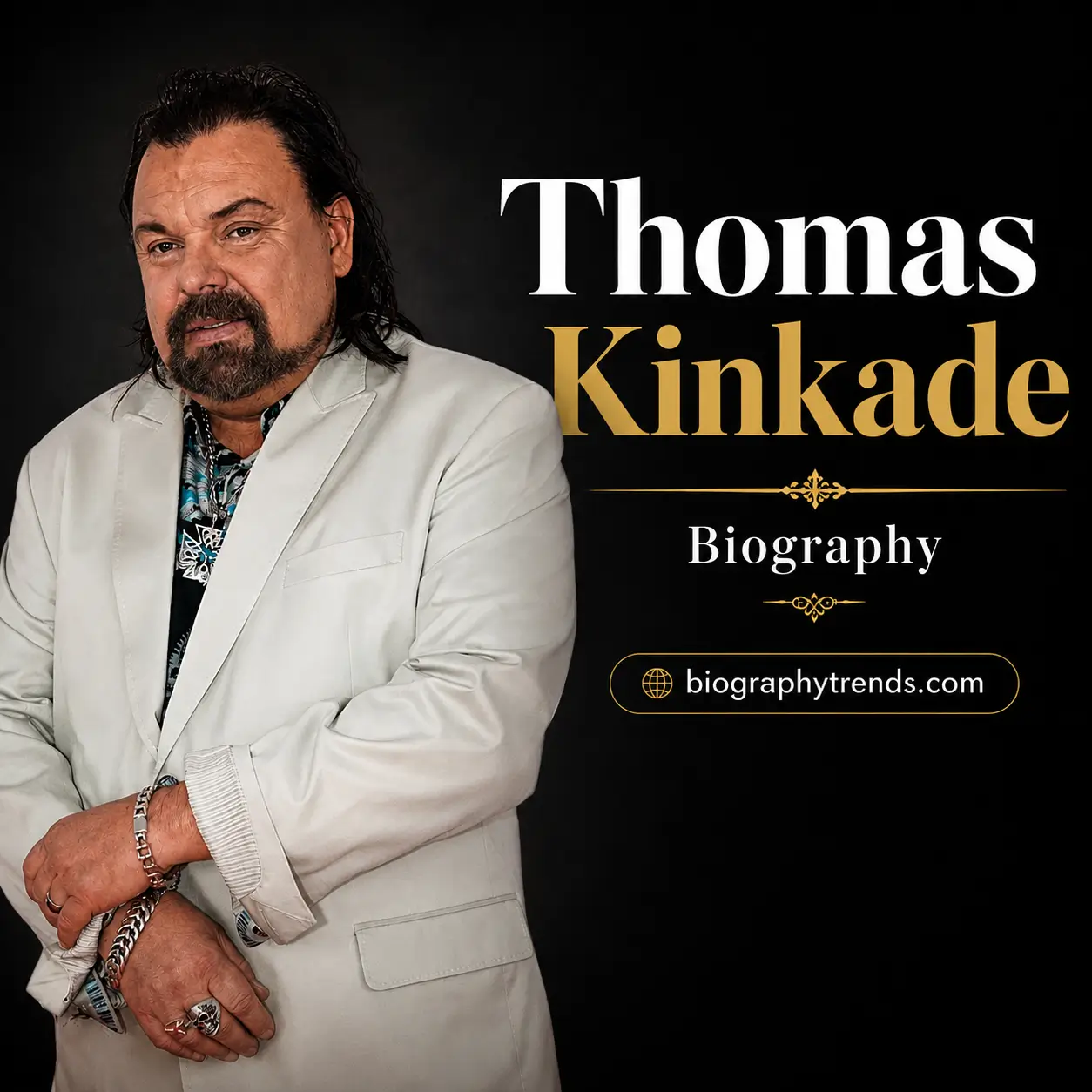
Who Is Thomas Kinkade?
Searching for Thomas Kinkade Biography, was an American painter best known for creating warm, nostalgic landscapes filled with cozy cottages, glowing windows, peaceful gardens, and picturesque villages. Because of his signature style and his emphasis on light, he became widely known as the “Painter of Light,” a title he trademarked during his career.
Unlike many fine artists whose works are displayed only in museums or private collections, Kinkade focused on making his paintings accessible to everyday people. His images were reproduced as prints, calendars, puzzles, greeting cards, home décor, and other licensed products, allowing millions of households to own versions of his artwork.
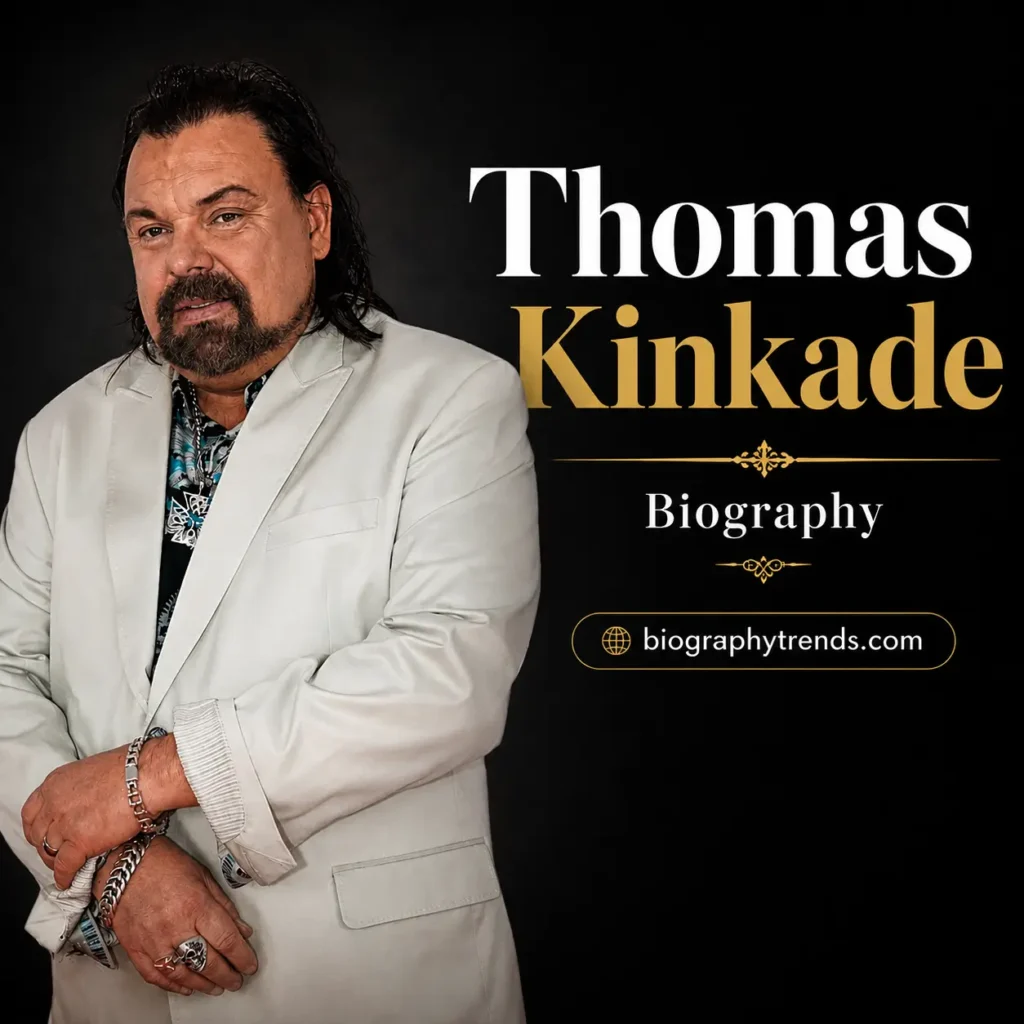
Early Life and Poverty in Placerville (1958–1976)
Birth and Family Background
Thomas Kinkade was born on January 19, 1958, in Sacramento County, California. He grew up in the small town of Placerville, a former Gold Rush settlement tucked into the Sierra Nevada foothills. His childhood was marked by poverty and hardship. His parents divorced when he was young, and Thomas was raised by a single mother who struggled to keep food on the table. The family was so poor that they often could not afford heating or lighting in their home. These early experiences of deprivation shaped Kinkade’s artistic vision in profound ways: his obsession with warm, glowing light, his fixation on cozy domestic spaces, and his fierce determination to achieve financial security through his art.
The poverty Kinkade experienced was not simply about lacking nice things. It was a daily, visceral reality that burned itself into his memory. Cold rooms without heat. Dark evenings without light. The constant, gnawing anxiety about money. When he later painted cottages glowing with golden warmth, lanterns casting pools of light on snowy paths, and windows shining with domestic comfort, he was painting the world he wished he had grown up in. The light in his paintings was not just aesthetic; it was psychological, a way of compensating for the darkness of his early years.
The Singlewide Trailer Myth
Kinkade himself helped build the mythology of his impoverished childhood. In some accounts, he described growing up in a rundown singlewide trailer in a dilapidated trailer park on the outskirts of town. This image of extreme deprivation became part of his personal narrative, the foundation story of a self made artist who rose from nothing to achieve the American Dream. However, photographs from his childhood show a conventional house, not a trailer. The gap between Kinkade’s account and the photographic evidence reveals something essential about who he was: he was a storyteller as much as a painter, and he understood the power of a compelling narrative to shape how people saw him.
This tendency to embellish, to heighten, to dramatize ran through his entire career. Kinkade did not merely paint cottages; he painted the idea of cottage, the dream of home, the fantasy of warmth and safety. And he did not merely describe his childhood; he performed it, turning his biography into a narrative of redemption through art that resonated with millions of Americans who shared his longing for comfort and security.
Early Artistic Talent
Despite the hardships of his upbringing, or perhaps because of them, Kinkade showed artistic talent from an early age. He was drawn to drawing and painting, finding in art a refuge from the difficulties of his home life. The natural beauty of the Sierra Nevada foothills, with their forests, streams, and mountain vistas, provided visual inspiration. But it was the interior world of imagination, the world of cozy cottages and glowing windows, that would become his true subject.
Kinkade graduated from El Dorado High School in Placerville in 1976, a young man with artistic ambitions and no clear path to achieving them. His mother had raised him in the evangelical Christian faith, and this religious background would later become a crucial element of his public persona. But at this stage, Kinkade was simply a talented teenager from a poor family who dreamed of becoming an artist.
Education at Berkeley and ArtCenter College of Design (1976–1980)
University of California, Berkeley
In 1976, Thomas Kinkade enrolled at the University of California, Berkeley, one of the most prestigious public universities in the United States. Berkeley in the 1970s was a hotbed of political activism, countercultural experimentation, and intellectual ferment. It was, in many ways, the opposite of the world Kinkade would later create in his paintings. The Berkeley of this era was defined by radical politics, avant garde art, and a rejection of the very values of home, family, and tradition that Kinkade would celebrate.
Kinkade spent two years at Berkeley completing general education requirements. The experience exposed him to a wider world of ideas and possibilities, but it also confirmed his sense of being an outsider. He was not a radical. He was not interested in deconstructing American values. He wanted to affirm them, to celebrate them, to wrap them in a warm, glowing light that made them irresistible. This fundamental difference in orientation would eventually push him away from the contemporary art world and toward a direct relationship with the American public.
The ArtCenter College of Design
After two years at Berkeley, Kinkade transferred to the ArtCenter College of Design in Pasadena, one of the most respected art schools in the country. The ArtCenter was known for its rigorous technical training and its emphasis on commercial application. Unlike Berkeley’s countercultural atmosphere, the ArtCenter was oriented toward professional success, toward the marriage of artistic skill and market demand.
At the ArtCenter, Kinkade honed his technical abilities, developing the precise, detailed style that would become his trademark. He studied the techniques of the Old Masters, learning how to create depth, atmosphere, and luminosity in paint. He also absorbed the principles of commercial art, understanding that an artist could achieve success not merely through gallery exhibitions and critical acclaim but through direct engagement with the public.
The Mentor Glenn Wessels and Christmas Cottage (1980–1989)
Meeting Glenn Wessels
One of the most significant relationships of Kinkade’s early career was with Glenn Wessels, an artist and teacher who became his mentor. Wessels recognized Kinkade’s talent and encouraged him to pursue his artistic ambitions. He advised Kinkade to attend Berkeley, and he continued to guide and support him throughout his formative years. The relationship between Kinkade and Wessels became the subject of the 2008 semi biographical film “Christmas Cottage,” which dramatized a pivotal moment in Kinkade’s development as an artist.
Wessels represented a link to an older tradition of American art, a tradition that valued technical skill, narrative clarity, and emotional directness. He was not interested in the avant garde experiments that dominated the contemporary art world. He believed that art should communicate, that it should touch the heart as well as please the eye. These values, passed from Wessels to Kinkade, would become the foundation of the Painter of Light’s entire enterprise.
The Road Trip and Early Career
After completing his education, Kinkade embarked on a road trip with his friend and fellow artist James Gurney. The two young men traveled across the United States, painting landscapes and selling their work to support themselves. This period of wandering was a romantic apprenticeship, a time of freedom and exploration before the demands of career and family would constrain Kinkade’s movements.
During this period, Kinkade painted in a relatively conventional plein air style, creating landscapes that, while skillful, did not yet possess the distinctive glowing quality that would make him famous. He was searching for his voice, his subject, his unique contribution to the world of art. The answer would come not from the landscapes he painted on the road but from the inner landscapes of memory and desire.
The Birth of the Painter of Light (1989–1994)
Creating the Persona
In the late 1980s, Thomas Kinkade made a series of decisions that would transform him from a talented but obscure landscape painter into one of the most successful artists in American history. The first and most important of these decisions was the creation of his public persona: the Painter of Light. This phrase, which Kinkade trademarked, became the foundation of his brand identity. It suggested not merely a technical skill, the ability to depict light convincingly in paint, but a spiritual mission, a calling to bring light into the darkness of the world.
The Painter of Light persona was brilliantly conceived. It connected Kinkade’s art to a deep religious tradition, the tradition of Christ as the light of the world, of divine illumination dispelling spiritual darkness. It also resonated with the American public’s desire for optimism, for beauty, for art that affirmed rather than challenged their values. In an era when the contemporary art world was dominated by conceptualism, irony, and political critique, Kinkade offered something radically different: sincerity, sentiment, and spiritual uplift.
The Signature Style
Kinkade’s signature painting style emerged during this period. It was characterized by several distinctive elements: a glowing, diffused light that seemed to emanate from within the scene rather than from any identifiable source; idyllic pastoral subjects featuring cottages, gardens, churches, and small towns; a romanticized vision of nature that excluded any hint of decay, pollution, or modernity; and a meticulous attention to detail that invited prolonged, immersive viewing.
The technical foundation of this style was Kinkade’s mastery of chiaroscuro, the Renaissance technique of modeling form through the contrast of light and shadow. But Kinkade pushed this technique to extremes, creating scenes in which the light was not merely descriptive but transformative, turning ordinary cottages into visions of paradise and snowy landscapes into realms of ethereal beauty.
The Religious Dimension
Kinkade’s evangelical Christian faith was central to his artistic identity. He described his work as a form of ministry, a way of sharing God’s love with the world through beauty. He often included religious symbols in his paintings: hidden crosses, biblical references, church steeples pointing toward heaven. These elements were not merely decorative; they were expressions of Kinkade’s belief that art could be a vehicle for spiritual transformation.
This religious dimension gave Kinkade’s work a depth and resonance that transcended its commercial appeal. For millions of Christian viewers, his paintings were not merely pretty pictures but visual prayers, reminders of God’s presence in the world. The light that suffused his scenes was not merely physical but metaphysical, a manifestation of divine grace.
Building the Thomas Kinkade Empire (1994–2000)
The Thomas Kinkade Company
In 1994, Kinkade formalized his business operations by creating the Thomas Kinkade Company, which would become the vehicle for his extraordinary commercial success. The company was not merely a gallery or a studio; it was a vertically integrated enterprise that controlled every aspect of the Kinkade brand, from the creation of original paintings to the production of prints, the operation of retail galleries, and the licensing of his images for use on an astonishing array of products.
The business model was revolutionary in the art world. Most artists relied on galleries to sell their work, taking a significant commission on each sale. Kinkade bypassed the gallery system entirely, selling directly to the public through his own retail outlets, through QVC home shopping television, and through mail order catalogs. This direct to consumer approach allowed him to keep prices accessible while maintaining enormous profit margins.
The Gallery Network
At its peak, the Thomas Kinkade Company operated hundreds of franchised galleries across the United States and internationally. These galleries were not traditional art spaces; they were retail environments designed to sell Kinkade prints and licensed products in a welcoming, accessible atmosphere. The galleries were often located in shopping malls and tourist destinations, places where ordinary Americans already went to shop and relax.
The franchise model allowed Kinkade to expand rapidly without assuming the financial risk of owning and operating hundreds of retail locations. Franchisees paid for the right to use the Kinkade name and to sell his products, and they were required to maintain strict standards of presentation and customer service. This ensured that the Kinkade brand experience was consistent across the country, from California to Maine.
The Business Model: Franchises, QVC, and Mass Production (2000–2005)
QVC and Mass Marketing
One of the most distinctive elements of Kinkade’s business strategy was his embrace of television shopping. He became a regular presence on QVC, the home shopping network, where he would personally present his paintings to millions of viewers. These appearances were not merely sales pitches; they were performances, opportunities for Kinkade to share his vision, his values, and his personality with a national audience.
The QVC appearances were extraordinarily successful. Viewers who might never have visited an art gallery or considered purchasing a painting were drawn in by Kinkade’s warmth, his sincerity, and his ability to describe his work in accessible, emotionally resonant terms. He spoke directly to the camera, addressing his audience as friends, sharing stories about his creative process and his spiritual intentions.
The Assembly Line Production
To meet the enormous demand generated by his marketing efforts, Kinkade developed a production system that resembled Henry Ford’s assembly line more than a traditional artist’s studio. He employed numerous studio assistants who worked at specialized stations, each responsible for a particular aspect of the painting process. Some assistants painted skies, others added foliage, others applied the distinctive glowing highlights that were the hallmark of the Kinkade style.
This system allowed Kinkade to produce an astonishing volume of work. At its peak, his studio was creating hundreds of paintings per year, each one bearing Kinkade’s signature and each one marketed as a unique work of art. The original paintings were then reproduced as limited edition prints, which were sold in various formats and price points to suit every budget.
The Licensing Empire
Beyond paintings and prints, Kinkade licensed his images for use on an extraordinary range of products. His cottages and gardens appeared on jigsaw puzzles, greeting cards, calendars, coffee mugs, blankets, and countless other items. This licensing strategy extended the reach of the Kinkade brand far beyond the traditional art market, making his images a ubiquitous presence in American homes.
The licensing deals were enormously profitable, generating millions of dollars in annual revenue. They also reinforced Kinkade’s status as a cultural phenomenon, an artist whose work had transcended the boundaries of fine art to become a form of mass entertainment and domestic decoration.
The Hidden N: Secret Dark Paintings and Inner Turmoil (1980s–2012)
The Dual Life
While Thomas Kinkade was building his empire of light, he was simultaneously creating a body of work that remained hidden from the public. These paintings, which he marked with a secret “N” to distinguish them from his commercial work, were radically different in both style and subject matter. They were dark, brooding, abstract, and emotionally raw, the visual expression of an inner life that bore little resemblance to the cheerful persona he presented to the world.
The existence of these hidden paintings was revealed after Kinkade’s death, when his estate began to catalog his unpublished works. Of the approximately 6,000 paintings he left behind, about 600 were these dark, experimental pieces. They depicted haunted figures, turbulent landscapes, and abstract compositions that suggested deep psychological distress.
The Darkness Beneath the Light
The contrast between Kinkade’s public paintings and his private work was stark and disturbing. The Painter of Light created images of perfect tranquility, cottages glowing in eternal twilight, gardens in perpetual bloom, a world without pain or conflict. The hidden N paintings revealed a mind in turmoil, a soul wrestling with darkness that could not be dispelled by any amount of golden light.
This duality raises profound questions about the relationship between art and mental health, between public persona and private reality. Was Kinkade’s idyllic vision a genuine expression of his aspirations, or was it a defense against the darkness within? Did his commercial success depend on maintaining this division, on keeping the hidden N paintings secret from the public that adored his light?
The 2023 documentary “Art For Everybody” explored this question, revealing the hidden paintings and complicating the narrative of Kinkade as a simple sentimentalist. The film showed that Kinkade was a far more complex and troubled artist than his public image suggested, an artist whose commercial success may have come at the cost of his mental health and artistic integrity.
Personal Life: Marriage to Nanette and Four Daughters (1982–2012)
The Marriage
In 1982, Thomas Kinkade married Nanette Willey, a union that would last for thirty years and produce four daughters. In a gesture that revealed both his artistic ambitions and his romantic sensibility, Kinkade named each of his daughters after famous artists: Merritt, Chandler, Winsor, and Everett. This naming convention was a declaration of identity, a statement that art was not merely his profession but the organizing principle of his entire life.
The marriage to Nanette was, by all accounts, a genuine partnership in the early years. She supported his artistic ambitions, managed aspects of his growing business, and helped raise their daughters while Kinkade devoted himself to painting and empire building. Together, they embodied the traditional family values that Kinkade’s art celebrated.
The Separation
By the early 2010s, the marriage had deteriorated. Kinkade and Nanette had been separated for more than a year before his death in 2012. The reasons for the separation were complex, involving the pressures of Kinkade’s fame, his struggles with alcoholism, and the revelation of his relationship with another woman, Amy Pinto Walsh.
The separation was a source of deep pain for both Kinkade and Nanette. It represented the failure of the very ideal of family and home that his paintings celebrated so fervently. The man who painted perfect cottages with glowing windows could not maintain the domestic harmony he depicted. This contradiction between art and life would haunt Kinkade’s final years and complicate his legacy after death.
The Dark Years: Alcoholism, Scandal, and Legal Troubles (2005–2012)
The Alcoholism
Thomas Kinkade’s struggles with alcoholism were a closely guarded secret during his lifetime, known only to his closest family members and a few associates. But in the years following his death, the extent of his addiction became clear. His brother Patrick revealed that Kinkade had battled alcoholism for four or five years before his death, experiencing periods of sobriety followed by devastating relapses.
The pattern was tragically familiar. Kinkade would achieve sobriety, feel healthy and optimistic, and then succumb to the temptation of a single drink. “Thom believed that he should be able to control it,” his brother remembered, “and that contributed to his downfall. He had six months of sobriety and he was doing all these wonderful things. He was calling me and telling me: ‘Feeling good! Losing weight! Doing great!’ And then suddenly, you get a message: ‘Thom’s had a beer.’ Two days later, he’s into vodka. Seven days later, he’s dead.”
The Public Scandals
Kinkade’s alcoholism manifested in increasingly erratic and destructive public behavior. In 2006, the Los Angeles Times published a devastating exposé detailing incidents of drunkenness, verbal abuse, and sexual misconduct. According to the report, Kinkade had a habit of cursing and heckling other artists and performers. He allegedly fondled a woman’s breasts at a sales event in South Bend, Indiana. Most bizarrely, he was said to have relieved himself on a Winnie the Pooh figure at the Disneyland Hotel in Anaheim while declaring, “This one’s for you, Walt.”
At a Siegfried and Roy magic show in Las Vegas, Kinkade became so intoxicated that he began shouting “Codpiece! Codpiece!” at the performers until his mother calmed him down. A Media Arts Group executive described him as becoming “very incoherent” when drunk, “cussing and doing a lot of weird stuff.”
The Legal Troubles
Kinkade’s behavior had serious legal and financial consequences. In June 2010, he was arrested near Carmel, California, for driving under the influence of alcohol. He was convicted and served ten days in jail. The arrest was a public humiliation for a man who had built his brand on Christian values and family friendly imagery.
Former gallery owners who had invested in Kinkade franchises also brought lawsuits against him, alleging fraud and misrepresentation. Some claimed that Kinkade had used his religious persona to manipulate them into business deals that benefited him at their expense. The legal battles were costly and damaging to his reputation, even as his commercial empire continued to generate enormous revenue.
The Final Night: Death by Overdose at Age 54 (2012)
The Last Evening
On the night of April 5, 2012, Thomas Kinkade was at his home in Monte Sereno, California, a wealthy enclave in the Santa Clara Valley. He was with his girlfriend, Amy Pinto Walsh, whom he had been seeing for twenty one months. The evening was unremarkable in its outward appearance, but it would prove to be the last night of Kinkade’s life.
According to Pinto Walsh, Kinkade had been drinking alcohol throughout the evening. She later told police that he had been drinking all night, a relapse after a period of attempted sobriety. The details of those final hours remain private, but the outcome was devastating. Kinkade went to sleep and never woke up.
The Autopsy
Thomas Kinkade was found dead in his bed on the morning of April 6, 2012. He was fifty four years old. His family initially suggested that he had died of natural causes, a statement that reflected their shock and their desire to protect his reputation. But the Santa Clara County Medical Examiner’s autopsy revealed a darker truth.
The official cause of death was “acute ethanol and diazepam intoxication,” an accidental overdose of alcohol and Valium. Dr. Joseph O’Hara, the county’s lead medical examiner, determined that Kinkade had died of respiratory depression caused by the combination of high concentrations of alcohol and benzodiazepine. Contributing factors included hypertensive and atherosclerotic heart disease, the physical toll of years of heavy drinking and stress.
The news was devastating to Kinkade’s family, his fans, and the empire he had built. The Painter of Light, the man who had brought warmth and comfort to millions of homes, had died alone in the darkness of addiction.
The Estate Battle: Wife vs. Girlfriend (2012)
The Feud Begins
The aftermath of Kinkade’s death was marked by a bitter legal battle between his estranged wife, Nanette Kinkade, and his girlfriend, Amy Pinto Walsh. The dispute centered on control of Kinkade’s estate, which was estimated to be worth approximately sixty six million dollars at the time of his death.
Pinto Walsh claimed that Kinkade had written two handwritten notes leaving his mansion and ten million dollars to her for the establishment of a museum of his paintings. She asserted that Kinkade had planned to marry her as soon as his divorce from Nanette was finalized. Nanette Kinkade disputed these claims, seeking full control of her husband’s work and estate.
The conflict was messy, public, and painful. Pinto Walsh initially refused to leave the Monte Sereno mansion, and estate lawyers hired a security guard to prevent her from removing anything from the house. The dispute played out in the media, tarnishing the image of the Painter of Light and revealing the ugly reality behind the beautiful facade.
The Settlement
By December 2012, Nanette Kinkade and Amy Pinto Walsh announced that they had reached a private settlement. The terms were not disclosed, but the announcement described the resolution as “amicable” and noted that both women had kept Kinkade’s message of “love, spirituality and optimism” in mind. The settlement ended the public feud, but it could not erase the damage done to Kinkade’s reputation or the pain experienced by all parties involved.
Posthumous Revelations: Art for Everybody Documentary (2023)
The Hidden Paintings Revealed
In 2023, more than a decade after Kinkade’s death, a documentary titled “Art For Everybody” premiered, offering a radically different perspective on the artist’s life and work. The film, directed by Miranda Yousef, revealed the existence of Kinkade’s hidden N paintings and explored the psychological complexity of a man who had been dismissed by the art establishment as a mere commercial hack.
The documentary showed that Kinkade’s unpublished works “experiments with forms and styles and frequently depict the darkness that lurked inside of him. In several images, dark brooding figures rendered in charcoal seem haunted.” These paintings complicate the narrative of Kinkade as a simple purveyor of sentiment, revealing an artist who was far more self aware and conflicted than his public persona suggested.
Critical Reassessment
“Art For Everybody” prompted a significant reassessment of Kinkade’s place in American art history. Critics who had dismissed his work as kitsch were forced to confront the evidence of his genuine artistic ambition and psychological depth. The documentary suggested that Kinkade’s commercial success had trapped him in a persona that denied his full creative range, and that his hidden paintings represented the art he truly wanted to make.
The film also explored the tension between Kinkade’s evangelical Christian values and his personal behavior, asking whether the pressure to maintain his image as a family friendly Christian artist contributed to his psychological breakdown. It was a nuanced, compassionate portrait that refused to reduce Kinkade to either hero or villain.
The Art Market: Value, Oversaturation, and Collectibility
The Peak of the Market
At the height of his career, Thomas Kinkade was extraordinarily wealthy. His estimated net worth reached seventy million dollars, making him one of the few artists in history to achieve such financial success during his lifetime. His company generated hundreds of millions of dollars in annual revenue, and his images were reproduced on countless products sold around the world.
Collectors who purchased Kinkade’s limited edition prints in the 1990s and early 2000s often paid thousands of dollars for the privilege. The prints were marketed as investments, with the implicit promise that their value would appreciate over time. For a while, this promise seemed to hold true, as the Kinkade brand continued to grow and his images became ever more ubiquitous.
The Crash in Value
The art market for Kinkade’s work collapsed after his death, a victim of the very oversaturation that had made him famous. With millions of Kinkade prints hanging in homes across America and around the world, the law of supply and demand worked against his collectors. Paintings that had been purchased for three thousand to five thousand dollars were soon worth only a few hundred, if buyers could be found at all.
The problem was exacerbated by the sheer volume of Kinkade product in circulation. The assembly line production system, the franchised galleries, the QVC appearances, and the licensing deals had flooded the market with Kinkade imagery. What had once seemed like a brilliant business strategy now appeared, in retrospect, as a form of self destruction, an artist who had loved his own image too much and reproduced it too freely.
Current Market Conditions
As of 2026, the market for Kinkade’s work has stabilized but remains deeply divided. Mass produced prints and licensed products are essentially worthless as investments, available for pennies on the dollar at estate sales and online marketplaces. However, genuine original oil paintings by Kinkade, particularly those from his early career before the assembly line system was fully established, can still command significant prices.
The 2025 auction record for a Kinkade original was fifty thousand eight hundred dollars, and most originals now sell for between ten thousand and thirty thousand dollars at auction. These prices are a fraction of what comparable works by critically acclaimed artists command, but they represent a significant recovery from the posthumous collapse and suggest that Kinkade’s artistic legacy may be undergoing a gradual rehabilitation.
READ ALSO:
Legacy and Cultural Impact in 2026
The Kitsch Master
Thomas Kinkade’s legacy is defined by contradiction. To his detractors, he represents everything wrong with American culture: the triumph of sentiment over substance, of commerce over art, of mass taste over critical discernment. Author Susan Orlean termed him a “kitsch master” upon his death, and journalist Laura Miller described his work as “a bunch of garish cottage paintings.” Nathan Rabin of The A.V. Club wrote that Kinkade represented “the triumph of sub mediocrity and the commercialization and homogenization of painting.”
These criticisms are not without merit. Kinkade’s paintings are undeniably sentimental, deliberately escapist, and aggressively commercial. They offer a vision of the world that is fundamentally dishonest, a fantasy of eternal peace and beauty that bears no relation to the complexities and sufferings of real life. The man who painted these visions was himself a tortured soul, and the disconnect between his art and his life is difficult to ignore.
The Democratizer of Art
Yet Kinkade’s legacy also includes a more positive dimension. He was, in his own way, a democratizer of art, an artist who refused to accept that beauty and meaning should be the exclusive property of the educated elite. He believed that ordinary people deserved access to art that spoke to their values, their aspirations, and their spiritual needs. In this sense, he was a genuine heir to Norman Rockwell, another artist who was dismissed by critics while being adored by the public.
Kinkade’s hero was Andy Warhol, who, he felt, had rescued art from insularity and infused it with iconography that meant something to ordinary people. What Warhol did with soup cans and Marilyn Monroe, Kinkade thought he could do with Eden inspired garden scenes and Cotswolds cottages. This ambition, however commercially motivated, was not entirely cynical. Kinkade genuinely believed in the power of beauty to transform lives, and millions of his collectors would agree.
The Cultural Phenomenon
In 2026, Thomas Kinkade remains a cultural phenomenon, an artist whose work continues to provoke strong reactions from admirers and detractors alike. His paintings hang in millions of American homes, a testament to his enduring appeal. They are also the subject of ironic appropriation by contemporary artists who find in his kitsch aesthetic a rich source of commentary on American values and aspirations.
The 2023 documentary “Art For Everybody” has contributed to a more nuanced understanding of Kinkade’s life and work, revealing the hidden darkness beneath the glowing light and suggesting that his commercial success may have been as much a prison as a triumph. This reassessment is ongoing, and Kinkade’s place in the history of American art remains contested.
Frequently Asked Questions About Thomas Kinkade
How old was Thomas Kinkade when he died?
Thomas Kinkade was fifty four years old when he died on April 6, 2012. He was born on January 19, 1958, in Sacramento County, California. His death was caused by an accidental overdose of alcohol and Valium.
What is Thomas Kinkade famous for?
Thomas Kinkade is famous for being the “Painter of Light,” a self created persona that made him one of the most commercially successful artists in American history. He is best known for his idyllic paintings of cottages, gardens, churches, and pastoral landscapes glowing with warm, diffused light. At his peak, one in every twenty American homes owned a copy of his work.
What was Thomas Kinkade’s net worth?
Thomas Kinkade had an estimated net worth of approximately seventy million dollars at the peak of his career. At the time of his death in 2012, his estate was valued at approximately sixty six million dollars. However, the value of his work on the secondary market collapsed after his death due to oversaturation.
How did Thomas Kinkade die?
Thomas Kinkade died of an accidental overdose of alcohol and Valium (diazepam) at his home in Monte Sereno, California, on April 6, 2012. The Santa Clara County Medical Examiner ruled the cause of death as “acute ethanol and diazepam intoxication.” He had battled alcoholism for several years before his death.
Why do art critics dislike Thomas Kinkade?
Art critics have faulted Kinkade’s work for being kitschy, sentimental, and commercially driven. They argue that his paintings present a dishonest, escapist vision of the world that ignores real suffering and complexity. Critics also objected to his mass marketing techniques, including QVC appearances and franchised galleries, which they saw as degrading to the dignity of fine art.
What are Thomas Kinkade’s hidden N paintings?
After Kinkade’s death, approximately six hundred hidden paintings were discovered among his unpublished works. These paintings, marked with a secret “N,” are radically different from his commercial work: dark, brooding, abstract, and emotionally raw. They suggest a psychological complexity that contradicts his public image as a cheerful painter of light.
Was Thomas Kinkade a Christian?
Yes, Thomas Kinkade was raised in the evangelical Christian faith and described his art as a form of ministry. He often included religious symbols in his paintings and spoke publicly about his desire to share God’s love through beauty. However, his personal behavior in his final years, including alcoholism and extramarital relationships, contradicted the values he espoused.
How much are Thomas Kinkade paintings worth?
The value of Kinkade’s work varies dramatically depending on the type of piece. Mass produced prints and licensed products are worth very little, often only a few hundred dollars or less. Original oil paintings, particularly early works, can sell for ten thousand to thirty thousand dollars at auction, with the current record being fifty thousand eight hundred dollars.
Who inherited Thomas Kinkade’s estate?
The disposition of Kinkade’s estate was the subject of a legal battle between his estranged wife, Nanette Kinkade, and his girlfriend, Amy Pinto Walsh. The dispute was settled privately in December 2012, with the terms not disclosed to the public. It is not known who ultimately inherited his mansion and body of work.
What is the documentary Art For Everybody about?
“Art For Everybody” is a 2023 documentary directed by Miranda Yousef that reveals the hidden complexities of Thomas Kinkade’s life and art. The film explores his hidden dark paintings, his struggles with alcoholism, and the tension between his public persona and private reality. It has prompted a significant reassessment of his place in American art history.
Conclusion: Thomas Kinkade Biography
Thomas Kinkade Biography research reveals a life of extraordinary contradiction, commercial genius, and tragic self destruction. Thomas Kinkade achieved what few artists in history have accomplished: he built a billion dollar empire on the foundation of his own vision, reaching millions of people who felt excluded from the world of contemporary art. Yet he died alone in the darkness of addiction, his body betrayed by the very substances he used to escape the pressure of his own creation.
What makes Thomas Kinkade still matter in 2026? Partly it is the sheer scale of his achievement, the fact that one artist could penetrate so deeply into the American domestic imagination. Partly it is the mystery of his hidden paintings, the evidence that beneath the kitsch surface there lurked a genuine, troubled artistic sensibility. And partly it is the cautionary tale his life represents, a warning about the dangers of building an empire on a foundation of personal denial.
In an age of social media personas and curated public images, Kinkade’s story resonates with uncomfortable relevance. He was, in many ways, the original influencer, an artist who understood that success in the modern world depends not merely on talent but on brand, narrative, and the careful management of public perception. His hidden N paintings are the analog equivalent of a celebrity’s deleted tweets, the evidence of a private self that contradicts the public facade.
For anyone interested in American art, Thomas Kinkade Biography is essential reading. His life story, from the poverty of Placerville to the mansions of Monte Sereno, from the light filled cottages of his paintings to the darkness of his final night, offers a profound meditation on the American Dream and its discontents. His paintings, whether loved or loathed, remain a fixture of American visual culture, and his legacy continues to provoke debate about the boundaries between art and commerce, beauty and kitsch, authenticity and performance.
As we look toward the future of art in 2026 and beyond, Thomas Kinkade’s example reminds us that the most successful artists are not always the most admired, that popularity and critical acclaim are not the same thing, and that the light we project into the world may be a defense against the darkness within. He was, in the deepest sense, a painter of light, not because he understood light, but because he needed it so desperately. And in that need, he created a legacy that will endure as long as people continue to search for beauty, for comfort, and for the warmth of a glowing window in the cold night.
Thomas Kinkade Biography remains one of the most compelling and disturbing narratives in contemporary American art. From his birth in Sacramento County in 1958 to his death in Monte Sereno in 2012, Thomas Kinkade lived a life of artistic ambition, commercial triumph, personal torment, and ultimate tragedy that continues to fascinate scholars, collectors, and ordinary viewers around the world. Whether you are discovering his work for the first time, reassessing his legacy in light of the 2023 documentary, or simply standing before one of his glowing cottages in a thrift store or a grandmother’s living room, Thomas Kinkade offers an encounter with art that is as unsettling as it is comforting, as revealing as it is concealing, and as human as the light and darkness that war within us all.