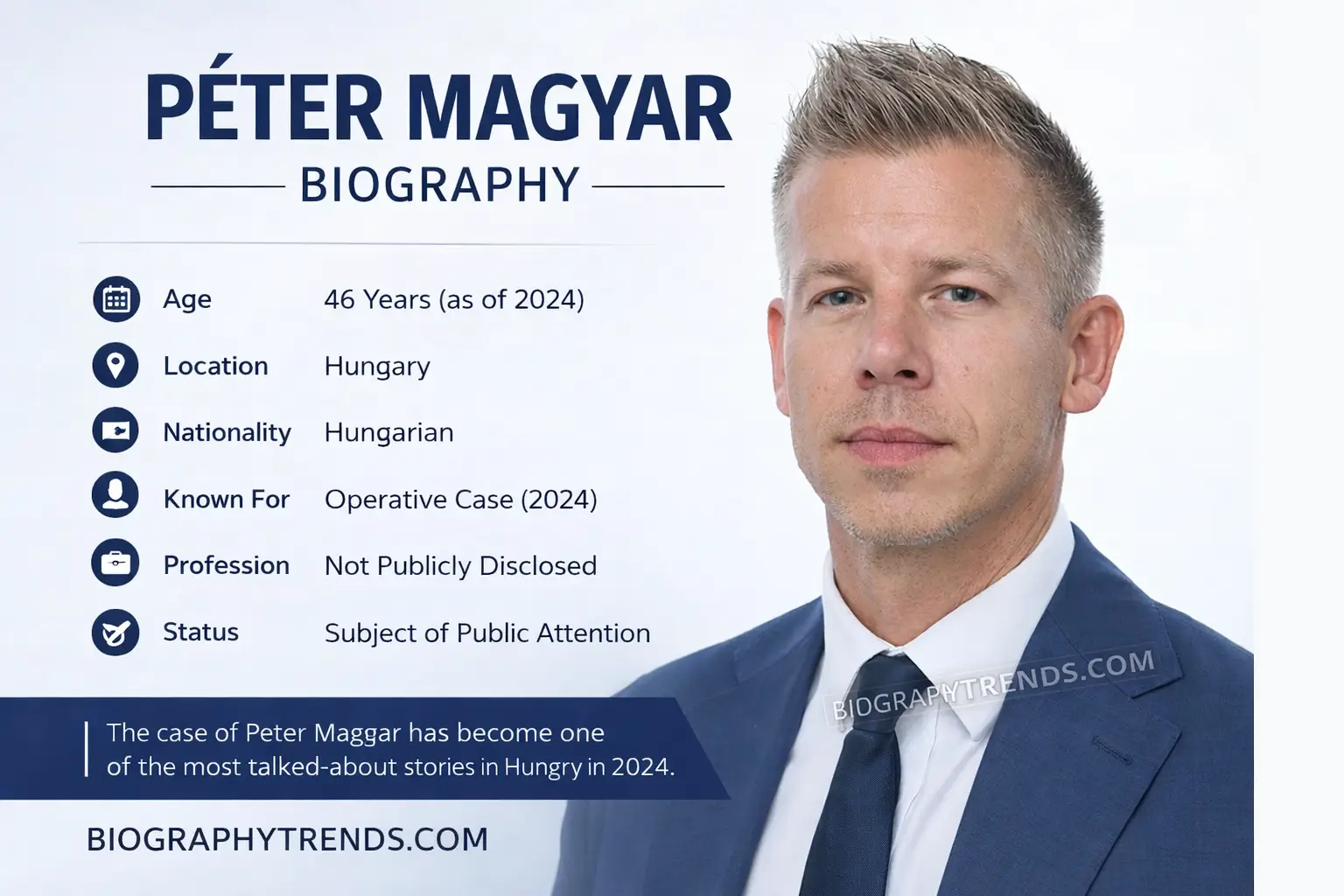
Péter Magyar is a Hungarian lawyer and politician who has become one of the most consequential figures in Hungary’s modern political history. A former Fidesz insider, he broke from Viktor Orbán’s party in 2024 amid a government pardon scandal and rapidly built the opposition Tisza Party into a national movement. In April 2026, Magyar led Tisza to a landslide election victory, ending Orbán’s 16-year hold on power, and he has served as Hungary’s prime minister since May 2026.
His rise from legal professional to head of government has made him a central figure in ongoing debates about democracy, governance, and reform not just in Hungary, but across the European Union.
Table of Contents
TogglePéter Magyar Biography: The Complete Story of Hungary’s Most Controversial Opposition Leader and Reform Advocate
Péter Magyar is a Hungarian lawyer and politician who has rapidly become one of the most talked about public figures in Hungary’s modern political landscape. Known for his outspoken views, strong criticism of political institutions, and involvement in opposition movements, he has risen from legal professional to national political voice with a speed that has surprised observers both inside Hungary and internationally. This comprehensive Péter Magyar Biography explores every dimension of his journey, from his birth in 1981 through his legal education and early career, his explosive entry into politics, his association with the TISZA Party, his key political themes of transparency and anti corruption, his complex public image, his personal life including divorce and fatherhood, his estimated net worth, and his significance for Hungary’s democratic future.
The Péter Magyar Biography has become essential reading for anyone seeking to understand contemporary Hungarian politics. In a political system long dominated by Prime Minister Viktor Orbán and his Fidesz party, Magyar represents something different: a new generation challenger who combines legal expertise with media savvy, traditional political organizing with viral social media engagement. Whether viewed as genuine reformer or opportunistic disruptor, his impact on Hungarian political discourse is undeniable and growing.
Péter Magyar Early Life and Background
Péter Magyar was born in Hungary on March 16, 1981, which makes him 45 years old as of 2026. His birth during the final decade of communist rule placed him among the last generation to experience childhood under that system, however briefly, before the transformative changes of 1989. This generational positioning is significant for understanding his political outlook, as he came of age during Hungary’s transition to democracy rather than inheriting either communist nostalgia or pre 1989 liberal convictions.
He grew up during a period of political transformation in the country, following the end of communist rule. The Hungary of Magyar’s childhood was a nation reconstructing itself, dismantling authoritarian institutions, introducing market economics, and seeking integration with Western Europe. This environment of fundamental change shaped his understanding of politics as something malleable and contested, rather than fixed and inevitable.
This environment played a key role in shaping his interest in law, justice, and governance. The legal vacuum created by communist collapse, the constitutional debates that accompanied democratic foundation, and the institutional building required for European Union accession all demonstrated law’s centrality to political order. For a young person observing these transformations, law offered both intellectual rigor and practical influence that pure politics might lack.
From a young age, he was reportedly interested in public affairs and social systems, which later influenced his decision to study law. This early interest, while common among future politicians, was apparently genuine rather than performative, sustained through adolescence and into university selection. The specific influences that channeled this interest toward law rather than journalism, activism, or direct political engagement remain private, but the choice proved consequential for his later career trajectory.
Péter Magyar Education and Legal Foundation
Péter Magyar studied law in Hungary and obtained a legal degree that allowed him to work in both private and public sectors. Hungarian legal education, rooted in continental European civil law traditions, provides comprehensive training in constitutional, administrative, criminal, and civil law. This broad foundation enables graduates to move between different legal domains throughout their careers, flexibility that Magyar would later exploit.
His legal education provided him with knowledge of constitutional law, understanding of government systems, and exposure to corporate and administrative law. Constitutional law knowledge became crucial for his later political critiques, as he could identify specific legal violations and institutional failures with technical precision that pure activists lacked. Understanding of government systems enabled him to navigate bureaucratic complexities and propose concrete reforms rather than merely rhetorical opposition. Exposure to corporate and administrative law prepared him for the practical business of governance and institutional management.
This background later helped him transition into political discussions and reform advocacy with credibility that non lawyers struggled to match. In political environments where expertise is often devalued in favor of charisma, Magyar’s legal training provided substantive foundation for his claims. When he criticized government practices, he could cite specific legal provisions and precedents. When he proposed alternatives, he could reference comparative constitutional models. This expertise distinguished him from opposition figures whose critiques remained at the level of general dissatisfaction.
Péter Magyar Career Before Politics: Legal and Administrative Roles
Before becoming widely known in politics, Péter Magyar worked in several professional roles, mainly in legal and administrative fields. His career path included legal advisory positions, work within corporate environments, and administrative roles connected to institutions. These experiences gave him direct exposure to how political and institutional systems operate in Hungary, knowledge that would inform his later critiques.
Legal advisory positions required him to analyze complex situations, identify legal risks, and recommend courses of action to clients. This analytical training developed capabilities for rapid assessment and clear communication that would serve his political career. The client service orientation also taught him to translate technical concepts for non specialist audiences, a skill essential for political communication.
Work within corporate environments exposed him to business perspectives on governance, regulation, and economic policy. Hungarian business operates within political frameworks that shape opportunity and constraint, and Magyar’s corporate experience provided understanding of these interactions from the private sector side. This perspective enriched his political positioning, enabling him to speak to business concerns as well as civic ideals.
Administrative roles connected to institutions demonstrated the practical challenges of organizational management, resource allocation, and personnel supervision. These experiences, while less glamorous than legal analysis or political rhetoric, provided grounding in implementation realities that pure critics often ignore. When Magyar later proposed institutional reforms, he could draw on firsthand understanding of why organizations resist change and how to overcome that resistance.
Péter Magyar Entry Into Politics: From Critic to Candidate
Péter Magyar’s entry into politics came through public criticism of government systems and policies, a path that has become increasingly common in an age of social media and viral communication. Unlike traditional politicians who rise through party hierarchies and electoral apprenticeship, Magyar leveraged direct public communication to bypass established channels and build personal following.
Over time, his statements gained attention, especially among citizens who were seeking political change. The specific timing of his emergence suggests sensitivity to political opportunity, as Hungarian opposition has struggled for years to mount effective challenge to Fidesz dominance. Magyar’s appearance offered something fresh for frustrated voters who had tired of established opposition parties and their repeated failures.
He became associated with opposition movements and reform oriented political discussions. These associations, initially informal and ideological, gradually solidified into organizational connections that would eventually include the TISZA Party. The progression from independent critic to movement participant to party affiliate represents typical path for political entrepreneurs in fragmented opposition environments.
His political rise was not gradual in the traditional sense. It accelerated quickly due to media attention, public speeches, viral interviews, and social media engagement. This rapid ascent, while exciting for supporters, also created challenges of organization, coalition building, and policy development that slower traditional rises allow time to address. Magyar’s ability to manage these challenges while maintaining momentum would test his political capabilities.
Péter Magyar Political Career and TISZA Party Association
Péter Magyar is now recognized as a growing figure in Hungarian opposition politics, with his most significant organizational association being the TISZA Party, formally known as the Respect and Freedom Party. This party represents one of several attempts to create viable opposition to Fidesz dominance, drawing on dissatisfaction with both the governing party and established opposition alternatives.
The TISZA Party aims to strengthen democratic values, challenge existing political dominance, and promote institutional reform. These objectives, while broadly shared across opposition spectrum, are pursued through specific strategies that distinguish TISZA from competitors. The party’s emphasis on new leadership, direct communication, and grassroots organizing reflects Magyar’s influence and the broader generational shift he represents.
His association with the TISZA Party has been both asset and challenge. The party brand provides organizational infrastructure, legal status, and electoral credibility that independent candidacy lacks. Simultaneously, party affiliation constrains individual autonomy and requires negotiation with other leaders who may have different priorities. Magyar’s ability to maintain his distinctive voice while operating within party framework has been crucial to his continued relevance.
Péter Magyar Key Political Themes and Messaging
His political messaging often focuses on four interconnected themes that resonate with diverse segments of Hungarian society. Government transparency represents his foundational demand, advocating for openness in governance and accountability in public institutions. This theme addresses widespread perception that Fidesz rule has created opaque decision making where public interest is subordinated to party advantage.
Anti corruption efforts constitute his most emotionally powerful theme, as corruption scandals have periodically damaged Fidesz credibility even among supporters. Magyar’s legal background enables him to identify specific mechanisms and cases with precision that general anti corruption rhetoric lacks. His ability to translate complex financial arrangements into accessible narratives has made this theme particularly effective.
Democratic reform supports strengthening democratic processes and institutions beyond merely changing governing parties. This systemic focus distinguishes Magyar from opposition figures who simply promise to govern better without addressing structural deficiencies. His reform agenda includes electoral system changes, media pluralism guarantees, and judicial independence protections.
Public accountability emphasizes the need for leaders to be accountable to citizens rather than to party hierarchies or personal networks. This theme connects to broader European concerns about democratic backsliding and resonates with international audiences who follow Hungarian developments.
Péter Magyar Rise to National Attention and Media Strategy
Péter Magyar became widely known after gaining media coverage for his strong public statements and political criticism. His rise can be attributed to public interviews that went viral, active social media presence, strong political commentary, and growing public interest in opposition voices. Each of these factors reinforced the others, creating momentum that traditional media and established politicians struggled to match or counter.
Public interviews that went viral demonstrated Magyar’s communication skills and his ability to generate memorable moments that traveled beyond their original context. In an age of clip culture and social media sharing, a single powerful statement can reach audiences who never consume full interviews or programs. Magyar’s legal training in clear argumentation and his performative comfort before cameras enabled him to produce such moments consistently.
Active social media presence allowed direct communication with supporters that bypassed traditional media gatekeepers. Hungarian media landscape, increasingly dominated by government aligned outlets, presents particular challenges for opposition figures seeking coverage. Magyar’s social media strategy circumvented these obstacles, reaching audiences directly with unfiltered messaging.
Strong political commentary provided substance that distinguished him from mere social media personalities. While his communication style attracted initial attention, his policy positions and institutional knowledge retained that attention and converted casual viewers into committed supporters.
Growing public interest in opposition voices created receptive environment that Magyar exploited effectively. Years of Fidesz dominance had generated accumulated desire for alternatives, and Magyar’s emergence offered fresh option for this demand.
Péter Magyar Public Image: Supporters and Critics
Péter Magyar has a complex public image that divides Hungarian society and observers. Supporters see him as a reform minded leader, a voice for transparency, and a strong political challenger who can finally break Fidesz dominance. These positive perceptions emphasize his energy, expertise, and apparent fearlessness in confronting powerful interests.
Critics describe him as controversial, politically aggressive, and a divisive figure in Hungarian politics. These negative perceptions question his motives, methods, and ultimate objectives. Some critics suggest his rapid rise reflects opportunism rather than principle, that his legal background equips him for procedural manipulation rather than genuine reform, and that his confrontational style risks further polarizing already divided society.
Despite differing opinions, his influence continues to grow, suggesting that both supporters and critics are responding to something genuine in his appeal. The intensity of reaction, positive and negative, indicates that Magyar has touched nerve in Hungarian political culture that less provocative figures miss.
Péter Magyar Personal Life: Marriage, Divorce, and Family
Péter Magyar keeps much of his personal life away from the public eye, maintaining boundaries that distinguish him from politicians who exploit family for electoral advantage. However, certain details are known that have become part of his public narrative.
He has been married before and is currently divorced. The circumstances of his marriage and divorce have generated some media interest, particularly as his political prominence has increased. Divorce in Hungarian political culture, while less stigmatized than in some societies, still carries implications for candidate image that Magyar has managed through relative silence rather than proactive narrative control.
He has children, though specific details about their number, ages, and current living arrangements remain private. Fatherhood, even when not publicly performed, shapes political perspective and priorities in ways that may influence Magyar’s policy positions and rhetorical choices.
After becoming more active in politics, his personal life also gained media attention, though he remains relatively private compared to other politicians. This comparative privacy may reflect genuine preference, strategic calculation that mystery enhances appeal, or simply the absence of family members willing to participate in public performance.
Péter Magyar Net Worth and Financial Status
There is no official public record of Péter Magyar’s net worth. However, based on his professional and political background, estimates place his wealth at approximately 500,000 to 2 million dollars. These figures are unofficial and should be treated as estimates only, reflecting the difficulty of assessing private wealth in political contexts where disclosure requirements remain limited.
His income sources include legal career earnings accumulated during his years of private practice, political roles and advisory positions that may provide compensation or expense coverage, public speaking engagements that command fees based on his prominence, and media related activities including potential book deals, interviews, or content monetization.
The relatively modest estimated wealth, compared to international political figures or Hungarian business leaders, may actually enhance Magyar’s credibility as anti establishment challenger. In political environments where wealth accumulation often indicates corruption or cronyism, moderate means can signal integrity and independence.
Péter Magyar Controversies and Public Debates
Like many rising political figures, Péter Magyar has been involved in public debates and controversies that test his resilience and shape his evolution. These include political disagreements with government supporters who challenge his legitimacy and question his motives, media criticism from outlets aligned with governing party or skeptical of his rapid rise, and public scrutiny over specific statements and positions that appear contradictory or impractical.
Despite these controversies, his popularity continues to increase among reform minded citizens. This resilience suggests either effective controversy management, genuine base of support that discount negative coverage, or both. The pattern of controversy followed by continued growth resembles trajectories of other successful political challengers who learned to convert attacks into evidence of establishment fear.
READ ALSO:
Péter Magyar Social Media Presence and Digital Strategy
Péter Magyar maintains active social media presence across major platforms, with his Facebook page under his official name serving as primary communication channel and his Instagram account providing more personal, visual content. These platforms enable direct supporter engagement, real time response to developments, and narrative control that traditional media appearances cannot match.
His digital strategy reflects understanding that Hungarian media landscape, with government aligned dominance of traditional outlets, requires opposition figures to build alternative communication infrastructure. Social media provides this infrastructure at relatively low cost while enabling metrics that demonstrate support to potential allies and donors.
Péter Magyar Significance for Hungarian Democracy
Péter Magyar represents a new political dynamic in Hungary that extends beyond individual ambition to reflect broader societal changes. He is important because he brings fresh opposition energy that has been lacking in established parties, he challenges established political structures that have calcified under long dominance, he attracts younger and reform focused voters who feel unrepresented by existing options, and he is part of evolving political movements that may reshape Hungarian party system.
His rise reflects broader political changes happening across Central Europe, where young voters disillusioned with both nationalist conservatism and traditional liberalism seek new alternatives. Whether Magyar and TISZA can capture and sustain this demand remains uncertain, but their emergence demonstrates that Hungarian political landscape is not static despite appearances of Fidesz immovability.
Péter Magyar Frequently Asked Questions
Who is Péter Magyar?
Péter Magyar is a Hungarian lawyer and politician known for his transition from legal career into active opposition politics. He has become prominent through criticism of government practices and advocacy for democratic reform.
How old is Péter Magyar?
He is 45 years old as of 2026, born on March 16, 1981. This places him in generation that experienced Hungary’s democratic transition during formative years.
What is Péter Magyar’s profession?
He is a lawyer and politician, combining legal expertise with political activism. His professional background distinguishes him from career politicians without independent career experience.
What political party is Péter Magyar associated with?
He is associated with the TISZA Party, formally known as the Respect and Freedom Party, a reform oriented opposition movement in Hungary.
What does TISZA Party stand for?
The TISZA Party stands for Respect and Freedom, advocating democratic values, institutional reform, and challenge to existing political dominance in Hungary.
What are Péter Magyar’s main political themes?
His main themes include government transparency, anti corruption efforts, democratic reform, and public accountability for political leaders.
Is Péter Magyar married?
No, he is currently divorced. He was previously married and has children, though he keeps personal details relatively private.
What is Péter Magyar’s net worth?
His net worth is estimated between 500,000 and 2 million dollars, though no official public record confirms this. His income sources include legal practice, political roles, speaking engagements, and media activities.
Where did Péter Magyar study?
He studied law in Hungary, obtaining degree that enabled practice in both private and public sectors. Specific institution details remain limited in public sources.
What languages does Péter Magyar speak?
He speaks Hungarian and English, enabling communication with both domestic audiences and international observers of Hungarian politics.
Why is Péter Magyar controversial?
He is controversial because his rapid rise challenges established political order, his confrontational style polarizes opinion, and his background outside traditional party structures generates suspicion among both supporters and opponents of current government.
How did Péter Magyar become famous?
He became famous through viral public statements, social media engagement, and media coverage of his political criticism that resonated with citizens seeking opposition alternatives.
What is Péter Magyar’s social media?
He maintains active Facebook page under Péter Magyar official name and Instagram account under Péter Magyar official handle.
Does Péter Magyar have children?
Yes, he has children, though specific details remain private consistent with his general approach to personal life exposure.
What makes Péter Magyar different from other Hungarian politicians?
His legal background, rapid rise through non traditional channels, direct social media communication, and generational positioning distinguish him from both governing party and established opposition figures.
Conclusion: The Péter Magyar Phenomenon
Péter Magyar is a Hungarian lawyer turned politician who has quickly become a major voice in opposition politics. His background in law, combined with his outspoken political views, has positioned him as a significant figure in Hungary’s evolving political landscape. The Péter Magyar Biography reveals a man who has leveraged professional expertise, communication skills, and political timing to achieve in months what traditional politicians require decades to build.
Whether viewed as a reformer or a controversial challenger, his influence continues to grow, and he is expected to remain an important figure in Hungarian politics in the coming years. The 2026 period represents critical juncture for his development, as initial novelty must be converted into sustained organization, and viral appeal must be transformed into electoral viability.
The Péter Magyar story ultimately raises fundamental questions about political change in contemporary democracies. Can institutional renewal emerge from outside established party structures? Does legal expertise translate into political effectiveness? Can social media based movements achieve lasting organizational form? The answers to these questions, still unfolding in Hungary, will shape not merely Magyar’s personal trajectory but broader understanding of democratic possibility in the twenty first century.
For those searching Péter Magyar Biography, Péter Magyar age, Péter Magyar TISZA Party, or Péter Magyar net worth, this comprehensive guide provides the most detailed account available of a figure who has already changed Hungarian political discourse and may yet change Hungarian political outcomes. The Péter Magyar Biography: Age, TISZA Party, Political Career & Net Worth 2026 represents not merely individual story but case study in how politics functions and transforms in our digital age.