
Who Is Pam Bondi?
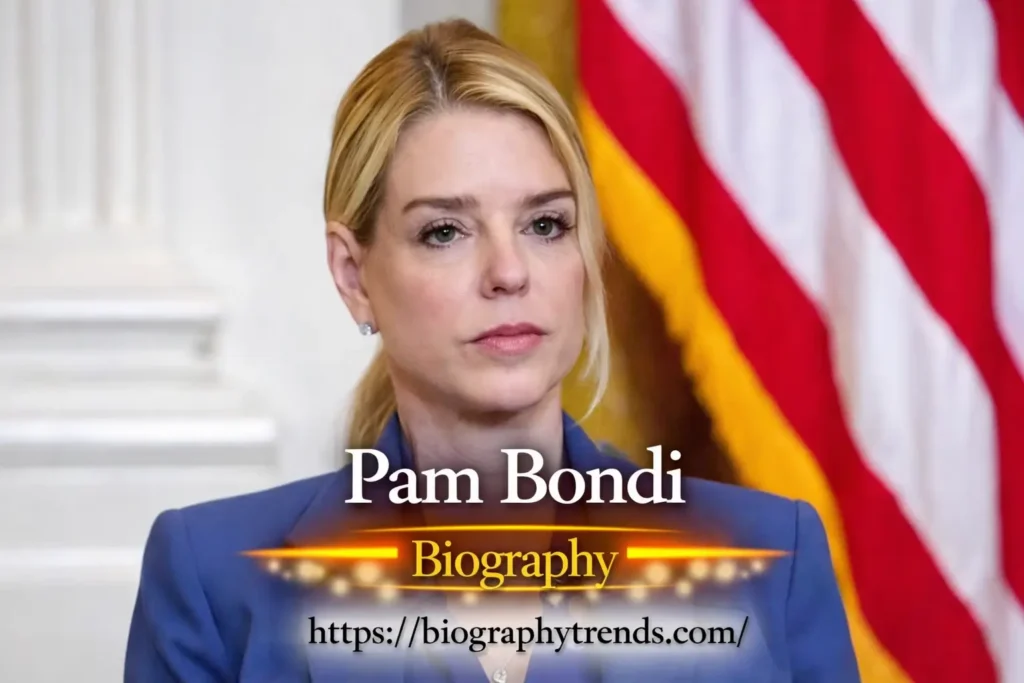
Pam Bondi is a distinguished American attorney, former prosecutor, and political figure whose career has spanned criminal prosecution, public service, and national politics. Her journey from serving as a prosecutor in Tampa to becoming one of the most recognized legal and political figures in the United States reflects decades of experience in law, government, and public affairs.
Pam Bondi rose to national prominence as the Attorney General of Florida, serving from 2011 to 2019. During her tenure, she became one of the most recognizable Republican attorneys general in the country. Known for her confident courtroom presence, strong communication skills, and conservative political views, she built a reputation that combined legal expertise with active involvement in public policy and politics.
What distinguishes Pam Bondi from many state-level political leaders is the lasting influence of her public career. While many attorneys general serve their terms and leave public office with limited national recognition, Bondi has remained an influential voice in legal and political discussions. Her participation in major legal cases, policy debates, and media appearances has helped maintain her national profile long after leaving elected office.
Her influence extends beyond Florida through her roles in national political events, presidential campaigns, advisory positions, and television appearances. She has contributed to discussions on law enforcement, consumer protection, constitutional issues, and government policy. Her continued presence in American politics demonstrates her ability to remain relevant in an evolving political landscape.
In this comprehensive biography, we will explore every aspect of Pam Bondi’s life and career, including her early life, education, legal career, rise as a prosecutor, election as Florida’s first female Attorney General, involvement in national politics, career after public office, and lasting impact on American law and politics. Whether you are interested in American politics, the legal profession, or public service, this biography provides a detailed overview of one of the most recognizable legal figures in modern American politics.
Early Life and Family Background in Tampa, Florida
Birth and Childhood in a Politically Engaged Family
Pam Bondi was born on November 17, 1965, in Tampa, Florida, a city that has remained closely connected to her personal and professional life. Tampa, located on Florida’s Gulf Coast, is one of the state’s largest cities and an important economic, cultural, and political center. Growing up in this environment exposed Bondi to the challenges and opportunities of public service, government, and community leadership from an early age.
A significant influence on Bondi’s early life was her family’s involvement in public service. Her father, Joseph Bondi, was active in local government, giving her firsthand exposure to how government operates and how public officials serve their communities. This early experience helped shape her understanding of leadership, civic responsibility, and the importance of public service.
Growing up in a politically engaged household allowed Bondi to develop an appreciation for government, public policy, and leadership. Observing her father’s work introduced her to the realities of public administration, community engagement, and political decision-making, experiences that would later influence her own career in law and politics.
The Florida Political Environment
Growing up in Florida during the 1960s and 1970s, Bondi witnessed a period of significant change. The state was rapidly expanding in population, economic development, and political influence, transforming into one of the nation’s fastest-growing states. These changes brought new challenges related to public safety, economic growth, infrastructure, and government administration.
The Tampa Bay area also experienced major economic and demographic growth during this period. Traditional industries gradually expanded to include tourism, healthcare, finance, technology, and other sectors that reshaped the region. These developments created both opportunities and challenges for local communities and policymakers.
Growing up during this period likely influenced Bondi’s practical approach to politics and public service, combining conservative values with a focus on law enforcement, public safety, and effective government administration.
Formative Values and Early Ambitions
Although much of Pam Bondi’s childhood has remained private, her later career reflects several core values that appear to have developed early in life. Her commitment to law enforcement, public service, and legal advocacy became defining characteristics of her professional journey.
Her decision to pursue a career in law, particularly as a prosecutor, demonstrated an interest in justice, accountability, and the legal system. Throughout her career, Bondi consistently emphasized the importance of protecting communities, enforcing the law, and serving the public through government institutions.
These early influences laid the foundation for a career that would eventually take her from the courtroom to statewide elected office and later to the national political stage.
Education: Building a Legal Foundation
The University of Florida Years
Pam Bondi’s higher education began at the University of Florida, one of the nation’s premier public universities and an institution with particular significance within the state. Founded in 1853, the University of Florida has grown into a major research university with strong programs across numerous disciplines, including the social sciences, humanities, and professional fields that prepare students for public service careers.
At the University of Florida, Bondi studied criminal justice, a field of academic inquiry that combines legal studies, sociology, psychology, and public administration to understand the nature of crime, the functioning of the criminal justice system, and the policies that can effectively reduce criminal behavior while protecting individual rights. This academic choice revealed early clarity regarding her career direction. Criminal justice is not a default major for uncertain students but a focused preparation for specific professional paths in law enforcement, prosecution, corrections, or criminal defense.
The University of Florida experience would have provided Bondi with several crucial developmental opportunities.
Academic preparation in the substantive knowledge required for legal and criminal justice careers, including constitutional law, criminal procedure, evidentiary standards, and the sociological factors that contribute to criminal behavior.
Intellectual community among peers and faculty who shared her interests and ambitions, creating networks that would prove valuable throughout her career. The relationships formed during university years often persist and provide professional support across decades.
Campus political engagement, common among students who later pursue public careers. University campuses serve as training grounds for political organizing, debate, and leadership that translate directly into electoral politics.
Credential acquisition, as the University of Florida’s reputation enhanced her subsequent applications to law school and her early career prospects.
Academic Performance and Extracurricular Activities
While specific details of Bondi’s academic performance remain private, her successful admission to law school and subsequent career achievements suggest strong academic capability. Students who excel in criminal justice programs typically demonstrate skills in analytical reasoning, written communication, and oral argumentation that are directly transferable to legal education and practice.
Extracurricular activities during her university years, while not extensively documented, likely included participation in pre-law societies, debate organizations, or political groups that provided practical experience in the skills she would later employ as a prosecutor and politician. These activities, often underestimated in their importance, provide opportunities for leadership development, network building, and the cultivation of public confidence that are essential for political careers.
The University of Florida’s location in Gainesville, Florida, also provided exposure to a different Florida community than her Tampa upbringing, broadening her understanding of the state’s diversity and the varying concerns of different regions. This geographic breadth would prove valuable when she later sought statewide office, requiring appeal beyond her home metropolitan area.
Stetson University College of Law
Legal Education and Professional Preparation
Following her undergraduate studies, Pam Bondi earned her law degree from Stetson University College of Law, one of Florida’s most respected legal institutions. Founded in 1900, Stetson Law has established a strong reputation for preparing students for the practical demands of legal practice, with particular strengths in trial advocacy, legal writing, and clinical education that provides hands-on experience.
The decision to attend Stetson rather than a more nationally prominent law school reflects several considerations that are common among Florida legal professionals.
Regional reputation, as Stetson is highly regarded within Florida’s legal community and maintains strong relationships with local law firms, government agencies, and judicial offices.
Practical orientation, as Stetson emphasizes skills training and professional preparation over theoretical scholarship, an approach well suited to students intending careers in litigation and public service.
Geographic proximity to Tampa and the broader Tampa Bay legal market, facilitating internships, clerkships, and early professional connections.
Cost considerations, as regional law schools often provide excellent value compared to elite national institutions, particularly for students intending to practice within the region.
Law School Curriculum and Skill Development
Stetson’s law school curriculum would have provided Bondi with comprehensive legal education encompassing the following areas.
Core doctrinal subjects including contracts, torts, property, civil procedure, criminal law, and constitutional law, the foundational knowledge required for the bar examination and legal practice.
Skills courses in legal research, writing, and oral advocacy that develop the practical capabilities essential for courtroom success.
Clinical programs offering supervised representation of actual clients, providing invaluable experience in client interaction, case management, and advocacy.
Trial advocacy training, particularly relevant to her subsequent prosecutorial career, developing the courtroom presence and persuasive techniques that would become her professional trademark.
Law school also provides the socialization into legal culture that shapes professional identity. The values, norms, and expectations of the legal profession, including commitment to client service, adherence to ethical standards, and respect for precedent and procedure, are transmitted through legal education and reinforced through professional practice. Bondi’s subsequent career demonstrated both an embrace of these professional values and a willingness to challenge certain conventions when political circumstances demanded.
Bar Admission and Early Professional Identity
Upon completing her legal education, Bondi would have sat for the Florida Bar Examination, the comprehensive assessment required for admission to practice law in the state. Florida’s bar examination is known for its rigor, testing knowledge across multiple legal domains and the practical skills necessary for competent practice. Successful passage represents a significant achievement and the gateway to professional legal careers.
Her admission to the Florida Bar marked her formal entry into the legal profession and enabled her to pursue the prosecutorial career that would define her early professional life and establish the foundation for her subsequent political ambitions.
Early Legal Career: Prosecutor in Hillsborough County
Entering Public Service as a Prosecutor
Pam Bondi’s professional legal career began as a prosecutor in Hillsborough County, Florida, the jurisdiction that includes Tampa and represents one of the state’s most populous and legally complex counties. The decision to pursue prosecution rather than private practice or defense work revealed her professional values and political orientation. Prosecutors represent the state and society against accused criminals, a role that appeals to those who believe in the protective and punitive functions of government.
The Hillsborough County State Attorney’s Office, like prosecutorial offices nationwide, handles a vast caseload encompassing every category of criminal offense, from minor misdemeanors to capital murder. New prosecutors typically begin with less serious cases, gradually advancing to more complex and significant matters as they demonstrate capability and accumulate experience. Bondi’s progression through this system would have required years of dedicated work, developing the skills and reputation that would eventually support her political ambitions.
The Nature of Prosecutorial Work
Prosecutorial work is demanding in ways that differ significantly from other legal specialties. Unlike civil litigators, who may spend years on a single case, prosecutors handle high volumes of matters, requiring rapid assessment, quick decision making, and efficient case management. Unlike defense attorneys, who serve individual clients, prosecutors represent the broader public interest, requiring a balance between competing values such as punishment and rehabilitation, individual rights and social protection, and procedural fairness and substantive justice.
Bondi’s work as a prosecutor encompassed a wide range of criminal cases, from routine drug offenses and property crimes to serious violent felonies. Each case required careful review of evidence, assessment of legal issues, negotiation with defense counsel, and, when cases proceeded to trial, presentation of proof to judges and juries. The skills developed through this work, including case analysis, evidentiary evaluation, witness examination, and persuasive argumentation, would prove directly transferable to her later political and media careers.
Building Professional Credibility
Through years of legal practice in the trenches of criminal prosecution, Bondi developed the professional credibility and recognition that would support her political aspirations. Prosecutors who succeed in demanding jurisdictions like Hillsborough County earn respect from judges, defense attorneys, and colleagues that transcends partisan affiliation. This professional respect is essential for political credibility, as voters are more likely to support candidates whose competence has been demonstrated in demanding professional contexts.
Her work also provided practical knowledge of the criminal justice system that would inform her policy positions as attorney general. Theoretical understanding of criminal law, while valuable, cannot substitute for the experiential knowledge gained through handling actual cases, observing systemic failures, and understanding the human dimensions of crime and punishment. Bondi’s prosecutorial background gave her authority on criminal justice issues that purely academic or political credentials could not match.
Public Safety and Community Impact
Beyond individual case handling, prosecutorial work involves contributions to public safety through deterrence, incapacitation, and rehabilitation of offenders. Bondi’s prosecution of serious offenses removed dangerous individuals from the community, while her work on less serious cases contributed to the overall functioning of the criminal justice system.
This community impact, while difficult to quantify for individual prosecutors, contributes to the sense of public service that motivates many criminal justice professionals. The knowledge that one’s work protects potential victims, maintains social order, and upholds the rule of law provides professional satisfaction that can sustain careers through the stresses and disappointments that prosecution inevitably involves.
Developing a Courtroom Reputation
The Art of Trial Advocacy
Pam Bondi’s reputation as a prosecutor was built significantly on her courtroom performance, where she demonstrated the skills that distinguish effective trial advocates. Trial advocacy is a specialized discipline that combines legal knowledge, rhetorical ability, strategic thinking, and psychological insight into a performance art that can determine the outcomes of cases and the fates of defendants.
Effective trial advocacy requires multiple capabilities.
Case theory development, the ability to construct coherent, persuasive narratives that explain evidence and guide jurors to desired conclusions.
Witness examination, including both direct examination of friendly witnesses to elicit favorable testimony and cross examination of adverse witnesses to undermine credibility and expose inconsistencies.
Opening statements and closing arguments, the opportunities to frame cases for jurors and to synthesize evidence into compelling conclusions.
Evidentiary objections and rulings, the technical legal arguments that determine what evidence jurors may consider.
Improvisational adaptation, the ability to respond effectively to unexpected developments, witness answers, and judicial rulings during trial.
Bondi’s development of these capabilities through years of courtroom practice created the performance skills that would later serve her in political campaigns, legislative hearings, and media appearances.
The “Firm, Focused, and Effective” Persona
Bondi developed a professional persona characterized as “firm, focused, and effective”, qualities that appealed to conservative voters and colleagues who valued strength and decisiveness in law enforcement. This persona, while partly authentic personality and partly cultivated performance, served her professional advancement by creating a memorable impression on judges, juries, and observers.
The emphasis on firmness communicated an unwillingness to compromise on principle, a quality valued by those who believe that criminal justice has become insufficiently punitive. The emphasis on focus suggested disciplined attention to essential matters rather than distraction by peripheral concerns. The emphasis on effectiveness promised results rather than merely intentions, appealing to pragmatic voters who valued outcomes over ideology.
This persona, developed in courtrooms and refined through years of practice, became the foundation of her political identity. When she later sought elected office, voters were not merely evaluating policy positions but responding to a personality that had been tested and proven in adversarial legal contexts.
Professional Network Development
Years of prosecutorial work also enabled Bondi to build professional networks that would prove essential for political advancement. The legal community in any major jurisdiction is relatively small and interconnected. Prosecutors who demonstrate competence and integrity earn allies among judges, fellow attorneys, law enforcement officials, and court personnel who can provide support, endorsements, and campaign contributions.
These networks extend beyond the legal community to encompass victim advocacy groups, law enforcement organizations, and community leaders who interact with the criminal justice system. Prosecutors who handle high-profile cases or demonstrate particular commitment to certain issues develop relationships with constituencies that can be be mobilized for political purposes.
Bondi’s network development was strategic and sustained, creating the infrastructure of support that would enable her statewide campaign for attorney general.
The Path to Attorney General
Political Opportunity and Timing
Pam Bondi’s decision to run for Attorney General of Florida reflected both personal ambition and favorable political circumstances. The attorney general position, one of Florida’s four statewide elected cabinet offices, represents a significant step up from local prosecutorial work, offering statewide jurisdiction, executive authority, and national visibility.
The timing of her candidacy was influenced by several factors.
Term limits and open seats, as electoral opportunities arise when incumbents are ineligible for reelection or choose to pursue other offices.
Political climate, as favorable conditions for Republican candidates in Florida created opportunities for conservative prosecutors to advance.
Personal career trajectory, as years of prosecutorial work had provided sufficient experience, credibility, and a network to support a credible statewide campaign.
National political trends, as the Tea Party movement and conservative activism created energy that benefited candidates with strong law enforcement credentials.
Campaign Strategy and Messaging
Bondi’s campaign for attorney general emphasized themes that would define her political identity.
Experience and competence, highlighting her years of prosecutorial work as preparation for statewide executive responsibility.
Conservative values, aligning with Republican Party priorities regarding law enforcement, limited government, and individual responsibility.
Gender breakthrough, implicitly and explicitly positioning her candidacy as historic, appealing to voters who valued diversity in elected office.
Florida focus, emphasizing state-specific concerns rather than national ideological debates, a strategy common among successful statewide candidates.
Her campaign messaging was disciplined and consistent, avoiding controversies that might alienate moderate voters while energizing conservative base support. This strategic discipline, learned through years of courtroom practice where every statement can be used against the speaker, served her well in the political arena.
The 2010 Election and Historic Victory
Pam Bondi was elected Attorney General of Florida in 2010, a Republican wave year that saw significant conservative gains across the nation. Her victory made her the first woman to hold the position in Florida’s history, a milestone that attracted national attention and positioned her as an emerging figure in Republican politics.
The significance of this achievement should not be underestimated. Florida, despite its reputation as a politically competitive state, had historically elected men to statewide executive offices. Bondi’s breakthrough demonstrated that women could win these positions when they combined professional credentials, political positioning, and effective campaigning. Her success provided a template that subsequent female candidates in Florida and elsewhere could emulate.
The election also established Bondi as a rising star within the Republican Party, a status that would lead to national opportunities and increased scrutiny in the years ahead.
Historic Election: Florida’s First Female Attorney General
The Significance of the Position
The Attorney General of Florida occupies one of the most powerful positions in state government, with responsibilities that extend far beyond the criminal prosecution that characterizes local district attorneys. The attorney general serves as the state’s chief legal officer, representing Florida in litigation, providing legal opinions to state agencies and officials, enforcing consumer protection laws, and addressing matters of statewide concern.
Specific powers and responsibilities include:
Civil litigation representation, defending state laws and agencies against legal challenges and pursuing litigation on behalf of state interests.
Criminal appeals, handling appeals from criminal convictions and representing the state before appellate courts.
Consumer protection enforcement, investigating and prosecuting fraudulent business practices that harm Florida residents.
Antitrust enforcement, addressing monopolistic practices that violate competition laws.
Opinion issuance, providing formal legal interpretations that guide state government action.
Charitable regulation, overseeing nonprofit organizations and charitable solicitations.
This broad portfolio makes the attorney general position a significant platform for policy influence, enabling officeholders to shape legal and regulatory environments across numerous domains.
Breaking the Gender Barrier
Bondi’s election as Florida’s first female attorney general carried symbolic significance beyond its practical implications. In a state with a complex history regarding gender equality, where women gained the right to vote earlier than many states but where traditional gender roles remained powerful, her victory represented progress that resonated across political lines.
The gender dimension of her election also provided strategic advantages. As a woman in a party sometimes perceived as dominated by men, Bondi could appeal to female voters who might otherwise support Democratic candidates. Her professional credentials, including prosecutorial experience, legal education, and demonstrated competence, countered stereotypes that might have disadvantaged less qualified female candidates.
Her success contributed to a broader narrative of Republican women’s advancement that party strategists could deploy to counter Democratic claims of representing women’s interests more effectively. While Bondi’s conservative positions on many issues differed from those of feminist organizations, her achievement in breaking gender barriers provided a counter-narrative that complicated simplistic partisan gender analysis.
Consumer Protection and Fraud Prevention
Prioritizing Consumer Welfare
One of the defining priorities of Pam Bondi’s tenure as attorney general was consumer protection and fraud prevention, areas where the attorney general’s office possesses significant enforcement authority and where public impact is readily demonstrable. Florida’s large elderly population, significant tourist economy, and history of fraudulent schemes made consumer protection particularly important.
Bondi’s consumer protection efforts encompassed:
Mortgage fraud prosecution, addressing schemes that exploited homeowners during and after the housing crisis that devastated Florida’s real estate market.
Identity theft prevention, combating the growing problem of stolen personal information used for financial crimes.
Elder fraud protection, targeting schemes that specifically victimized Florida’s substantial senior population through telemarketing scams, investment fraud, and predatory financial products.
Telemarketing regulation, addressing unwanted and fraudulent commercial calls that harassed consumers.
Price gouging enforcement, particularly during emergencies when unscrupulous vendors exploited disaster victims.
These efforts generated measurable results in terms of financial recoveries, criminal prosecutions, and consumer education that Bondi’s office could publicize as evidence of effective governance.
Major Legal Battles and National Litigation
Challenging the Affordable Care Act
One of the defining moments of Pam Bondi’s tenure as Florida Attorney General was her participation in the legal challenge against the Affordable Care Act (ACA), the landmark healthcare reform law signed by President Barack Obama in 2010. Bondi joined a coalition of Republican attorneys general who argued that certain provisions of the legislation exceeded the constitutional powers granted to the federal government.
The primary focus of the lawsuit was the individual mandate, which required most Americans to obtain health insurance or pay a financial penalty. Bondi and the coalition contended that compelling individuals to purchase health insurance exceeded Congress’s authority under the Commerce Clause and represented an unprecedented expansion of federal power.
The case eventually reached the United States Supreme Court, becoming one of the most significant constitutional cases of the twenty-first century. Although the Supreme Court ultimately upheld most of the Affordable Care Act in National Federation of Independent Business v. Sebelius (2012), Bondi’s involvement elevated her national profile and established her as a leading conservative legal voice.
Her participation reflected a broader commitment to states’ rights and constitutional federalism, themes that would continue to shape her legal and political career. The litigation also demonstrated how state attorneys general could influence national policy debates through coordinated legal action rather than legislation alone.
Defending Florida’s Legal Interests
Beyond healthcare litigation, Bondi regularly represented Florida in major constitutional and regulatory disputes involving the federal government. As the state’s chief legal officer, she was responsible for defending Florida’s laws, agencies, and constitutional interests before both state and federal courts.
Her office handled litigation involving:
- Federal regulatory authority and state sovereignty
- Environmental regulations affecting Florida’s economy and natural resources
- Immigration-related legal disputes
- Constitutional interpretation involving executive and legislative powers
- Election and voting-related legal matters
These responsibilities required balancing legal analysis with policy considerations, as many high-profile cases carried both constitutional significance and political consequences. Bondi’s willingness to engage in nationally significant litigation strengthened her reputation among conservative policymakers and legal organizations.
Multi-State Legal Coalitions
During her time as attorney general, Bondi became an active participant in multi-state coalitions of attorneys general, an increasingly influential feature of American governance. Through these partnerships, states combined legal resources to challenge federal actions, investigate corporations, and negotiate nationwide settlements.
These coalitions addressed issues such as:
- Consumer protection and deceptive business practices
- Pharmaceutical litigation
- Financial institution misconduct
- Environmental compliance
- Technology and data privacy concerns
Working within these coalitions enhanced Bondi’s national visibility and demonstrated her ability to collaborate with attorneys general from across the country on issues that extended beyond Florida’s borders.
Leadership During Florida’s Public Crises
Responding to Natural Disasters
Florida’s geographic location makes it one of the most disaster-prone states in the United States, facing frequent hurricanes, tropical storms, flooding, and other emergencies. During Bondi’s tenure, her office played an important legal and administrative role in supporting statewide disaster response efforts.
The Attorney General’s Office focused on:
- Protecting consumers from fraud following natural disasters
- Investigating price gouging involving essential goods and services
- Providing legal guidance to affected residents
- Supporting law enforcement agencies during emergency operations
- Coordinating with state and federal authorities
Price gouging became a particularly visible issue during hurricane seasons, when businesses were accused of dramatically increasing prices for necessities such as fuel, water, food, generators, and hotel accommodations. Bondi consistently emphasized enforcement against businesses found to be exploiting vulnerable consumers during emergencies.
Protecting Vulnerable Communities
Bondi frequently highlighted the importance of protecting vulnerable populations during crises, particularly:
- Senior citizens
- Children
- Individuals with disabilities
- Low-income families
- Disaster victims
Her office encouraged residents to report fraud, scams, and unfair business practices while expanding public awareness campaigns designed to prevent victimization.
These efforts reinforced her broader public image as an attorney general focused on consumer protection, public safety, and government accountability.
National Political Profile
Becoming a Prominent Republican Figure
As her second term progressed, Pam Bondi emerged as one of the Republican Party’s most recognizable statewide elected officials. Her courtroom experience, media presence, and willingness to defend conservative policy positions made her a frequent guest on national television and a regular participant in major Republican political events.
Unlike many attorneys general who remain focused almost exclusively on state matters, Bondi successfully expanded her influence into national politics by commenting on issues including:
- Constitutional law
- Federal government authority
- Immigration policy
- Crime and public safety
- Consumer protection
- Judicial appointments
Her communication style—confident, direct, and accessible—made her an effective spokesperson capable of explaining complex legal issues to general audiences.
Support for Donald Trump
Bondi became a prominent supporter of Donald Trump during the 2016 presidential campaign, publicly endorsing his candidacy and appearing frequently at campaign events and national media interviews.
Her legal background allowed her to defend campaign positions from both political and constitutional perspectives, making her one of Trump’s most trusted legal surrogates.
She appeared regularly on national television to discuss:
- Constitutional issues
- Election law
- Criminal justice policy
- Supreme Court nominations
- Executive authority
Her visibility during the campaign substantially increased her national recognition beyond traditional legal and political audiences.
Role in the Presidential Transition
Following Trump’s election victory in 2016, Bondi participated in the presidential transition process and remained closely associated with the administration.
Although she was considered for several federal appointments—including speculation surrounding the position of U.S. Attorney General—she ultimately remained in Florida until completing her elected term in 2019.
Her continued relationship with the administration positioned her for influential advisory and legal roles after leaving statewide office.
Media Presence and Public Communication
An Effective Legal Communicator
One of Pam Bondi’s distinguishing strengths has been her ability to communicate complex legal issues in language that ordinary citizens can understand.
Throughout her career, she developed a reputation for:
- Explaining legal concepts clearly
- Presenting structured arguments
- Remaining composed during interviews
- Responding confidently to criticism
- Simplifying complicated constitutional issues
These communication skills, originally refined in the courtroom, translated naturally into television interviews, press conferences, and political debates.
Television and Public Commentary
After leaving office, Bondi became a regular legal commentator and political analyst on national television.
Her commentary has frequently addressed:
- Constitutional litigation
- Criminal investigations
- Election law
- Federal prosecutions
- Supreme Court decisions
- Public corruption cases
Her experience as both a prosecutor and attorney general gives her credibility when discussing legal developments, while her political experience enables her to analyze the broader implications of legal controversies.
Balancing Law and Politics
Bondi’s media career illustrates the increasingly close relationship between law, politics, and journalism in modern America.
As a former statewide attorney general, she occupies a unique position that combines:
- Practical courtroom experience
- Executive leadership
- Public policy expertise
- Political campaign experience
- Media communication skills
This combination has allowed her to remain a relevant public figure long after leaving elected office, demonstrating how modern legal careers increasingly extend beyond traditional courtroom practice.
Controversies and Public Criticism
Navigating Political Controversy
Like many nationally recognized political figures, Pam Bondi’s career has attracted both strong support and significant criticism. Her prominence in high-profile legal and political debates has ensured that many of her decisions received intense public scrutiny.
Critics have questioned aspects of her handling of certain investigations, legal decisions, and political relationships, while supporters argue that many criticisms reflected partisan disagreement rather than professional misconduct.
Throughout her career, Bondi has maintained that her decisions were guided by legal judgment and public interest rather than political considerations.
The Trump University Donation Controversy
Among the most widely discussed controversies surrounding Bondi involved a political donation connected to Donald Trump’s charitable foundation during the period when her office considered complaints involving Trump University.
The matter generated substantial national media attention and political debate.
Bondi denied that any official action was influenced by political contributions, and no criminal charges were brought against her regarding the matter. Nevertheless, the controversy remained a recurring subject during subsequent election cycles and media coverage.
The episode illustrates the heightened ethical scrutiny faced by attorneys general, whose responsibilities frequently involve investigations affecting politically connected individuals and organizations.
Public Perception
Public opinion regarding Bondi has generally reflected broader partisan divisions in American politics.
Supporters often praise her for:
- Strong law enforcement leadership
- Conservative legal philosophy
- Consumer protection initiatives
- Effective communication
- Loyalty to constitutional principles
Critics have focused on:
- Partisan political involvement
- Certain legal decisions
- Close association with national Republican leadership
- High-profile political controversies
Despite these differing perspectives, few dispute that Bondi has remained one of the most influential Republican legal figures of her generation.
The Supreme Court Decision and Its Lasting Impact
A Landmark Constitutional Case
The United States Supreme Court’s 2012 ruling in National Federation of Independent Business (NFIB) v. Sebelius became one of the most consequential constitutional decisions in modern American history. The Court delivered a nuanced judgment that both accepted and rejected elements of the arguments advanced by Pam Bondi and the coalition of state attorneys general challenging the Affordable Care Act (ACA).
Writing for the majority, Chief Justice John Roberts concluded that Congress could not justify the Affordable Care Act’s individual mandate under the Commerce Clause, agreeing that the federal government lacked authority to compel individuals to engage in commerce simply because they were inactive participants in the marketplace. However, Roberts also determined that the financial penalty attached to the mandate could reasonably be interpreted as a tax, making the provision constitutional under Congress’s taxing power.
The Court also ruled that the federal government could not compel states to expand Medicaid by threatening the loss of existing Medicaid funding, limiting the federal government’s leverage over state healthcare programs. This portion of the ruling significantly strengthened the constitutional principle of state sovereignty while allowing the broader Affordable Care Act to remain in effect.
Although the ACA ultimately survived, the decision reshaped constitutional discussions surrounding federal authority, states’ rights, and the balance of power between Washington and state governments.
Bondi’s Role in the Constitutional Debate
For Pam Bondi, the Supreme Court’s decision represented a mixed legal and political outcome. While the primary objective of overturning the Affordable Care Act was not achieved, the litigation significantly influenced the Court’s constitutional reasoning regarding the limits of congressional authority.
Bondi argued throughout the litigation that:
- Congress should not possess unlimited authority under the Commerce Clause.
- States retained important constitutional protections against excessive federal control.
- Healthcare policy should respect principles of federalism and state autonomy.
Although the Supreme Court upheld the Affordable Care Act overall, the Court’s agreement that the Commerce Clause could not support the individual mandate was viewed by many constitutional scholars as an important limitation on federal legislative power.
The litigation therefore elevated Bondi from a state attorney general into a nationally recognized constitutional advocate, strengthening her reputation among conservative legal organizations and Republican policymakers.
A Turning Point in Her National Profile
The Affordable Care Act litigation also marked the beginning of Pam Bondi’s emergence as a national Republican legal figure.
The case demonstrated several characteristics that would define her later career:
- Willingness to challenge Democratic administrations in federal court.
- Strong commitment to conservative constitutional interpretation.
- Comfort handling nationally significant litigation under intense public scrutiny.
- Ability to communicate complex legal issues to both political leaders and the general public.
These qualities helped establish Bondi as one of the Republican Party’s most recognizable attorneys general during the 2010s.
Environmental, Financial, and Consumer Litigation
A Broad Legal Portfolio
Although the Affordable Care Act challenge received the greatest national attention, Pam Bondi’s office managed an extensive portfolio of litigation affecting nearly every aspect of Florida government.
As Florida’s chief legal officer, she supervised major cases involving:
- Environmental protection and pollution enforcement
- Consumer fraud investigations
- Financial misconduct
- Healthcare regulation
- Privacy and technology issues
- Antitrust enforcement
- Public corruption matters
This wide range of responsibilities illustrated the expansive authority exercised by state attorneys general, whose work extends well beyond criminal law into civil enforcement, regulatory oversight, and constitutional litigation.
Protecting Florida’s Environment
Florida’s economy depends heavily on its natural environment, making environmental protection an important legal responsibility for the Attorney General’s Office.
During Bondi’s tenure, her office participated in legal actions involving:
- Water pollution
- Illegal waste disposal
- Environmental damage affecting public lands
- Enforcement of state environmental regulations
- Protection of Florida’s coastal resources
These cases often required cooperation with environmental agencies, scientific experts, and federal regulators, demonstrating the multidisciplinary nature of modern legal enforcement.
Continuing Tobacco Settlement Enforcement
Bondi’s office also continued Florida’s participation in enforcing provisions of the historic Tobacco Master Settlement Agreement, which required major tobacco companies to compensate states for healthcare costs associated with smoking-related illnesses.
Responsibilities included:
- Monitoring industry compliance.
- Protecting settlement revenues.
- Enforcing advertising restrictions.
- Addressing violations involving tobacco marketing practices.
These long-running legal efforts generated substantial financial benefits for Florida while supporting broader public health objectives.
Financial Fraud and Consumer Protection
Following the national financial crisis, Bondi prioritized investigations involving financial misconduct affecting Florida residents.
Her office pursued matters involving:
- Mortgage-related fraud
- Deceptive lending practices
- Investment scams
- Banking misconduct
- Consumer restitution
Florida’s rapid population growth and extensive real estate market made financial fraud an especially significant concern, requiring aggressive enforcement and close coordination with federal agencies.
Technology, Privacy, and Emerging Legal Issues
As digital technology became increasingly integrated into daily life, Bondi’s office expanded its attention to new legal challenges involving:
- Data privacy
- Identity theft
- Cybercrime
- Online consumer fraud
- Digital financial crimes
These emerging issues required adaptation to evolving technologies and demonstrated the changing responsibilities of modern attorneys general.
Working with Attorneys General Across America
Building Multi-State Coalitions
Many of Bondi’s largest legal initiatives involved cooperation with attorneys general from across the United States.
These coalitions enabled states to:
- Share investigative resources.
- Coordinate litigation strategies.
- Negotiate nationwide settlements.
- Present unified legal positions before federal courts.
Working within these partnerships required significant negotiation, diplomacy, and legal coordination, skills that later proved valuable in Bondi’s national political career.
Leadership Through the National Association of Attorneys General
Bondi actively participated in the National Association of Attorneys General (NAAG), the bipartisan organization representing attorneys general from every state and territory.
Through NAAG, she collaborated on issues including:
- Consumer protection
- Cybersecurity
- Human trafficking
- Opioid enforcement
- Environmental compliance
- Criminal justice reform
The organization also provided opportunities to exchange policy ideas, develop professional relationships, and coordinate responses to nationwide legal challenges.
Participation in NAAG expanded Bondi’s professional network and strengthened her reputation among state legal leaders throughout the country.
Political Philosophy and Conservative Leadership
A Traditional Republican Approach
Pam Bondi’s political philosophy has generally reflected mainstream Republican conservatism, combining support for limited government with a strong emphasis on public safety and constitutional principles.
Her public positions consistently emphasized:
- Strong law enforcement
- Protection of crime victims
- Individual responsibility
- Constitutional originalism
- Limited federal authority
- Free-market economics
- Fiscal responsibility
Rather than focusing exclusively on ideological debates, Bondi often framed these principles in practical terms, emphasizing their impact on public safety, economic growth, and effective governance.
Law and Order as a Core Priority
Throughout her career, Bondi consistently promoted the importance of effective law enforcement.
She argued that government should:
- Enforce criminal laws consistently.
- Support police officers and prosecutors.
- Protect victims’ rights.
- Maintain public confidence in the justice system.
- Reduce violent crime through effective prosecution.
Her prosecutorial background gave these positions additional credibility among voters who viewed criminal justice experience as valuable preparation for statewide office.
Supporting States’ Rights
Another defining feature of Bondi’s political philosophy has been her support for federalism and the constitutional role of individual states.
Her litigation against the Affordable Care Act reflected a broader belief that:
- States should retain significant policy autonomy.
- Federal authority should remain constitutionally limited.
- Local governments often understand community needs better than Washington.
These principles aligned closely with long-standing Republican constitutional arguments regarding the proper balance of governmental power.
Balancing Conservative Principles with Practical Governance
Although firmly conservative, Bondi generally adopted a pragmatic governing style.
Her administration pursued bipartisan initiatives in areas such as:
- Human trafficking prevention
- Consumer protection
- Opioid enforcement
- Disaster fraud prevention
This combination of ideological consistency and practical governance helped her maintain broad public support throughout much of her tenure as Florida Attorney General.
Relationship with the Republican Party
Building National Influence
Bondi steadily expanded her influence within the Republican Party through active participation in national campaigns, policy discussions, and legal initiatives.
Her relationships with governors, members of Congress, attorneys general, and presidential candidates positioned her as one of the party’s most recognizable legal voices.
She became known for her ability to explain legal issues in politically accessible language while defending conservative constitutional principles.
Appeal Across Republican Factions
One reason for Bondi’s political success was her ability to maintain support among different segments of the Republican coalition.
She earned credibility with:
- Traditional conservatives
- Law enforcement organizations
- Business leaders
- Grassroots Republican activists
- Religious conservatives
- Constitutional originalists
This broad appeal strengthened her influence both within Florida politics and on the national stage.
Defending Donald Trump During Impeachment
Entering the National Spotlight
Pam Bondi reached an even higher level of national visibility when she joined President Donald Trump’s legal defense team during his first impeachment trial before the United States Senate in 2020.
The impeachment proceedings centered on allegations involving the President’s interactions with Ukraine and accusations that he had abused presidential authority while obstructing congressional investigations.
Bondi’s role involved presenting legal arguments, participating in strategic planning, and publicly defending the President’s constitutional position throughout the proceedings.
Her courtroom experience and years as Florida Attorney General made her one of the defense team’s most recognizable legal advocates.
Presenting the Defense
During the Senate trial, Bondi argued that:
- The evidence presented by House managers did not justify removal from office.
- The impeachment process had become heavily influenced by partisan politics.
- Constitutional standards for removing a sitting president had not been satisfied.
Her presentations combined legal reasoning with political messaging, reflecting the unique constitutional nature of impeachment proceedings, which differ significantly from traditional criminal trials.
The impeachment defense further solidified Bondi’s reputation as one of the Republican Party’s leading legal communicators and expanded her role in national constitutional debates.
Legal Arguments During the Impeachment Proceedings
Presenting the Constitutional Defense
As a member of Donald Trump’s legal defense team, Pam Bondi helped present the administration’s case during the Senate impeachment trial, combining legal analysis with political messaging before a national audience. Drawing upon her experience as a prosecutor and former attorney general, she focused on defending both the President’s actions and the constitutional standards governing impeachment.
Bondi’s arguments centered on several key themes:
- Procedural fairness, asserting that the House impeachment process failed to provide adequate due process protections and that the investigation had been conducted in a politically charged manner.
- Evidentiary challenges, arguing that the evidence presented by House managers did not establish conduct warranting removal from office.
- Constitutional interpretation, maintaining that the allegations did not satisfy the Constitution’s requirement of “high crimes and misdemeanors” necessary for impeachment and removal.
- Political context, contending that the proceedings reflected deep partisan divisions rather than a genuinely bipartisan constitutional response.
Her legal presentations reflected a structured courtroom approach, emphasizing constitutional principles while challenging both the factual record and the legal theories advanced by the prosecution.
Communication Skills Under National Scrutiny
The impeachment proceedings placed Bondi before one of the largest audiences of her career. Millions of Americans watched the Senate trial live, making every argument subject to immediate legal analysis, political commentary, and media coverage.
Bondi’s performance highlighted several strengths that had characterized her career since her days as a prosecutor:
- Presenting complex constitutional issues in language accessible to the public.
- Remaining composed under intense political and media scrutiny.
- Responding confidently to criticism and opposing arguments.
- Maintaining disciplined messaging throughout extended legal proceedings.
Her courtroom experience proved particularly valuable during televised proceedings, where effective communication required balancing legal precision with public understanding. The impeachment trial demonstrated her ability to function comfortably in high-pressure national legal settings while representing politically sensitive clients.
Career Impact of the Impeachment Defense
Bondi’s participation in President Trump’s defense significantly influenced the next phase of her public career. The impeachment trial increased her visibility among Republican voters and strengthened her standing within conservative political circles, while simultaneously exposing her to greater criticism from political opponents.
Supporters viewed her role as evidence of:
- Loyalty to constitutional principles.
- Confidence under pressure.
- Strong legal advocacy.
- Commitment to defending elected institutions against what they considered politically motivated actions.
Critics, by contrast, argued that her defense aligned her too closely with one of the most polarizing presidencies in modern American history.
Regardless of perspective, the impeachment proceedings firmly established Bondi as one of the Republican Party’s best-known legal advocates and ensured that her influence would continue well beyond her tenure as Florida Attorney General.
Expanding National Political Influence
Remaining Active After Leaving Office
Unlike many former state attorneys general who gradually retreat from public life, Pam Bondi maintained a consistent presence in national politics after leaving office in 2019.
Her continued visibility came through multiple avenues, including:
- Speaking at Republican political events.
- Campaigning for GOP candidates nationwide.
- Providing legal commentary on television.
- Advising conservative organizations and political leaders.
- Participating in policy discussions concerning law enforcement, constitutional law, and government accountability.
This sustained engagement allowed Bondi to remain an influential Republican voice despite no longer holding elected office.
A Recognized Conservative Legal Commentator
Bondi increasingly became a familiar figure on national news networks, where she analyzed major legal and political developments.
Her commentary frequently covered:
- Federal criminal investigations.
- Supreme Court decisions.
- Constitutional disputes.
- Election law.
- Public corruption cases.
- National security issues.
Her experience as both a prosecutor and statewide attorney general gave her perspectives that resonated with audiences seeking practical legal analysis rather than purely academic commentary.
Continuing Relationship with Donald Trump
Following the impeachment proceedings, Bondi remained closely associated with Donald Trump and continued supporting his political efforts.
Her ongoing relationship with Trump reflected broader developments within the Republican Party, where loyalty to the former president became an increasingly important factor in national politics.
For Bondi, this relationship provided:
- Continued national visibility.
- Access to influential Republican networks.
- Opportunities for advisory and campaign roles.
- Expanded influence within conservative legal circles.
At the same time, the close political alliance also meant that public perceptions of Bondi increasingly reflected broader opinions about Trump himself, contributing to both strong support among conservatives and equally strong criticism from opponents.
Controversies and Public Criticism
A Career Under Public Scrutiny
As one of America’s most recognizable Republican attorneys and political figures, Pam Bondi has faced significant public scrutiny throughout her career.
Many of the controversies surrounding her have reflected the realities of modern American politics, where legal decisions are frequently interpreted through partisan perspectives and public officials operate under constant media attention.
Criticism directed toward Bondi generally falls into two broad categories:
- Policy disagreements, involving differences over legal priorities, constitutional interpretation, and public policy.
- Ethics-related questions, involving allegations concerning political relationships, campaign finance, and decision-making.
Understanding these controversies requires distinguishing between disagreements over ideology and allegations of improper conduct, as the two are often treated differently in both public discourse and legal evaluation.
Criticism of Her Policy Positions
Political opponents have criticized Bondi on several major issues throughout her career.
Among the most frequently cited criticisms are:
- Her leadership in challenging the Affordable Care Act.
- Conservative positions on criminal justice policy.
- Opposition to certain federal environmental regulations.
- Strong support for Donald Trump.
- Positions on executive authority and constitutional interpretation.
Supporters generally argue that these positions reflected legitimate conservative legal principles and electoral mandates, while critics contend that they prioritized ideology over broader public policy considerations.
These disagreements largely represent competing political philosophies rather than questions of professional competence.
The Trump Foundation Donation Controversy
Background of the Issue
The most widely discussed controversy involving Pam Bondi concerned a $25,000 political contribution made in 2013 by the Donald J. Trump Foundation to a political committee supporting Bondi’s reelection campaign.
At approximately the same time, Bondi’s office had received requests to consider participating in investigations involving Trump University, a real estate education business that later became the subject of lawsuits and consumer fraud allegations.
Because of the timing, critics questioned whether the donation had influenced the Attorney General’s Office’s decision not to pursue legal action against Trump University.
Public Debate
The controversy generated extensive national media coverage and prompted debate regarding ethics and campaign finance.
Questions focused on:
- Whether the donation created the appearance of a conflict of interest.
- Whether campaign contributions should be accepted from individuals or organizations connected to potential investigations.
- Whether the Attorney General’s Office should have taken additional steps to avoid any appearance of impropriety.
Bondi consistently denied that the donation affected any official decision, maintaining that prosecutorial judgments were based solely on legal merit and available evidence.
Investigations and Outcome
The controversy eventually became part of broader scrutiny surrounding the Donald J. Trump Foundation.
Subsequent developments included:
- Media investigations examining the timeline of events.
- Internal Revenue Service review of the foundation’s political contribution.
- Ethics complaints filed by watchdog organizations.
- Civil proceedings involving the Trump Foundation’s operations.
The Trump Foundation later agreed to dissolve as part of a settlement with New York authorities concerning its charitable activities.
Importantly, no court concluded that Pam Bondi had engaged in criminal misconduct, and she was never charged with any crime related to the donation. Nevertheless, the episode remained one of the most frequently discussed controversies of her public career and continued to be referenced by critics in later political debates.
The controversy illustrates the heightened ethical expectations placed upon attorneys general, whose offices routinely make prosecutorial decisions affecting powerful political and business figures. Even where no legal wrongdoing is established, questions surrounding public confidence and perceived impartiality can have lasting political consequences.
Lessons and Implications
The Trump Foundation controversy illustrates the ethical complexities that arise when political contributions intersect with official responsibilities. Even absent proven illegality, the appearance of impropriety can undermine public confidence and provide lasting political damage.
For Bondi specifically, the episode demonstrated both vulnerabilities and resilience. The controversy did not prevent her reelection or her subsequent national roles, suggesting that her political base either discounted the allegations or considered them outweighed by her other qualities. However, the episode remained a persistent vulnerability that opponents could exploit and that complicated her appeal beyond core Republican constituencies.
Other Ethical Questions
Additional Scrutiny
Beyond the Trump Foundation matter, Bondi faced other ethical questions during and after her attorney general tenure:
Consulting arrangements after leaving office raised questions about the “revolving door” between government service and private-sector influence.
Lobbying activities on behalf of clients with interests before government entities she had previously overseen.
Media commentary that blurred lines between journalistic analysis and political advocacy.
These questions, while not rising to the level of proven misconduct, contributed to a narrative of ethical flexibility that critics advanced and that complicated her public image.
The Revolving Door Debate
The “revolving door” between government and private sector is a persistent concern in American politics, with critics arguing that former officials improperly leverage insider knowledge and relationships for private gain. Bondi’s post-government career, like those of many former officials, raised these concerns.
Defenders argue that experienced officials possess valuable expertise that private-sector entities legitimately seek, and that restrictions on post-government employment would discourage talented individuals from public service. Critics counter that the appearance of impropriety undermines public trust and that specific arrangements may constitute improper influence.
Bondi’s navigation of this debate reflected broader tensions in American governance that remain unresolved and that will likely continue to affect her and similar figures.
Post-Government Career Transition
Leaving Office in 2019
Pam Bondi completed her term as Attorney General in 2019, having reached term limits that prevented reelection. Her departure from office marked the end of a significant chapter and the beginning of a new phase in which she would need to redefine her professional identity and income sources.
The transition from elected office to private life is challenging for many former officials, who must adjust to reduced public visibility, altered daily routines, and the need to generate income without the platform that government position provides. For Bondi, this transition was facilitated by the national reputation and relationships she had developed, which created opportunities unavailable to less prominent former officials.
Strategic Repositioning
Bondi’s post-government career involved strategic repositioning across multiple domains:
Legal consulting, leveraging her prosecutorial and governmental experience to advise private clients on legal and regulatory matters.
Political advisory, providing strategic counsel to Republican candidates, campaigns, and organizations.
Media commentary, maintaining public visibility through regular appearances as a legal and political analyst.
Potential future appointments, positioning for potential roles in Republican administrations at the federal or state level.
This diversified approach reduced dependence on any single income source while maintaining the flexibility to pursue opportunities as they arose.
Legal Consulting and Advisory Work
Leveraging Government Experience
Bondi’s legal consulting work capitalized on the expertise developed through years of prosecutorial practice and executive leadership. Private-sector clients, particularly those facing regulatory scrutiny or litigation risk, valued her insights into government decision-making processes, enforcement priorities, and legal strategies.
Consulting arrangements typically involve:
Regulatory guidance, helping clients navigate complex regulatory environments and anticipate government enforcement actions.
Litigation strategy, advising on approaches to pending or potential litigation based on prosecutorial experience.
Risk assessment, evaluating compliance programs and identifying vulnerabilities that might attract government attention.
Government relations, facilitating communication and relationship building with relevant officials and agencies.
These services command premium fees that reflect the consultant’s expertise, reputation, and network. For former officials with Bondi’s visibility, consulting can generate substantial income while maintaining professional engagement with legal and policy issues.
Client Confidentiality and Public Perception
Consulting work raises tensions between client confidentiality and public transparency. While attorneys have ethical obligations to protect client confidences, excessive secrecy regarding consulting relationships can create perceptions of impropriety, particularly when clients have interests before government entities the consultant previously oversaw.
Bondi’s consulting practice, like those of many former officials, navigated these tensions through careful client selection, transparent disclosure where required, and avoidance of matters that might create conflicts of interest. However, the inherent challenges of post-government consulting remain, contributing to ongoing debates about revolving door regulation.
Lobbying and Policy Influence
The Lobbying Dimension
In addition to legal consulting, Bondi engaged in lobbying and policy-related work that sought to influence government decisions on behalf of private interests. Lobbying, while constitutionally protected as petitioning the government, occupies a controversial position in American politics, with critics arguing that it enables wealthy interests to disproportionately influence policy.
Bondi’s lobbying activities, like her consulting, leveraged her government experience and relationships to advance client interests. This work generated income while maintaining her engagement with policy issues, but also exposed her to criticism regarding the influence of private money on public decisions.
Policy-Related Positions
Beyond direct lobbying, Bondi assumed policy-related positions with organizations that aligned with her political philosophy:
Think tank affiliations, providing intellectual support for conservative policy positions.
Advocacy organization roles, advancing specific causes through public education and political engagement.
Academic appointments, contributing to legal education and professional development.
These positions provided income, visibility, and policy influence while maintaining the flexibility that private-sector employment offers.
Media Commentary and Public Analysis
The Commentator Role
Pam Bondi became a regular presence in media as a legal analyst, sharing insights on ongoing legal cases and political developments through cable news networks, digital platforms, and other venues. This commentator role served multiple functions: income generation, visibility maintenance, and continued influence on public discourse.
As a commentator, Bondi brought genuine legal expertise that distinguished her from purely political commentators. Her prosecutorial experience, constitutional litigation background, and executive leadership provided substantive grounding for her analysis that lent credibility even to viewers who disagreed with her conclusions.
However, the commentator role also blurred boundaries between legal analysis and political advocacy. In an era of partisan media, commentators are often expected to advance predetermined positions rather than provide neutral analysis. Bondi’s commentary, while informed by legal knowledge, was generally consistent with Republican positions, raising questions about whether she was providing analysis or advocacy.
Building Media Relationships
Regular media appearances enabled Bondi to build relationships with journalists, producers, and network executives that provided ongoing access and influence. These relationships, while professionally valuable, also created dependencies; commentators who become too predictable or too partisan risk losing platforms that value novelty and balance.
Bondi’s media strategy balanced accessibility with selectivity, appearing frequently enough to maintain visibility while avoiding overexposure that might diminish her perceived value. This calibrated approach reflected the media sophistication developed through years of political campaigning and public communication.
Personal Life: Privacy and Public Persona
Maintaining Personal Boundaries
Pam Bondi has generally kept her personal life out of the public spotlight, choosing to focus media and public attention on her professional achievements rather than private matters. This approach, while increasingly unusual in an era of social media oversharing, reflects traditional political wisdom that personal privacy protects both the individual and their family from the intrusions that public life inevitably brings.
The decision to maintain personal boundaries also reflects strategic calculation. Politicians whose personal lives become public spectacles often find their professional messages drowned out by tabloid coverage. By keeping personal matters private, Bondi ensured that public attention remained focused on her policy positions and professional accomplishments.
The Costs of Privacy
However, privacy also carries costs in contemporary politics. Voters increasingly expect authenticity and personal connection from political figures, and excessive reticence can create perceptions of distance or calculation. Social media has democratized information access, meaning that attempts to control personal narratives may be undermined by unauthorized disclosures.
Bondi’s privacy strategy has been largely successful, with limited public information about her personal life and few controversies arising from private conduct. This success reflects both disciplined personal behavior and effective management of information boundaries.
Marriages and Relationships
Documented Marital History
While Pam Bondi does not frequently share details about her relationships or family life, it is known that she has been married in the past. Specific details regarding her marriages—including dates, spouses’ identities, and circumstances of dissolution—remain largely private, consistent with her overall approach to personal matters.
The decision to maintain privacy regarding marital history reflects both personal preference and political strategy. Divorce, while increasingly common and socially accepted, can still generate negative attention in political contexts, particularly for female candidates who face different scrutiny standards than their male counterparts.
Public Image Centered on Professionalism
Bondi’s public image is centered around her work in law and politics rather than personal matters, aligning with her overall approach to maintaining a professional identity. This image construction emphasizes competence, experience, and achievement while deflecting attention from personal details that might distract from political messaging.
The effectiveness of this approach is demonstrated by Bondi’s sustained political viability despite personal privacy that might have damaged less strategically positioned candidates. Her ability to maintain focus on professional qualifications, even when personal matters attracted curiosity, reflects sophisticated image management.
Net Worth and Financial Standing
Estimated Wealth
Pam Bondi has built her financial standing through years of work in law, public service, and private consulting. Her estimated net worth is believed to fall between $1 million and $5 million, a range that reflects both the limitations of government service compensation and the opportunities that post-government private-sector work provides.
This net worth, while substantial by ordinary standards, is modest compared to national political figures who have accumulated significant wealth through business careers, family inheritances, or lucrative post-government arrangements. It positions Bondi as financially comfortable but not independently wealthy, a status that may influence her career decisions and political options.
Comparison with Other Attorneys General
Bondi’s net worth, while not precisely documented, appears comparable to or somewhat below that of other state attorneys general who have pursued similar career trajectories. Government service, even at the executive level, rarely generates significant wealth; financial accumulation typically occurs through post-government private-sector activities.
Some attorneys general have achieved substantially greater wealth through early entry into lucrative private practice, corporate board service, or business ventures. Bondi’s more modest financial standing may reflect career choices that prioritized political positioning over maximum income generation, or may simply reflect the timing of her career transition relative to peak earning opportunities.
Income Sources and Earnings
Government Salary
During her tenure as Attorney General of Florida, Bondi earned a government salary determined by state compensation schedules. Florida attorney general salaries, while comfortable, are modest compared to private-sector legal earnings, particularly for attorneys with comparable experience and qualifications. This salary sacrifice is common among public servants who accept reduced compensation in exchange for public influence and service satisfaction.
Legal Practice Earnings
Prior to her attorney general service, Bondi’s prosecutorial salary was similarly modest, reflecting the public-sector compensation structure. Her pre-government private practice earnings, if any, are not publicly documented but would have been constrained by her relatively early career stage.
Post-Government Income
Bondi’s post-government income sources have included:
Consulting fees from legal and policy consulting arrangements, which can range from hundreds to thousands of dollars per hour depending on the engagement.
Speaking fees for appearances at conferences, corporate events, and political gatherings, which for prominent figures can reach five or six figures per appearance.
Media compensation for regular commentary roles, which typically provide annual retainers or per-appearance fees.
Book advances and royalties, if she has pursued publishing projects, though no major book publication has been widely publicized.
These income sources, while variable and often confidential, collectively provide financial security that exceeds government compensation.
Influence and Legacy in American Politics
Sustained Relevance
Pam Bondi remains a notable figure in American legal and political circles due to her leadership experience and continued involvement in national discussions. Her time as Attorney General marked a significant period in Florida’s legal landscape, and her participation in high-profile political events expanded her influence beyond the state level.
Her sustained relevance in an era of rapid political turnover is itself noteworthy. Many state-level officials achieve brief national attention before fading into obscurity; Bondi’s ability to maintain visibility and influence reflects genuine political skill and strategic positioning.
Communication Style and Public Impact
Bondi is often recognized for her direct communication style and her ability to navigate complex legal issues, making her an important voice in conversations about law, governance, and public policy. This communication style—direct, confident, unapologetic—resonates with audiences who value strength and clarity over nuance and compromise.
Her ability to translate complex legal concepts into accessible public discourse represents a genuine skill that distinguishes effective political communicators. Legal expertise without communication ability rarely translates into political influence; Bondi possesses both capabilities in combination.
Historical Significance
Bondi’s historical significance encompasses multiple dimensions:
Gender breakthrough, as Florida’s first female attorney general, contributing to the gradual expansion of women’s representation in American governance.
Constitutional litigation, as a leading figure in challenges to federal healthcare legislation that shaped judicial interpretation of federalism limits.
Impeachment defense, as a participant in presidential impeachment proceedings that tested constitutional boundaries.
Political realignment, as a figure who navigated the Republican Party’s evolution from Tea Party activism through Trump-era populism.
These contributions, evaluated historically, position Bondi as a significant figure in early twenty-first century American politics, even if her ultimate historical ranking remains to be determined.
Women in Republican Politics
Breaking Barriers Within the Party
Pam Bondi’s career illustrates both the progress and the limitations of women in Republican politics. Her election as Florida’s first female attorney general represented genuine breakthrough, demonstrating that women could win statewide executive office in a party sometimes perceived as male-dominated.
However, the Republican Party’s gender dynamics have remained complex throughout Bondi’s career. While individual women have achieved significant success—governors, senators, cabinet members—the party has struggled to match Democratic levels of female representation and has faced criticism regarding policies perceived as hostile to women’s interests.
Bondi’s navigation of these dynamics required balancing gender identity with partisan loyalty, emphasizing professional qualifications while avoiding positions that might alienate conservative base voters. This navigation, while personally demanding, provided a model that other Republican women could study and adapt.
The Intersection of Gender and Ideology
Bondi’s career also illustrates the intersection of gender and ideology in contemporary politics. Her conservative positions on many issues—opposition to ACA, support for restrictive abortion policies, alignment with Trump—differed significantly from those of feminist organizations and progressive women’s groups. This ideological divergence complicated simple narratives about women’s political advancement, demonstrating that gender equality and ideological agreement are distinct values.
For scholars and practitioners, Bondi’s career raises important questions about how to evaluate women’s political progress when women achieve power while advocating positions that many women oppose. Does the mere fact of women’s representation constitute progress, or must representation be accompanied by substantive policy alignment with women’s interests? Bondi’s career embodies this tension without resolving it.
The Evolution of Florida Politics
From Swing State to Republican Stronghold
Pam Bondi’s career coincided with significant political evolution in Florida, a state that transformed from a closely contested battleground to a Republican-leaning state during the 2010s and 2020s. This transformation, driven by demographic shifts, migration patterns, and political realignment, created the environment in which Bondi’s conservative politics could succeed.
Florida’s growing retiree population, Cuban-American conservatism, suburban expansion, and rural Republicanism combined to create a coalition that supported Republican candidates at levels that would have seemed unlikely in earlier decades. Bondi’s electoral success reflected and contributed to this transformation.
The Role of State Attorneys General
The position of state attorney general has gained increasing significance in American federalism, as attorneys general have become primary vehicles for challenging federal policies and advancing state interests. Bondi’s ACA litigation exemplified this trend, which has been embraced by attorneys general of both parties.
This nationalization of state attorney general offices has transformed what were traditionally local legal positions into platforms for national political influence. Bondi’s career illustrates this transformation, as her Florida office became a vehicle for national constitutional litigation and political positioning.
Legal Career Trajectories in American Politics
The Prosecutor-to-Politician Path
Pam Bondi’s career follows a well-established trajectory in American politics: the prosecutor who transitions to elected office and potentially to national roles. This path, followed by figures ranging from Thomas Dewey to Rudy Giuliani to Kamala Harris, reflects the political advantages that prosecutorial experience provides.
Prosecutors benefit from:
Law enforcement credibility
Tough-on-crime positioning
Courtroom communication skills
Professional networks that support political advancement.
They also avoid the vulnerabilities that defense attorneys sometimes face regarding “soft on crime” accusations.
However, the prosecutor-to-politician path also carries risks. Prosecutorial decisions that seemed appropriate in context may be reevaluated politically, and the adversarial skills that serve courtroom advocacy may prove less effective in legislative or executive contexts requiring coalition building and compromise.
Bondi’s Place in This Tradition
Bondi’s career both exemplifies and modifies this traditional trajectory. Like predecessors, she leveraged prosecutorial experience for political advancement. Unlike some, she achieved national visibility through constitutional litigation and impeachment defense rather than through high-profile criminal prosecutions. Her post-government career also differs from some predecessors who pursued elected office, instead focusing on consulting, commentary, and potential appointed positions.
Comparison with Other State Attorneys General
Contemporary Comparisons
Pam Bondi’s tenure and subsequent career can be compared with other state attorneys general who achieved national prominence:
Eric Schneiderman (New York), who pursued aggressive litigation against Trump administration policies before resigning amid personal scandal.
Xavier Becerra (California), who continued progressive litigation strategies and subsequently joined the Biden administration as Secretary of Health and Human Services.
Letitia James (New York), who achieved national visibility through investigations of Trump business practices and civil litigation against the former president.
Ken Paxton (Texas), who maintained conservative litigation strategies while facing personal legal controversies.
These comparisons reveal both common patterns—the use of attorney general positions for national political positioning—and individual variations reflecting personal choices, state political environments, and external circumstances.
Partisan Litigation Strategies
Bondi’s partisan litigation strategies, challenging Democratic policies through multi-state lawsuits, have been emulated by attorneys general of both parties. Democratic attorneys general similarly challenged Trump administration policies, creating a pattern of partisan litigation that has become normalized in American federalism.
This normalization raises questions about the proper role of state attorneys general, who are traditionally expected to represent state interests rather than advance partisan agendas. Bondi’s career contributed to this evolution, whether intentionally or as a participant in broader trends beyond individual control.
Media Presence and Public Communication
Television and Digital Platforms
Pam Bondi’s media presence has been carefully cultivated across multiple platforms:
Cable news networks, particularly Fox News, where her conservative analysis aligns with audience expectations and network positioning.
Social media, including Twitter/X and Instagram, where she maintains direct communication with supporters.
Podcasts and digital media, where longer-form discussions allow more nuanced exploration of positions.
Public speaking, at Republican events, legal conferences, and other venues that maintain visibility and network relationships.
This multi-platform strategy ensures that Bondi remains accessible to diverse audiences while controlling her message and avoiding hostile interrogation.
Communication Effectiveness
Bondi’s communication effectiveness derives from several factors:
Legal expertise, providing substantive grounding that distinguishes her from purely political commentators.
Courtroom experience, developing skills in persuasive argumentation and rapid response.
Political seasoning, learning to advance positions while managing controversy.
Media training, refining delivery, appearance, and message discipline.
These combined capabilities make her a formidable communicator who can advance complex arguments while maintaining audience engagement.
Future Prospects and Political Speculation
Potential Appointed Positions
Given her legal expertise, political loyalty, and national visibility, Pam Bondi remains a candidate for appointed positions in Republican administrations:
Federal judgeships, leveraging her legal background for judicial service.
Cabinet or sub-cabinet positions, particularly in justice-related agencies.
Ambassadorial appointments, representing American interests abroad.
Special prosecutor or investigative roles, addressing matters requiring legal expertise and political sensitivity.
These possibilities depend on electoral outcomes, political calculations, and personal preferences that remain uncertain.
Electoral Possibilities
While Bondi has not pursued elected office since leaving the attorney general position, future electoral campaigns remain possible:
Congressional races, leveraging name recognition for House or Senate seats.
Gubernatorial campaigns, returning to Florida politics at the executive level.
Other statewide offices, depending on political opportunities and personal ambitions.
These possibilities are constrained by Florida’s political environment, Bondi’s age and career stage, and the availability of attractive opportunities.
Legacy Building
Regardless of future positions, Bondi is likely to focus on legacy building through:
Memoir or book projects, documenting her experiences for historical and financial purposes.
Foundation or nonprofit work, advancing causes consistent with her values.
Mentorship and professional development, supporting younger conservatives entering law and politics.
Historical documentation, ensuring that her contributions are properly recorded and appreciated.
Conclusion: A Career of Legal and Political Significance
Pam Bondi has established herself as a prominent legal and political figure through years of dedication to public service and law. From her early days as a prosecutor in Hillsborough County through her historic role as Florida’s first female Attorney General and her continued presence in national politics, her career reflects a combination of legal expertise and political involvement that has become increasingly characteristic of American public life.
Her influence continues to be felt through her work, public appearances, and contributions to ongoing legal and political debates in the United States. Whether defending presidents in impeachment proceedings, commenting on Supreme Court decisions, or advising Republican campaigns, she remains a significant voice in national discourse.
The complexities of her career—the genuine achievements and the controversies, the principled positions and the political calculations, the public service and the private gain—mirror the complexities of American politics itself. In an era of polarization, institutional distrust, and blurred boundaries between public and private, Bondi’s trajectory offers insights into how ambitious individuals navigate systems that simultaneously enable and constrain their aspirations.
For students of American politics, her career demonstrates the possibilities that legal expertise creates for political advancement, the strategies that sustain visibility across electoral cycles, and the challenges that accompany association with polarizing figures. For citizens, her example raises important questions about the proper relationship between law and politics, the ethics of post-government employment, and the standards by which we evaluate public officials.
Ultimately, Pam Bondi’s significance will be determined by historians who assess her contributions within broader contexts of political development, legal evolution, and social change. What is clear now is that she has been a significant participant in the major legal and political events of her era, and that her career will continue to generate analysis, debate, and lessons for those who follow.
Frequently Asked Questions (FAQ) About Pam Bondi
1. Who is Pam Bondi?
Pam Bondi is an American attorney, former prosecutor, politician, and government official who served as the Attorney General of Florida from 2011 to 2019, becoming the first woman to hold the office. She is also known for serving on Donald Trump’s legal defense team during his impeachment trial and for her continued work as a legal analyst and political commentator.
2. How old is Pam Bondi?
Pam Bondi was born on November 17, 1965, making her 60 years old as of 2026.
3. What is Pam Bondi known for?
She is best known for:
- Serving as Florida’s first female Attorney General
- Challenging the Affordable Care Act (ACA) in court
- Serving on Donald Trump’s impeachment defense team
- Leading consumer protection and anti-human trafficking initiatives
- Her strong courtroom presence and conservative legal philosophy
4. What is Pam Bondi’s profession?
Pam Bondi is a lawyer, former prosecutor, former Attorney General, political commentator, legal consultant, and public policy adviser. Throughout her career, she has worked in criminal prosecution, constitutional litigation, public administration, and legal analysis.
5. Where did Pam Bondi go to school?
She attended the University of Florida, where she studied Criminal Justice, before earning her Juris Doctor (J.D.) from Stetson University College of Law.
6. Did Pam Bondi work with Donald Trump?
Yes. Pam Bondi served on Donald Trump’s legal defense team during his 2019–2020 impeachment trial and later became one of his most recognizable legal and political allies.
7. Where is Pam Bondi from?
Pam Bondi was born and raised in Tampa, Florida, United States, where she also began her legal career as a prosecutor in Hillsborough County.
8. Is Pam Bondi married?
Pam Bondi has been married in the past, but she keeps her personal life largely private. She rarely discusses her relationships publicly, choosing instead to focus attention on her legal and political career.
9. What is Pam Bondi’s net worth?
Pam Bondi’s estimated net worth is generally reported to be between $1 million and $5 million, earned through her government service, legal career, consulting work, speaking engagements, and media appearances.
10. What did Pam Bondi do after leaving office?
After completing her term as Florida Attorney General in 2019, she moved into private-sector roles, including:
- Legal consulting
- Public policy advisory work
- Media commentary
- Political consulting
- Public speaking engagements
She has remained active in national legal and political discussions.
11. What were Pam Bondi’s major priorities as Attorney General?
Her administration focused on several major priorities, including:
- Consumer protection and fraud prevention
- Combating prescription drug abuse and the opioid crisis
- Fighting human trafficking
- Constitutional litigation involving federal policies
- Environmental enforcement and consumer safety
12. Was Pam Bondi involved in any controversies?
Yes. The most widely discussed controversy involved a $25,000 donation from the Donald J. Trump Foundation to her reelection campaign while her office was considering whether to investigate Trump University. Bondi denied any connection between the donation and her office’s decision, but the matter received significant media attention and political criticism.
13. What political party does Pam Bondi belong to?
Pam Bondi is a member of the Republican Party and has remained active in Republican politics through campaign appearances, fundraising, legal advisory work, and media commentary.
14. Why is Pam Bondi considered important?
She is regarded as an influential public figure because of her:
- Historic election as Florida’s first female Attorney General
- Leadership in statewide law enforcement
- Role in major constitutional litigation
- Participation in presidential impeachment proceedings
- Continued influence in American legal and political discussions
15. What is Pam Bondi’s communication style?
Pam Bondi is known for a direct, confident, and composed communication style. She explains complex legal issues in accessible language and is recognized for her courtroom advocacy, public speaking skills, and media presence.
16. Has Pam Bondi written any books?
As of current public information, Pam Bondi has not published a major book. However, given her legal and political career, future memoirs or publications remain possible.
17. What are Pam Bondi’s social media handles?
Pam Bondi maintains an online presence through:
- X (formerly Twitter): @PamBondi
- Instagram: @agpambondi
- Facebook: Limited or unofficial public presence
- LinkedIn: No officially verified public profile
18. What is Pam Bondi’s legacy?
Pam Bondi’s legacy includes:
- Becoming Florida’s first female Attorney General
- Leading significant constitutional legal challenges
- Expanding consumer protection efforts
- Fighting human trafficking and opioid abuse
- Remaining an influential figure in Republican legal and political circles
19. What are Pam Bondi’s future political prospects?
Potential future opportunities could include:
- Appointment to senior positions in future Republican administrations
- Judicial or ambassadorial appointments
- Returning to elected office
- Continuing work in legal consulting, public policy, media, and nonprofit leadership
Her future direction will depend on political developments and personal decisions.
20. How did Pam Bondi become Florida’s Attorney General?
Pam Bondi was elected Attorney General of Florida in 2010 after campaigning on her experience as a prosecutor, commitment to public safety, and conservative legal principles. Her victory made history, as she became the first woman ever elected to serve as Florida’s Attorney General.